
Google Ads reports 84 conversions, call tracking shows 63 calls and the CRM contains 49 new opportunities. The numbers may describe different units rather than a single broken system. Reconciliation starts by defining those units and tracing a controlled set of records, then separating expected differences from actual data failures.
 View full-size graphic ↗
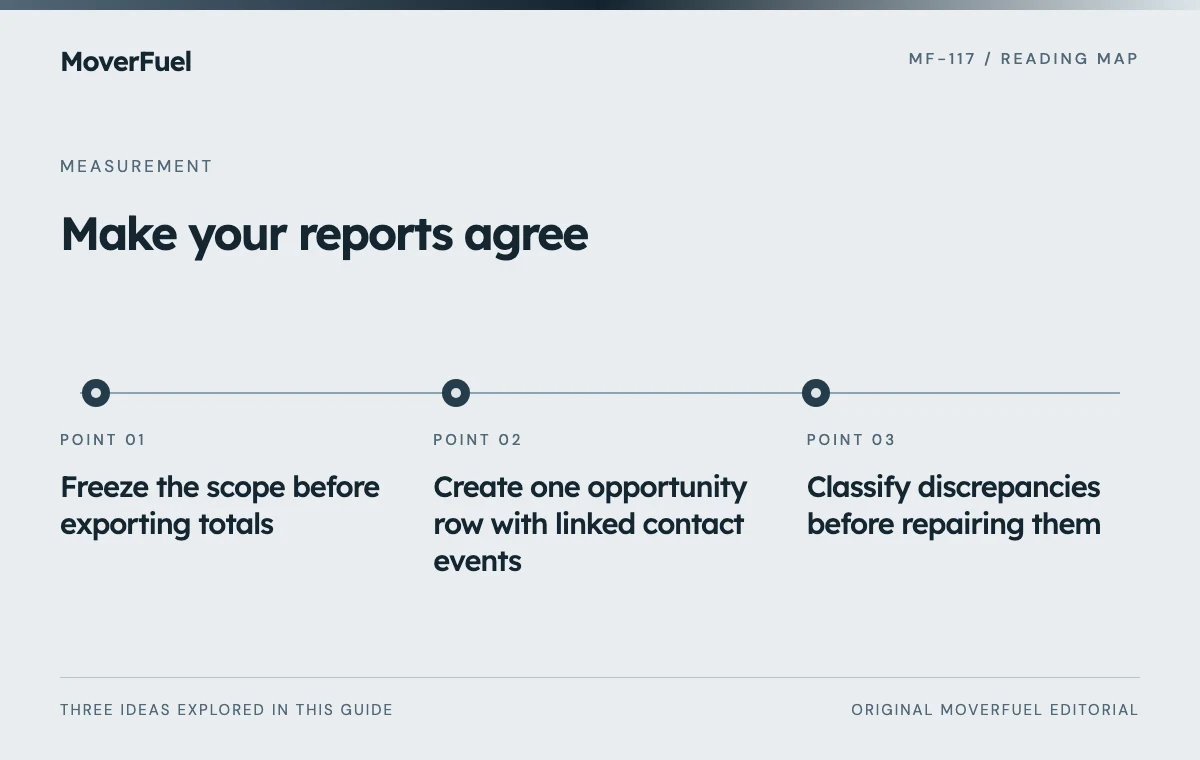
Freeze the scope before exporting totals
Record the account, date range, time zone, filters, conversion actions and attribution basis for each report. Decide whether the investigation follows an inquiry cohort or calendar activity. Save the export time because delayed imports can change a report after it is downloaded.
Scroll the table horizontally to compare all columns.
| System | Typical unit to verify | Important settings |
|---|---|---|
| Google Ads | Configured conversion actions and credited events | Included actions, dates, model and counting settings |
| Call tracking | Calls or conversations | First/repeat calls, source and routing filters |
| Website forms | Submission attempts or accepted records | Success definition, retries and spam handling |
| Moving CRM | Contacts, opportunities, projects or jobs | Status, date basis and duplicate policy |
Do not assume that identically named fields have identical meanings. A ‘lead’ can be a call, a submitted form or a qualified project depending on the system. Write the meaning in the workbook before comparing counts.
Create one opportunity row with linked contact events
Use the unique moving opportunity as the commercial reconciliation unit, with a separate event ledger for calls, forms and status changes. This preserves the fact that one opportunity can have several contacts without inflating the acquired-work count.
Scroll the table horizontally to compare all columns.
| Field | Example meaning |
|---|---|
| Opportunity reference | Internal stable project identifier |
| Acquired at | First recorded inquiry for this move |
| Contact references | Related call and form identifiers |
| Captured source | Evidence from the original contact path |
| Reported discovery | Customer's separately recorded answer |
| Current outcome | Qualified, estimated, booked or other defined state |
| Exception code | Why the systems do not yet reconcile |
Supermove documents that a project can occupy multiple marketing-milestone rows. That makes deduplication by the intended project unit essential when such an export is used for opportunity totals. [1]
Use supported identifiers and careful review for matching. A shared phone number or similar name may not prove two records represent the same move. Keep uncertain matches unresolved rather than automatically merging unrelated customers.
Classify discrepancies before repairing them
Scroll the table horizontally to compare all columns.
| Code | Meaning | Next check |
|---|---|---|
| UNIT | Different counting unit | Calls versus unique projects |
| TIME | Different date or time-zone basis | Acquisition, event and import dates |
| DUP | Repeated event or opportunity | Identifiers and delivery paths |
| MISSING | Expected record absent | Form delivery, integration or assignment |
| PENDING | Outcome or import has not matured | Processing and sales-cycle timing |
| SCOPE | Filters exclude different populations | Branch, service and status filters |
| ATTR | Credit allocated differently | Model and eligible touchpoints |
| UNKNOWN | Evidence insufficient | Named owner and further investigation |
Some differences are legitimate. An existing customer can generate a tracked call without creating a new opportunity. A new opportunity can arrive through an untracked offline referral. Neither should be forced into the other system's count.
Separate explanation from repair
A duplicate tag, broken delivery path or incorrect status mapping is a defect to fix. A difference caused by a documented attribution model is an explanation to retain. Changing valid data merely to make totals match destroys the value of reconciliation.
Trace a small sample through the complete path
Select examples of a normal form inquiry, a phone inquiry, a repeated contact, a qualified booking and an unresolved discrepancy. Trace each from the original interaction to the CRM and destination report. Use authorized access and avoid placing unnecessary customer data in a shared worksheet.
For each record, compare event time, delivery time, source evidence and outcome. If a connector accepted an upload, check destination diagnostics rather than assuming the conversion was attributed. If a form showed success, confirm that a real record was received.
Review the offline conversion contract when the discrepancy appears between the CRM event and the advertising destination.
Turn the workbook into a repeatable control
Assign an owner and review interval for each exception type. Track the age of unresolved items and the share of opportunities with reliable source context. A report with persistent unknowns should show those limitations, not quietly redistribute them.
Save the mapping rules and export definitions with the reporting process. Recheck them after campaign-goal changes, new form integrations, CRM status edits or tracking-number changes. These events can alter counts even when business performance is stable.
Publish a concise reconciliation note with the management report: what matches, what differs by definition, what is broken and what remains unknown. The goal is an explainable relationship among systems, not artificial equality among unlike totals.
Common questions
Should Ads conversions equal CRM leads?
Not automatically. They may use different events, scopes, attribution and dates. Define the intended relationship and investigate unexplained differences.
Can we merge records that share a phone number?
Only when the evidence supports the same opportunity under your matching policy. Shared contact details can represent different moves or people.
Your next step
Reconcile definitions and records before totals. A reason-coded exception ledger reveals real defects while preserving legitimate differences between advertising, contact and business outcomes.
Sources & editorial notes
Platform claims cite the documents below. Operating frameworks and labeled examples are MoverFuel editorial analysis, not client results or industry benchmarks.
- Supermove: Marketing Milestones SummarySupermove's project-milestone row grain supports the need to distinguish events from unique projects. Workbook and exception codes are original. Reviewed .