
An offline conversion integration is a data agreement between systems. It needs to say which business event happened, when it happened, how it relates to the original inquiry and what should happen if delivery fails or the outcome changes. Defining that agreement is more important than choosing a connector from a marketplace list.
 View full-size graphic ↗
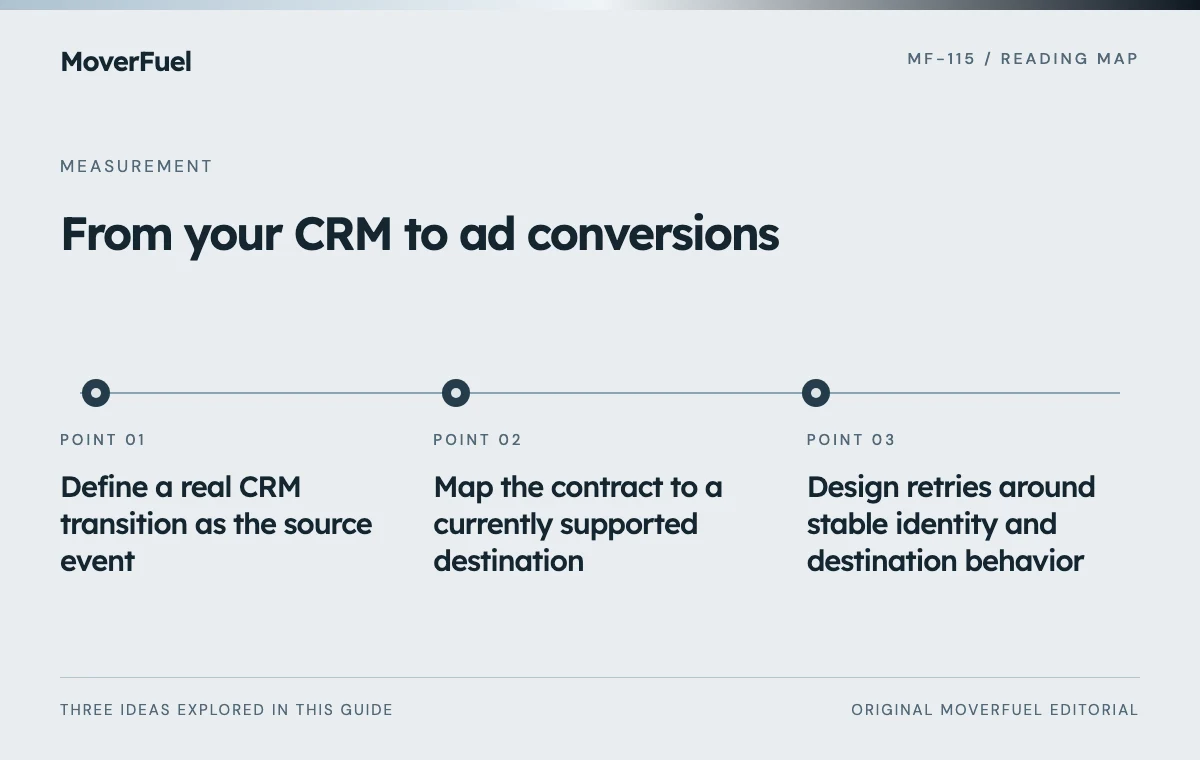
Define a real CRM transition as the source event
Choose a stage with observable evidence, such as a qualified opportunity or a booking meeting the company's rules. The CRM should record the original transition time and the responsible process. Reopening a record for an administrative edit must not create another acquisition outcome.
Distinguish internal opportunity identity from a destination platform's event or transaction identity. One moving project can have several meaningful stages, but each stage should have a stable identity that survives retries. Do not generate a new identifier every time an export runs.
Scroll the table horizontally to compare all columns.
| Field | Meaning | Validation question |
|---|---|---|
| Opportunity reference | Internal relationship to the moving project | Does it resolve to one intended opportunity? |
| Stage and version | Which approved business milestone occurred | Is it an allowed transition? |
| Occurred-at timestamp | When the business event happened | Is the time zone explicit? |
| Destination identity | Account and conversion action | Is the receiving configuration correct? |
| Matching identifiers | Permitted identifiers for attribution | Are format and eligibility requirements met? |
| Value and currency | Defined economic or stage value | Is the basis documented and consistent? |
| Delivery state | Validation, submission and diagnostic status | Can a failed delivery be investigated? |
Map the contract to a currently supported destination
Google's current Data Manager API guide documents offline event ingestion using a destination conversion action and event fields such as timestamp, identifiers, value and transaction ID. Its requirements are specific to that API; a generic internal record is not automatically a valid request. [1]
Verify the current supported path for the CRM and destination at implementation time. A native connector, managed data connection and custom API adapter can have different field coverage and correction capabilities. Do not promise an integration merely because both products offer APIs.
Keep identity and permission requirements explicit
Document which identifiers can be collected and transmitted, where they are stored and how access is controlled. Apply required normalization or hashing only according to the destination's specifications. Hashing is not a substitute for an appropriate permission and data-use review.
Keep operational customer details out of general-purpose logs. Error records should contain enough context to diagnose a failed event without exposing complete move descriptions, contact details or credentials.
Design retries around stable identity and destination behavior
Use an export ledger that records the internal event, destination, payload version, submission attempt and result. A network timeout can leave delivery uncertain, so retry behavior must account for the destination's documented deduplication rules rather than blindly creating a new event.
Within a conversion action, Google documents transactionId-based deduplication across sources. The same guide describes a fast-fail validation model: an invalid event can reject the entire request. It also supports validation-only requests. [1]
Scroll the table horizontally to compare all columns.
| State | Action |
|---|---|
| Invalid local record | Hold and repair before sending |
| Validation-only success | Record validation; do not mark as ingested |
| Request rejected | Inspect the documented error and repair the affected request |
| Submission accepted | Retain response reference and check destination diagnostics |
| Unknown after timeout | Use stable identity and documented retry behavior |
| Outcome corrected | Use a supported correction path, not an invented negative event |
Plan cancellations, rebookings and value changes
Agree on what happens when a booked move cancels or its value changes. Keep the original business history and create a deliberate correction workflow supported by the destination. If a connector cannot perform the required correction, document the limitation before selecting it.
Do not overwrite the original event time with the export time. Preserve both so reporting can distinguish when the customer progressed from when the integration delivered the update. Use one agreed time-zone policy and test daylight-saving boundaries where relevant.
The booked-job import guide explains the booking outcome itself; this data contract governs its dependable transport.
Separate stage value from final revenue when they are different. If an expected or proxy value is used, label it and document the model. Never present it in a business report as collected revenue.
Test a small contract before automating production volume
Build controlled fixtures for a valid transition, missing identifier, malformed timestamp, repeated delivery, canceled booking and changed value. Confirm that each produces the intended local and destination behavior. Use validation-only or authorized test facilities where available.
Google's guide returns a request reference and may include warnings; it directs implementers to retain the reference and inspect diagnostics. Save those results with the export ledger rather than reducing every response to a green checkmark. [1]
Assign monitoring and repair ownership. The business needs to know when eligible events stop exporting, when rejection rates change and when mappings drift after a CRM update. A dependable integration includes these operating responsibilities as well as the initial connector configuration.
Common questions
Does a CRM integration guarantee every booking is attributed?
No. Matching, eligibility, configuration and reporting rules still apply. Confirm delivery and attribution separately.
Should retries create a new conversion ID?
Generally the same business event needs stable identity, mapped to the destination's documented rules. New IDs on every retry can create duplicate outcomes.
Your next step
Treat offline conversions as a maintained data contract. Stable events, explicit timestamps, tested retries and correction ownership make business outcomes more trustworthy.
Sources & editorial notes
Platform claims cite the documents below. Operating frameworks and labeled examples are MoverFuel editorial analysis, not client results or industry benchmarks.
- Google Data Manager API: send Google Ads offline eventsCurrent Data Manager destination/event fields, transaction-ID deduplication, validation-only requests, fast-fail behavior and response diagnostics. Internal contract is an original vendor-neutral design. Reviewed .