
When a moving quote does not book, ‘price’ is an easy explanation and often an unsupported one. A useful lost-booking record separates what the customer actually said from what the salesperson inferred. Train that distinction first, then use the evidence to improve the offer, intake process or campaign targeting.
 View full-size graphic ↗
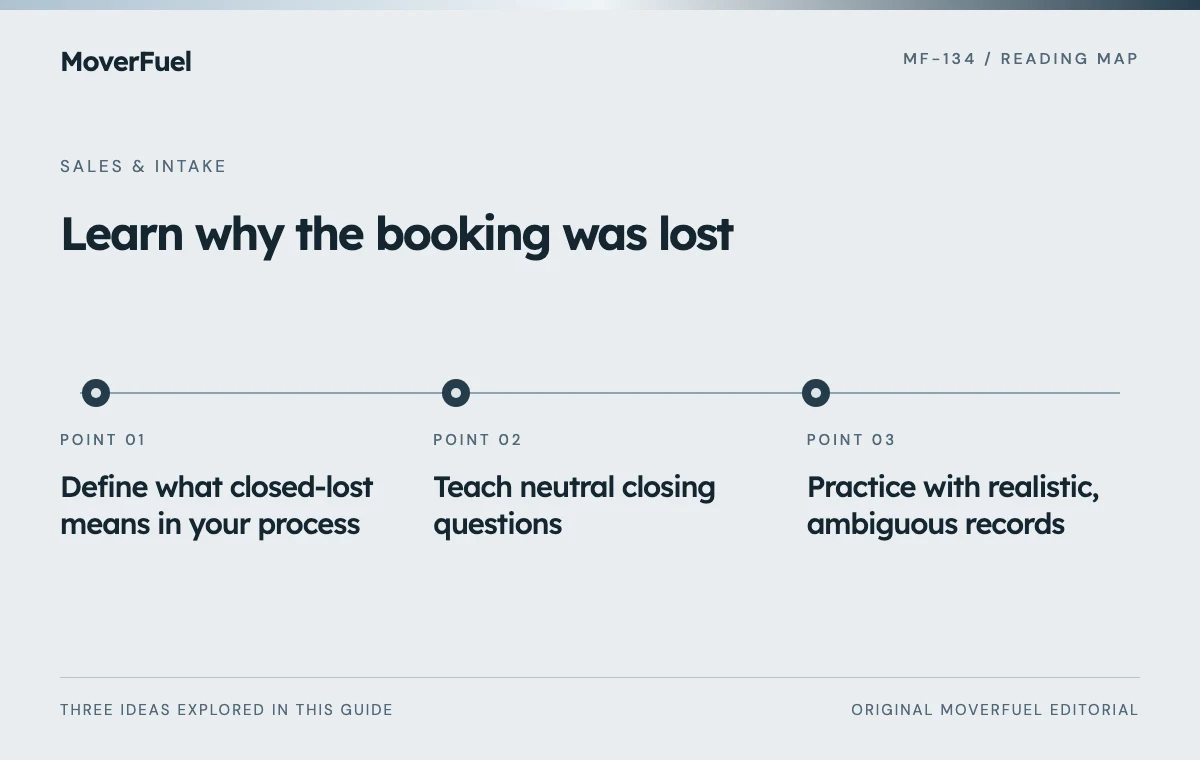
Define what closed-lost means in your process
An explicit decline, an expired opportunity under a documented policy and an unreachable customer are different outcomes. A quote that is still awaiting a decision should not be closed merely because the reporting week ended. Establish the conditions and owner for closing a record.
HubSpot documents closed-lost reason as a deal property separate from deal stage. That separation is useful in any system: the stage indicates that active work has ended, while the reason needs its own evidence. [1]
Scroll the table horizontally to compare all columns.
| Label | Example | Reporting treatment |
|---|---|---|
| Customer stated | Customer says the requested date no longer works | Known reason with conversation reference |
| Operationally confirmed | Company cannot serve the verified route | Known service-fit limitation |
| Staff hypothesis | Representative suspects a cheaper competitor | Unverified hypothesis |
| Unknown | No response and no confirmed explanation | Unknown; not automatically price |
Preserve enough context to support coaching without collecting unnecessary personal detail. A concise factual note is usually more useful than a long speculative narrative about the customer's motives.
Teach neutral closing questions
An original prompt after a customer declines: ‘Thanks for letting us know. If you are comfortable sharing, what was the main factor in your decision?’ The customer is free not to answer. Do not make an explanation a condition of ending the sales conversation.
Clarify only when the answer is genuinely ambiguous
If the customer says ‘the quote did not work,’ ask whether they mean the scope, timing or total budget. Avoid leading language such as ‘Was our price too high?’ that encourages the category the salesperson already expects. Record the customer's actual distinction.
Scroll the table horizontally to compare all columns.
| Avoid | Use when appropriate |
|---|---|
| You chose someone cheaper, right? | What mattered most in your choice? |
| Why did you waste our time? | I will update the record; thank you for letting us know. |
| We can beat any quote. | Would a scope clarification still be useful, or is your decision final? |
| I will mark this as price. | I do not have a confirmed reason, so I will record it as unknown. |
When the customer has made a final decision, respect it. The purpose of the question is learning, not disguising another sales attempt. Apply any no-contact request to the relevant workflow.
Practice with realistic, ambiguous records
Give the team synthetic examples: a customer who stops replying after asking about packing; a move postponed because the destination is not ready; a company that cannot meet a building window; and a caller who explicitly chooses a lower price for equivalent scope. Ask staff to code the evidence independently.
Discuss why silence after a price conversation does not prove price caused the loss. Likewise, a lower competitor quote may reflect a different inventory or service package. Staff should distinguish a stated comparison from a verified like-for-like conclusion.
Create a short reference with code definitions and two or three ambiguous examples per code. Review it when new services or markets change the process. Keep the taxonomy stable enough for trend reporting, with version notes when definitions change.
Use a weekly coaching worksheet
Scroll the table horizontally to compare all columns.
| Question | Action |
|---|---|
| Was the opportunity actually closed? | Reopen or correct premature closure |
| What supports the reason? | Attach a factual note or mark unknown |
| Did the company fulfill its promises? | Assign missed callback or scope repair |
| Was the inquiry a service fit? | Separate targeting from sales issues |
| Is this part of a repeated pattern? | Review comparable records before concluding |
| What can be tested? | Assign one specific improvement and owner |
Sample records across representatives, services and sources, not only the most expensive campaign. Share examples without turning the review into blame. A missed handoff may be a system problem involving staffing, unclear ownership or unavailable information.
Show counts and the share with a verified reason. A report with many unknowns can still be honest and useful. A report assigning every loss to price may be less informative if the underlying evidence is weak.
Translate patterns into bounded improvements
If verified losses repeatedly mention unclear packing inclusions, test a clearer scope explanation. If dates cannot be served, coordinate capacity and campaign pacing. If callbacks were missed, repair ownership. Each action should address the observed cause rather than defaulting to a discount or a larger ad budget.
Compare similar opportunity groups over an adequate decision period and note seasonal or service-mix changes. Do not claim that a new script caused an improvement when the team also changed targeting, staffing and availability. Use the findings to form a testable hypothesis.
Pair this coaching process with lead disposition definitions and lead tracking so evidence reaches the people responsible for acquisition and conversion.
Common questions
Should unknown losses be excluded from reports?
No. Show them explicitly, along with the share of losses that have a supported reason. Excluding them can make the known reasons look more representative than they are.
How can a manager improve reason accuracy?
Train neutral questions, review ambiguous examples, sample supporting notes and avoid penalizing honest uncertainty. Correct definitions and handoffs before relying on the chart for budget decisions.
Your next step
A lost reason is valuable when it reflects evidence. Teach staff to ask respectfully, preserve uncertainty and connect repeated findings to a specific improvement the business can test.
Sources & editorial notes
Platform claims cite the documents below. Operating frameworks and labeled examples are MoverFuel editorial analysis, not client results or industry benchmarks.
- HubSpot: default deal propertiesHubSpot documents deal stage and closed-lost reason as separate deal properties, supporting separate state and reason records. Reviewed .