
An audit is useful when it changes a decision. Renaming campaigns while broken conversion events steer bidding is the wrong priority. These 30 checks produce an evidence-backed repair queue for a moving company: what is wrong, which jobs it affects, who can fix it and how the repair will be verified.
 View full-size graphic ↗
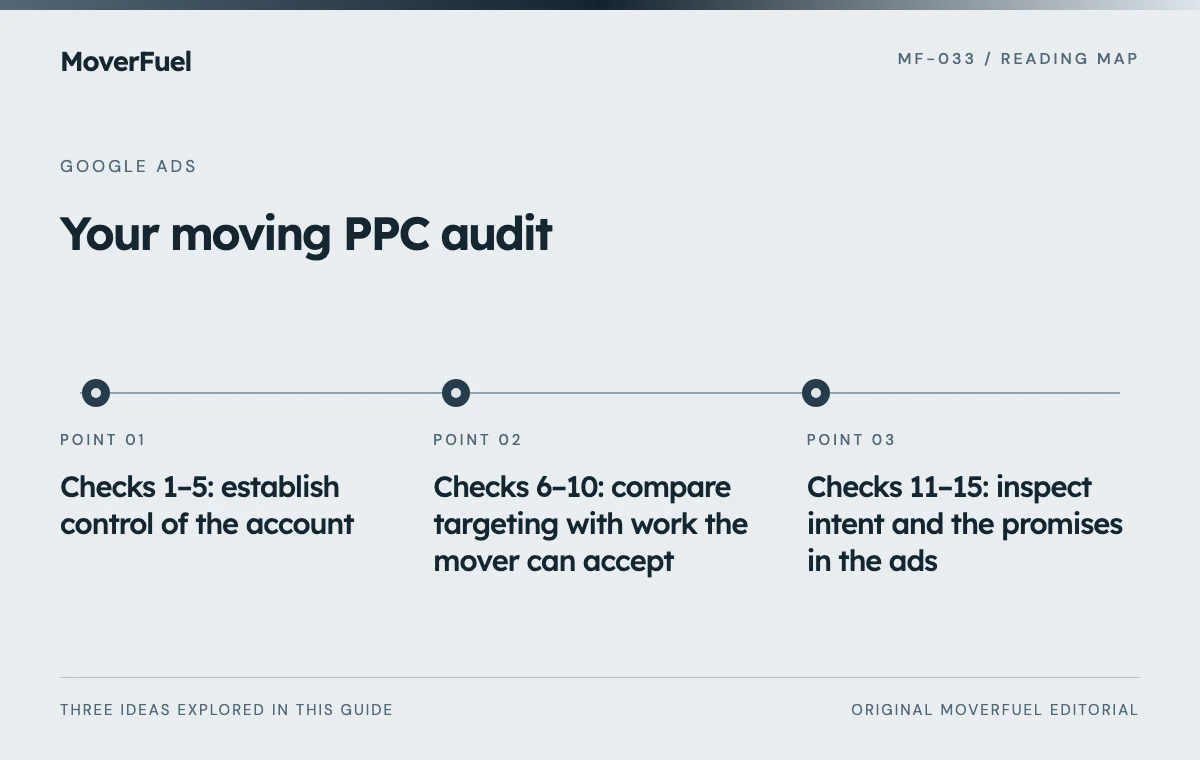
Checks 1–5: establish control of the account
Begin with access and accountability. The company should be able to inspect its own advertising history and understand who can change spending or measurement. Review permissions with the owner; do not remove a person whose operational role has not been established.
Scroll the table horizontally to compare all columns.
| # | Check | Evidence to retain |
|---|---|---|
| 1 | Identify the business owner of the account | Account identifier and responsible company contact |
| 2 | Review administrator and partner access | Approved access list with roles |
| 3 | Confirm billing responsibility and alerts | Billing owner and alert destination |
| 4 | Locate change history and recent major edits | Dates of budget, targeting and tracking changes |
| 5 | Document reporting access and handover needs | Who can retrieve campaigns, outcomes and assets |
Record uncertainty as uncertainty. An agency-managed account is not automatically a problem; an undocumented arrangement that prevents continuity is. The deliverable is a clear responsibility map, not a blanket recommendation to change platforms.
Checks 6–10: compare targeting with work the mover can accept
Scroll the table horizontally to compare all columns.
| # | Check | Evidence to retain |
|---|---|---|
| 6 | Compare included areas with actual pickup coverage | Operations-approved area list |
| 7 | Review presence and location-interest settings | Current campaign settings and business rationale |
| 8 | Inspect exclusions and adjacent-market leakage | Lead origins and destination patterns |
| 9 | Separate materially different services | Local, long-distance and commercial campaign map |
| 10 | Match schedules and contact paths to staffed coverage | Call routing, hours and overflow owner |
Google location targeting uses signals that are not perfectly accurate. A campaign location is therefore not proof that a household’s origin and destination are suitable. Audit the settings and the actual inquiries together. [1]
For a long-distance mover, a person searching from elsewhere may still need an eligible origin pickup. Do not apply a local-only targeting rule without understanding the route model. Ask operations to review real rejected inquiries before tightening coverage.
Checks 11–15: inspect intent and the promises in the ads
Scroll the table horizontally to compare all columns.
| # | Check | Evidence to retain |
|---|---|---|
| 11 | Review available search terms by business fit | Examples of useful and unsuitable intent |
| 12 | Inspect negatives for gaps and conflicts | Reason for each material exclusion |
| 13 | Check service claims and proof | Approved facts behind prices, reviews and credentials |
| 14 | Compare ad language with landing-page scope | Ad-to-destination comparison |
| 15 | Open final URLs and extensions on mobile | Working destination and contact-path record |
Do not reject a query solely because its wording looks broad. Read what happened after the inquiry when records are available. Conversely, do not keep an obviously irrelevant query because it generates cheap form submissions.
For exclusion decisions, use the negative keyword guide and retain the reason for the change so a future manager can review it.
Checks 16–20: follow the conversion from customer action to report
Scroll the table horizontally to compare all columns.
| # | Check | Evidence to retain |
|---|---|---|
| 16 | Test form completion and genuine error states | A controlled local or approved test record |
| 17 | Check call events against actual conversations | Routing and event-definition documentation |
| 18 | Inspect primary, secondary and campaign goal selection | Which events can influence bidding |
| 19 | Verify qualified and booked stages reach the report | Matched, deduplicated sample records |
| 20 | Review imports, delays and adjustment handling | Diagnostics and reconciliation log |
Google distinguishes primary and secondary conversion actions; custom goals have an important exception that can include secondary actions in bidding. Inspect the campaign’s actual goal configuration instead of relying on the label alone. [2]
A successful form event does not prove successful delivery to the sales team. Trace a permitted test through the receiving system, then confirm that repeat contacts do not create multiple unique jobs. Avoid sending synthetic leads to a live client workflow without an agreed test process.
Checks 21–25: connect spend decisions to mature outcomes
Scroll the table horizontally to compare all columns.
| # | Check | Evidence to retain |
|---|---|---|
| 21 | Compare allocations with available crew capacity | Service and market capacity notes |
| 22 | Check the conversion definition behind bid targets | Target event and historical outcome quality |
| 23 | Compare cohorts at equal maturity | Inquiry dates, booking lag and review cutoff |
| 24 | Calculate cost per retained booking by service | Reconciled spend and unique retained jobs |
| 25 | Review cancellation and delivery-cost exposure | Completed work and contribution assumptions |
A low cost per inquiry can hide expensive unsuitable calls. A higher lead cost can still produce efficient jobs if the service fit and booking rate are stronger. Compare the full path, while keeping advertising cost separate from agency fees and sales labor unless the metric explicitly includes them.
Do not optimize around a denominator you cannot trust
If bookings cannot be matched to their inquiry cohort, mark the cost-per-job result provisional. Fixing that gap may be more valuable than changing a bid target based on an apparently precise but unreliable number.
Checks 26–30: turn findings into work that can be verified
Scroll the table horizontally to compare all columns.
| # | Check | Evidence to retain |
|---|---|---|
| 26 | Rank findings by business impact and confidence | Critical, important and exploratory findings |
| 27 | Assign an owner and dependency to each repair | Responsible person and required access |
| 28 | Define a verification step before changing settings | Expected technical and customer behavior |
| 29 | Choose a review date and rollback condition | When to inspect results and reverse a harmful change |
| 30 | Preserve the baseline and unresolved questions | Dated audit, exports and decision log |
Separate a confirmed defect from a hypothesis. A broken destination is a defect. A theory that a new message will qualify better is a test. Mixing them makes it difficult to know whether the account was repaired or merely changed.
Finish with a short action list the owner can use: the immediate repair, the evidence needed next and the experiment worth funding after measurement is dependable. A 30-point audit should produce fewer, better priorities—not 30 simultaneous edits.
Common questions
Does every failed check require an immediate change?
No. Fix confirmed failures that affect access, customers or measurement promptly. Investigate uncertain performance explanations before changing several variables at once.
Is this a Google certification checklist?
No. It is MoverFuel’s editorial operating framework. Platform-specific settings should be checked against current Google documentation and the account itself.
Your next step
Keep the evidence, distinguish defects from hypotheses and give every important repair an owner and verification step.
Sources & editorial notes
Platform claims cite the documents below. Operating frameworks and labeled examples are MoverFuel editorial analysis, not client results or industry benchmarks.
- Google: advanced location optionsLimits and intent distinctions in Google location targeting. Reviewed .
- Google: primary and secondary conversion actionsPrimary/secondary conversion roles and the custom-goal exception. Reviewed .