
An online complaint creates two tasks: address the customer's underlying concern and communicate responsibly in public. A polished reply cannot replace an investigation or a missed callback. Give the issue an owner, preserve the relevant facts and state the next step accurately without exposing the customer's private information.
 View full-size graphic ↗
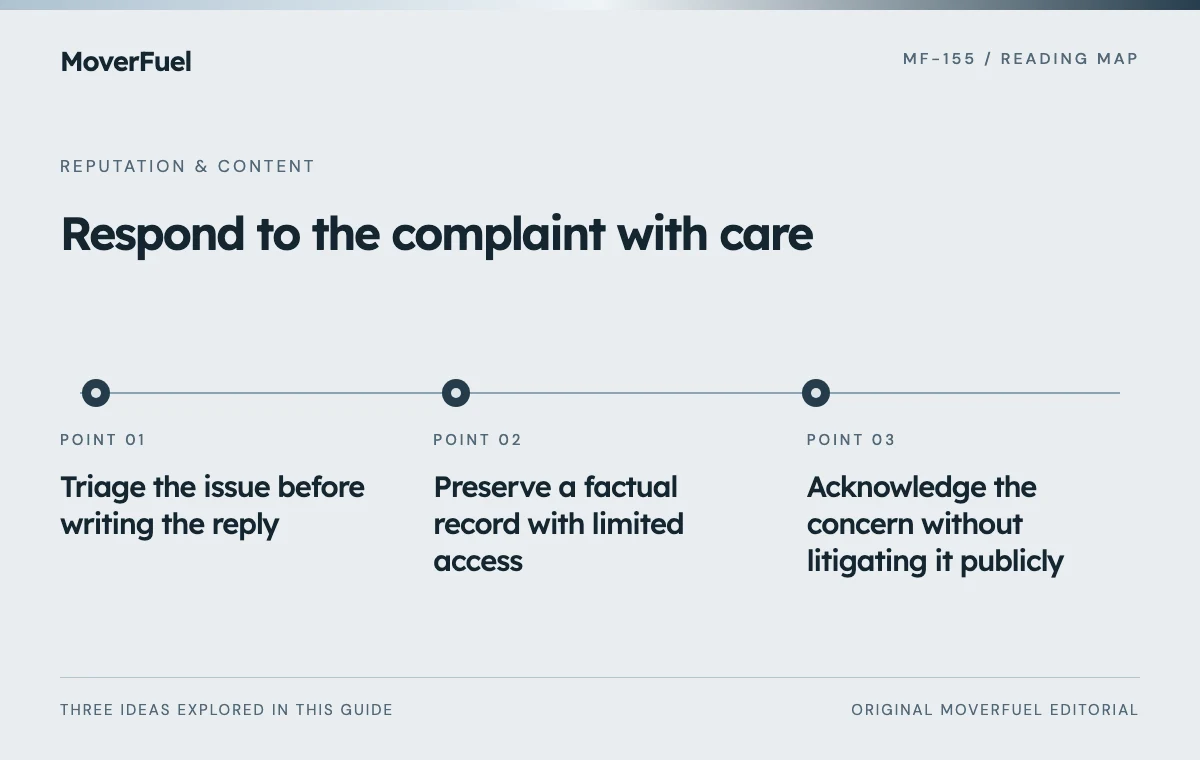
Triage the issue before writing the reply
Scroll the table horizontally to compare all columns.
| Issue | Initial owner | Immediate task |
|---|---|---|
| Move currently in progress | Operations contact | Assess the active service problem |
| Estimate or charge concern | Authorized billing or management contact | Review the applicable documents |
| Reported damage or loss | Designated claims/service team | Follow the verified process and preserve records |
| Missed communication | Responsible manager | Assign a concrete return contact |
| Unclear customer identity | Profile or service owner | Seek appropriate private clarification |
| Threat or sensitive legal issue | Authorized leadership/adviser | Follow the relevant escalation procedure |
Use the company's actual operating and claims procedures. This communication framework does not determine liability, coverage or statutory deadlines. Route those questions to the qualified person and current applicable documents instead of improvising an answer in a review response.
Record when the complaint arrived and any promised contact already missed. If the customer has been explaining the issue repeatedly, establish one accountable owner so the next conversation does not restart the story.
Preserve a factual record with limited access
Collect the relevant job reference, estimate version, service notes and communication history. Separate what the customer reports, what the records confirm and what remains disputed or unknown. Do not edit the history to make the public response easier to defend.
FTC business security guidance supports limiting retained information and access to what the task requires. Keep customer addresses, payment details and private correspondence out of public replies and unrestricted marketing files. [1]
Use a concise case record
The record should identify the concern, owner, next action, promised contact time and evidence still needed. Keep speculative judgments about the customer's motives out of it. A factual chronology is more useful for resolution than a long argument drafted for public consumption.
Acknowledge the concern without litigating it publicly
An original response pattern is: ‘We are sorry to hear that the experience raised these concerns. Our service team would like to review the details with you through our usual support channel. We have assigned the matter for follow-up.’ Use only statements that are true, and provide the business's verified contact route rather than invented contact information.
Adapt the response to the issue. A generic message promising an investigation is inappropriate if nobody has been assigned. Do not assert that a customer is lying, publish private records or imply a resolution has occurred when it has not.
Scroll the table horizontally to compare all columns.
| Question | Release standard |
|---|---|
| Is it factual? | Every claim can be supported |
| Is it private enough? | No unnecessary personal or job detail |
| Is the next step real? | An owner and monitored contact path exist |
| Is the tone proportionate? | No threats, ridicule or retaliation |
| Does it overpromise? | No unsupported outcome or deadline |
If the reviewer cannot be matched to a record, ask for appropriate private information through the verified channel. Do not conclude publicly that the experience is fake merely because the name differs from the booking contact.
Follow through privately and keep the customer informed
Explain the review process, what information is needed and when the next update is expected. Set a commitment the responsible team can meet. If the investigation takes longer, communicate the change before the promised update is missed.
Document the outcome and the basis for it through the appropriate service process. The customer may disagree with the conclusion; that does not justify an argument in public or pressure to change the review. A service resolution should not be conditioned on favorable public feedback.
The broader reputation management guide explains monitoring and policy-based escalation without claiming that every unfavorable review can be removed.
Close the loop with a specific process repair
After the case is handled, identify whether the cause involved unclear scope, a missed handoff, outdated instructions or a failure to meet a commitment. Assign the repair to the team that controls it. ‘Be more careful’ is not an actionable correction.
Review repeated themes across cases without publishing customer details. If marketing repeatedly creates an expectation that operations does not support, update the offer or the delivery. If estimates are unclear, improve the explanation and documentation process.
Keep the case open until the agreed actions are complete or the status is accurately recorded. Measure follow-through and recurrence, not merely how quickly a public reply was posted. A fast response with no actual service work can leave the customer more frustrated.
Connect estimate accuracy with conversion and messaging review when the complaint reveals a gap between the promise and the service.
Common questions
Should a mover argue the facts in a public review reply?
Keep the public response factual and limited, then use the appropriate private process to investigate details. Do not expose customer information or make unsupported accusations.
Can a resolution require the customer to remove a review?
Do not use service recovery as pressure for favorable feedback. Handle the underlying concern through the verified process and review any proposed agreement with the appropriate qualified adviser.
Your next step
A responsible complaint response connects a restrained public acknowledgment to real private follow-through. Clear ownership, protected records and a specific process repair matter more than a polished reply alone.
Sources & editorial notes
Platform claims cite the documents below. Operating frameworks and labeled examples are MoverFuel editorial analysis, not client results or industry benchmarks.
- FTC: protecting personal informationFTC business guidance supports data minimization and appropriate access controls for retained customer information. Reviewed .