The next customer reading a negative review is watching how the moving company responds. A defensive argument can create more uncertainty than the original complaint. A useful reply acknowledges the concern, avoids exposing private move details and gives the customer a specific route to a person who can investigate.
 View full-size graphic ↗
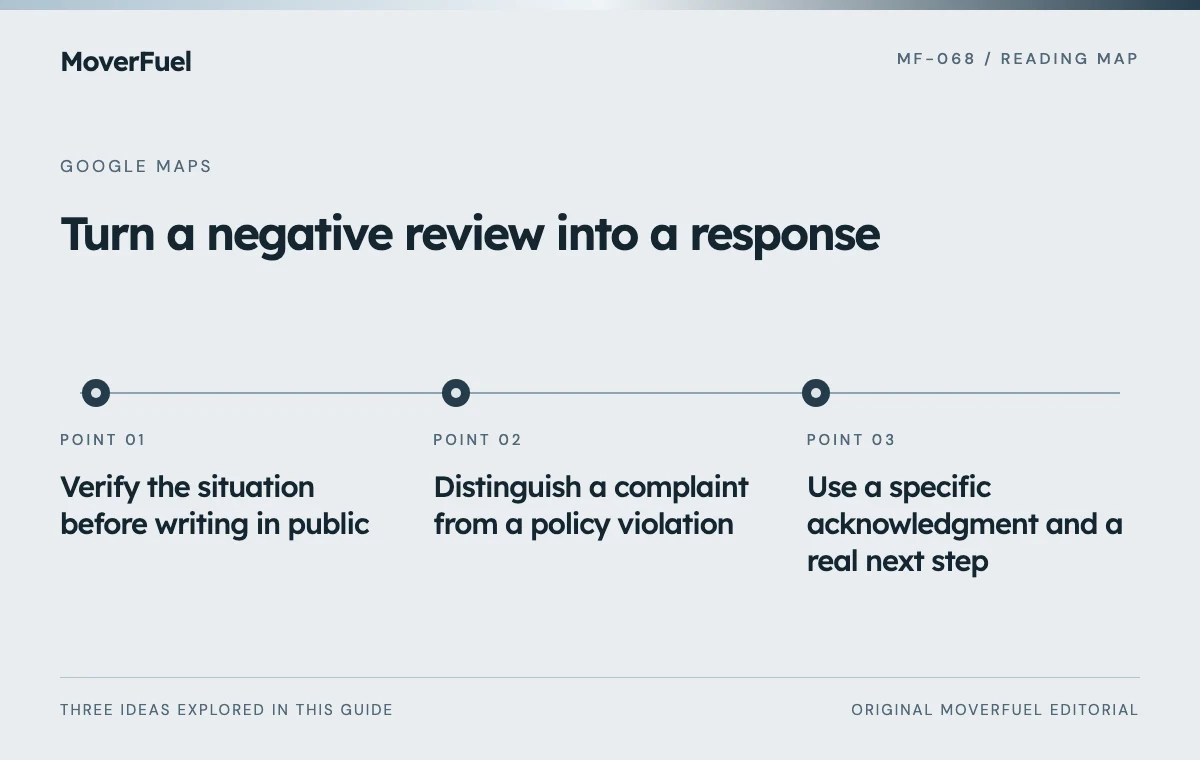
Verify the situation before writing in public
Save the review and assign an owner. Check whether the reviewer can be connected to a job, what the complaint alleges and whether a service or claims process is already active. A different display name or a family member’s review does not by itself establish that the experience is fake.
Scroll the table horizontally to compare all columns.
| Finding | Immediate action | Public-response boundary |
|---|---|---|
| Known move with an unresolved issue | Notify the person responsible for resolution | Acknowledge without publishing the case file |
| Identity cannot yet be matched | Check legitimate booking and contact records | Ask for private contact without accusing the reviewer |
| Potential policy violation | Preserve evidence and review reporting options | Do not promise that the review will disappear |
| Safety, legal or serious damage allegation | Escalate to the appropriate responsible person | Avoid speculation or unapproved commitments |
Agree on who can authorize a remedy and who may publish the reply. A social-media contractor should not commit the company to a claims outcome that operations has not reviewed. Conversely, a slow internal approval chain should not leave a customer without a clear contact route.
Use a specific acknowledgment and a real next step
Example: a reported arrival delay
This reply recognizes the reported issue without inventing a cause. Before using it, make sure the manager knows about the complaint and will actually receive the contact. Replace the role with the real responsible person or team; do not publish a fictional name.
Example: an allegation of damaged belongings
Do not decide liability, compensation or coverage in a public reply before the facts and applicable process have been reviewed. The purpose is to move the matter to a competent person, not to use reassuring language as a substitute for follow-through.
Example: a disputed final charge
This approach offers a review of the records without announcing that the customer misunderstood. If an error is found, address it through the company’s authorized process. Public copy should not imply that an investigation has already occurred when it has not.
Make the private handoff accountable
Create a case record with the concern, responsible person, promised next action and follow-up date. Verify that the customer can reach the advertised contact route. If the public reply asks for an email that no one monitors, the reply adds friction rather than resolving it.
Google prohibits incentives in exchange for revising or removing a negative review. Keep refunds, claim handling and service remedies independent of review changes. [2]
If the customer later updates the review voluntarily, do not treat that as proof that every underlying issue has been fixed. Close the operating case based on the actual resolution and required documentation, not on the disappearance of public criticism.
Use repeated complaints to change the operation
Group concerns by the process they implicate: arrival communication, estimate clarity, protection expectations, crew conduct or claims follow-up. Read the underlying cases before drawing conclusions. Several reviews can describe one incident, while a quiet complaint channel can hide a recurring problem.
Keep this response process aligned with your neutral review-request policy. Customers should receive help regardless of whether they leave praise, criticism or no review at all.
Assign a concrete improvement when a pattern is supported: revise the arrival update, clarify an estimate field or change the handoff to customer care. Record what changed and check whether the same issue appears in later cases. The strongest reputation work may be an operational repair that prevents the next complaint.
Common questions
Should we reply when we cannot identify the customer?
A brief, neutral invitation to contact the office can be appropriate. State that you need more information without calling the reviewer dishonest or revealing private records.
Can we ask for deletion after resolving a complaint?
Do not make a remedy conditional on deletion or offer an incentive for a change. Focus on resolving the concern and leave the customer’s review decision independent.
Your next step
A good response is the public beginning of a real resolution process. Verify facts, acknowledge the concern, protect private information and make sure the promised handoff happens.
Sources & editorial notes
Platform claims cite the documents below. Operating frameworks and labeled examples are MoverFuel editorial analysis, not client results or industry benchmarks.
- Google: report inappropriate reviewsOnly policy-violating reviews qualify for removal; disagreement alone is insufficient. Reviewed .
- Google Maps: prohibited and restricted contentIncentives for revision or removal of a negative review are prohibited. Response examples and triage are original editorial guidance. Reviewed .