
A review request should invite a customer to describe their experience in their own words. It should not tell them which rating to choose, which employee to mention or what they receive in return. For movers, the policy needs to be clear enough for office staff, estimators and crews to follow without improvising under pressure.
 View full-size graphic ↗
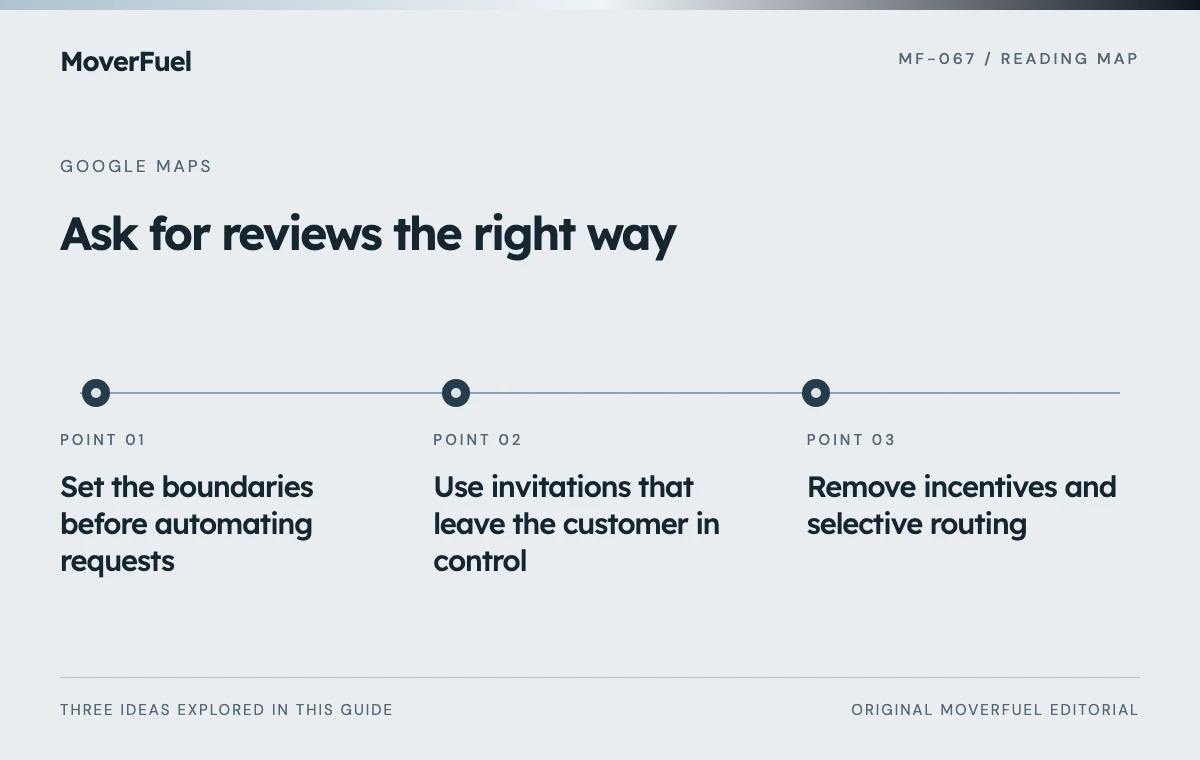
Set the boundaries before automating requests
Google Maps prohibits incentives for reviews, selectively requesting positive reviews, pressure to review on the premises and requests for specific review content. Its current policy also addresses staff review-solicitation quotas. Invitations should reflect genuine experiences without attempting to control the rating or wording. [1]
Write a short internal policy that applies across every branch. It should explain who may send invitations, the approved wording, how customers can decline and where staff should raise uncertainty. A CRM workflow cannot make an inappropriate message acceptable merely by sending it consistently.
Scroll the table horizontally to compare all columns.
| Situation | Recommended operating rule |
|---|---|
| Customer had a completed service experience | Use the same neutral eligibility standard regardless of sentiment |
| Customer reports a problem | Resolve the problem independently of the review invitation |
| Staff member wants a named mention | Let the customer choose what to write |
| Customer does not want to review | Respect the choice and stop prompting |
| Vendor proposes a rating incentive | Reject the tactic and review the contract or workflow |
Use invitations that leave the customer in control
Example: a brief post-move email
Insert the company’s real review link and monitored reply destination before use. Keep the service-support invitation available to everyone; it should not be an alternative route shown only to customers predicted to leave a low rating.
Example: a neutral office-team invitation
These examples intentionally avoid asking for stars, a crew member’s name or a phrase such as ‘best movers.’ They are starting points for editorial review, not approval to send messages through channels for which the company lacks appropriate permission.
Remove incentives and selective routing
Review gating occurs when a private satisfaction question is used to send happy customers toward a public review while diverting unhappy customers elsewhere. A support survey can have a legitimate purpose, but its result should not determine who receives an invitation designed to produce a positive public rating.
Scroll the table horizontally to compare all columns.
| Pattern to avoid | Better design |
|---|---|
| Only high survey scores receive the Google link | Use a neutral, consistent invitation rule |
| Discount offered for a review | Separate promotions from review activity |
| Claim resolution depends on deleting a review | Resolve the claim on its own merits |
| Crew waits while customer writes the review | Allow a voluntary response later |
Google’s platform rules and the FTC’s review rule are not identical. The FTC rule addresses, among other practices, incentives conditioned on positive or negative sentiment; Google’s review policy is stricter about incentives for reviews generally. Do not use a narrow reading of one rule to ignore the other. [2] [1]
Train staff around situations, not rating targets
Use role-play examples from moving operations: a customer worried about damage, a rushed handover, an unresolved billing question or a customer praising the crew. Staff should know how to offer assistance without turning the moment into a demand for public praise.
Evaluate staff on following the agreed process and escalating service problems. Avoid incentives that encourage them to pressure customers or manipulate who gets asked. The most useful feedback may be a complaint that reveals a preventable scheduling or communication failure.
When feedback is negative, follow a separate public-response and private-resolution process. Review invitations and complaint handling should not become bargaining tools.
Audit actual messages and vendor behavior
Sample sent invitations, automation branches and staff instructions. Compare them with the approved policy. Check whether an old survey rule, a branch-specific template or a vendor’s default message still filters customers by satisfaction.
Maintain a change record for the invitation copy and audience logic. Recheck the current Google policy before major workflow revisions. If messages are sent by text or email, separately review applicable consent, privacy and messaging requirements with the responsible adviser; a review-policy check does not settle those obligations.
The result should be a process that welcomes useful feedback without manufacturing a score. Track delivery problems, opt-outs and unresolved service issues as operational signals rather than treating a higher rating as the only acceptable outcome.
Common questions
Can we offer a discount for an honest Google review?
Google’s policy prohibits review incentives even when the request says the review may be honest. Keep promotions separate from review requests.
Can a request ask customers to name their movers?
Let customers decide the contents of their review. The current Google policy addresses requests for specific content, including staff identification.
Your next step
Approve the policy before the automation: genuine experiences, neutral invitations, no pressure or incentives, and support that never depends on a review outcome.
Sources & editorial notes
Platform claims cite the documents below. Operating frameworks and labeled examples are MoverFuel editorial analysis, not client results or industry benchmarks.
- Google Maps: prohibited and restricted contentGoogle-specific incentive, selective solicitation, pressure, content-request and staff-quota restrictions. Reviewed .
- FTC: reviews and testimonials rule FAQNarrow distinction between the FTC rule on sentiment-conditioned incentives and Google’s broader platform restriction; not messaging-law advice. Reviewed .