
A keyword list is not yet a website plan. “Office movers,” “moving an office checklist” and “commercial movers near me” may share vocabulary while asking for different help. Organic keyword research becomes useful when each group points to a clear reader task and a page capable of answering it.
 View full-size graphic ↗
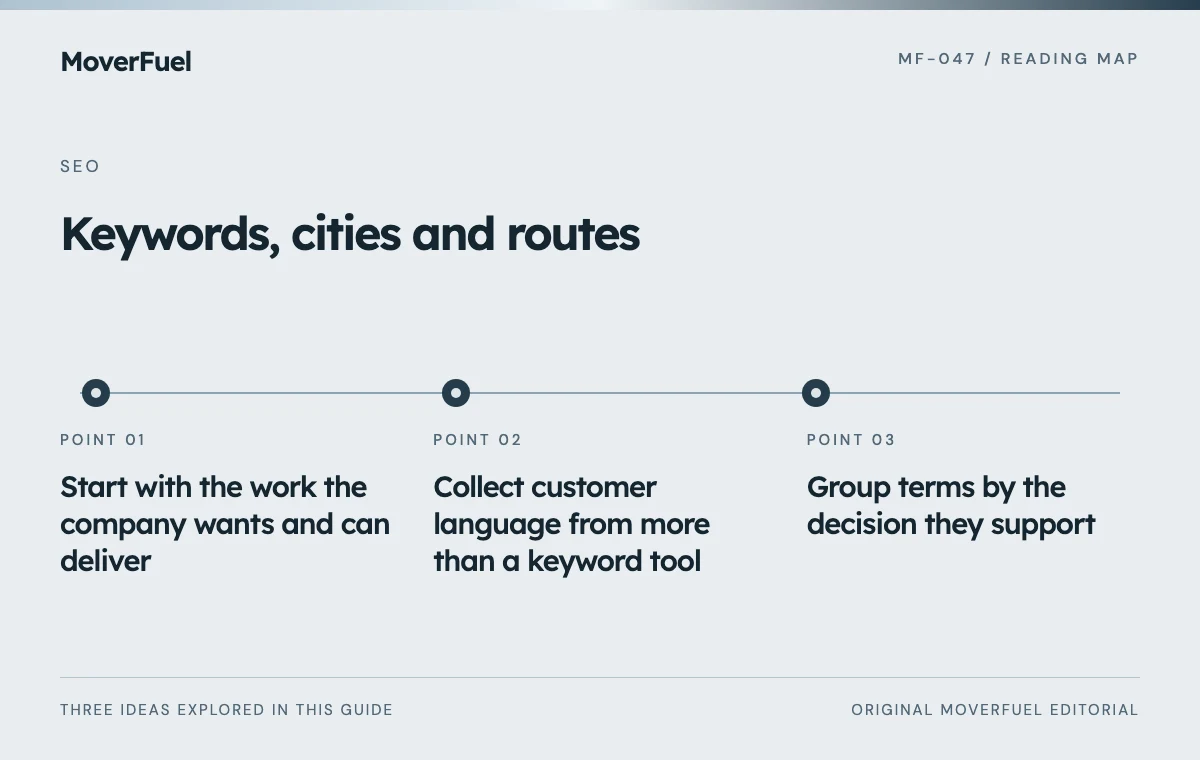
Start with the work the company wants and can deliver
List the offered services, meaningful exclusions, pickup markets and supported route types. Ask operations which jobs fit the business and sales which questions repeatedly arise before an estimate. This creates a commercial boundary before a tool suggests thousands of phrases.
Separate existing capabilities from planned expansion. An attractive search term is not permission to publish a service the mover does not offer. If a new service is still being prepared, its page belongs in a planning backlog until the business can fulfill its claims.
Scroll the table horizontally to compare all columns.
| Business offer | Customer question | Potential page role |
|---|---|---|
| Office relocation | Can this team plan our office move? | Commercial service page |
| Packing support | What does the packing service include? | Packing service page |
| Local household moving | Does this company serve my pickup area? | Service/coverage explanation |
| Temporary storage | How can storage bridge two move dates? | Service explanation or detailed guide |
Add a priority based on business relevance, evidence of demand and the ability to provide a useful answer. Search volume can inform that judgment when genuine data is available, but it should not erase operational fit.
Collect customer language from more than a keyword tool
Use approved, anonymized inquiry notes, estimate questions, existing Search Console data and relevant search results. Record the source and date for each observation. A phrase used by one salesperson is a hypothesis; a recurring customer question deserves stronger consideration.
Keep tool estimates labeled as estimates and preserve their geography and time frame. Do not report an unsupported volume or difficulty number because a spreadsheet has an empty column. Where data is unavailable, use a qualitative priority with the reason written beside it.
Inspect the type of answer the query currently receives
For priority phrases, examine whether results mainly offer services, comparisons, practical instructions or local business information. Search results vary by location and time, so record the observation rather than presenting it as a permanent rule. Look for unanswered buyer questions, not a set of competitor headings to reproduce.
Group terms by the decision they support
Scroll the table horizontally to compare all columns.
| Term family | Likely task to investigate | Differentiate from |
|---|---|---|
| Office moving company | Choose a provider | How to prepare an office inventory |
| Packing service cost | Understand an offer and its pricing factors | General packing tips |
| Movers in a serviceable city | Find a relevant local provider | A fictional branch page |
| Moving from one market to another | Check route capability | Every possible origin/destination combination |
| Moving-day checklist | Prepare for a move | A commercial service pitch |
Combine wording variations that ask for the same answer. Singular/plural changes or rearranged city phrases do not automatically justify separate URLs. Separate pages when the customer task, service explanation or evidence is materially different.
Google’s people-first content guidance emphasizes usefulness to an intended audience. Apply that test to the map: if a visitor arrives on the proposed page, can the company provide a complete and credible answer? [1]
Treat cities and routes as evidence requirements
A location page should explain real local service relevance. A route page should explain a genuine supported service and the questions specific to that route. Neither earns a place simply because two place names can be combined with “movers.”
Ask what the estimator knows that helps the customer: service limitations, access planning, survey requirements or the distinction between a local move and a longer route. Verify any local rule against its responsible source; do not invent parking or permit instructions to make a page seem specific.
The moving-company SEO guide connects this page map to technical access, local evidence and inquiry measurement.
Assign one preferred destination and a review action
For each intent group, record the preferred existing or planned URL, primary reader task, supporting questions, required evidence, conversion step and responsible owner. Mark whether the next action is to retain, improve, create, differentiate or consolidate a page.
An existing useful URL often deserves improvement rather than replacement. Preserve its internal links and historical role unless a genuine restructuring is necessary. Keep related guides connected to service pages without forcing them to target the same purchase intent.
After implementation, review which queries and landing pages bring suitable inquiries. A page may attract substantial educational traffic but little direct service demand; that is not automatically failure if education was its purpose. Judge it against the task assigned in the map, then revise the next-step links or scope when evidence supports a change.
Common questions
Do I need a page for every keyword variation?
No. Group terms that ask for the same answer and choose a useful preferred destination. Separate pages need a distinct reader task or service explanation.
Can I plan content without paid keyword-volume data?
Yes. Use customer questions, first-party search data and documented result observations. Be explicit that priorities are qualitative and do not invent numerical demand estimates.
Your next step
Turn phrases into reader tasks, then assign useful pages with evidence and ownership. The output is an actionable site map rather than a list of terms to repeat.
Sources & editorial notes
Platform claims cite the documents below. Operating frameworks and labeled examples are MoverFuel editorial analysis, not client results or industry benchmarks.
- Google: helpful people-first contentPeople-first usefulness and intended-audience principles. Keyword examples are original planning illustrations, not measured demand. Reviewed .