
Disposition codes turn individual sales conversations into information the whole moving company can use. They work only when staff apply the same meaning to the same situation. A short dictionary with observable criteria is more valuable than a long dropdown filled with subjective labels such as ‘bad lead’ or ‘not serious.’
 View full-size graphic ↗
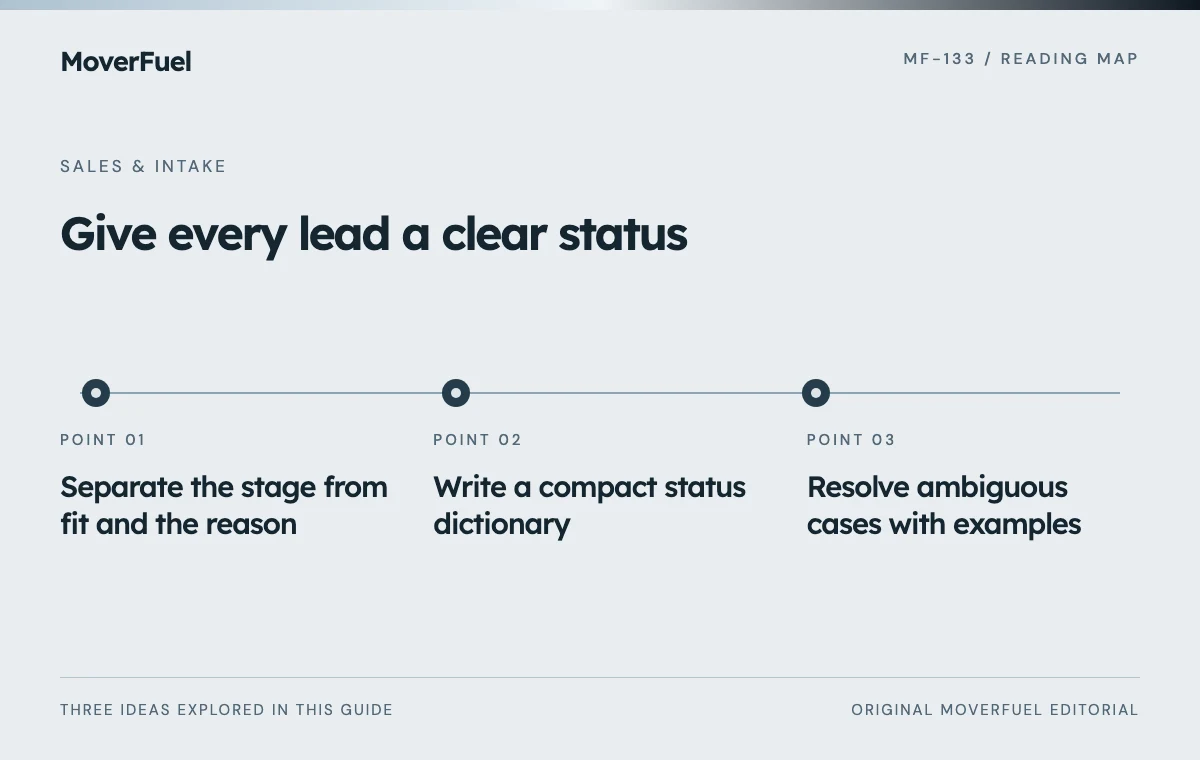
Separate the stage from fit and the reason
The stage describes where the inquiry is in the process. Fit describes whether the requested work meets service criteria. A reason explains a decision or obstacle. Combining all three into one field makes it difficult to distinguish a qualified customer who has not answered from an out-of-area inquiry.
HubSpot's lifecycle documentation distinguishes broad lifecycle stages from lead-status substages. The exact fields vary by CRM, but the underlying lesson is useful: name the business meaning of each field before mapping it into software. [1]
Scroll the table horizontally to compare all columns.
| Dimension | Example values | Question answered |
|---|---|---|
| Process stage | New, contacting, estimate, booked, closed | What happens next? |
| Service fit | Confirmed, not fit, unresolved | Can we serve this request? |
| Reason or blocker | Route, date, scope, price, no response, unknown | Why is progress limited or ended? |
Use a distinct outcome for existing-customer service calls and non-sales contacts. They should not inflate the new-moving-inquiry denominator. Keep an audit trail when a classification changes rather than silently overwriting the history used in reports.
Write a compact status dictionary
Scroll the table horizontally to compare all columns.
| Code | Entry criterion | Required next information |
|---|---|---|
| New | Valid inquiry received; no staff review yet | Owner and receipt time |
| Contacting | Staff attempt recorded; conversation not established | Attempt outcome and next task |
| Qualified | Required service-fit questions confirmed | Route, date window, scope and next step |
| Estimate scheduled | Customer and team agreed on assessment | Appointment or review details |
| Estimate delivered | Current estimate sent through approved process | Version and decision follow-up |
| Booked | Company booking conditions satisfied | Job ID and acceptance evidence |
| Closed | No active sales action remains under policy | Known reason or explicit unknown |
Adapt this example to your actual process. Do not add a stage because the CRM happens to offer it. A field should support a real handoff or decision. Conversely, do not skip an operationally necessary state merely to make the funnel look shorter.
Make qualification observable
‘Good conversation’ is not a qualification criterion. Write the minimum facts needed to confirm fit and the circumstances that require estimator review. A customer can be qualified but undecided; a high potential job value does not make an unsupported route qualified.
Resolve ambiguous cases with examples
Scroll the table horizontally to compare all columns.
| Situation | Consistent treatment |
|---|---|
| Caller never answered a callback | Contacting or closed-unreachable under policy; fit remains unresolved |
| Customer asks for a cheaper option | Record the question; do not automatically mark lost-price |
| Customer changes destination outside coverage | Reassess fit and record route reason |
| Customer accepts verbally but required booking steps remain | Use the actual pre-booking stage |
| Repeat form about the same move | Link to the existing inquiry when supported |
| Move cancelled after booking | Preserve the booking history and record cancellation separately |
Ask two team members to classify the same synthetic examples independently. Discuss disagreements and improve the definitions. This is a training exercise, not a contest to see who closes records fastest.
Attach updates to the work people already perform
Require the relevant update after a completed conversation, estimate delivery, booking or confirmed loss. Keep the required fields small enough to be usable, but sufficient to explain the state. Automatically captured timestamps can reduce work when their meaning is verified.
Define who owns corrections and how updates propagate. If a booking is cancelled in operations, the marketing outcome should not remain permanently booked because the salesperson no longer opens the record. A status integration needs a business owner, not only a technical connection.
Use tracking and automation to connect these events while retaining the underlying job record as the source of truth for operational outcomes.
Turn disposition patterns into specific marketing repairs
A rise in out-of-area inquiries suggests a geographic targeting or service-area messaging review. Unclear packing expectations suggest a scope explanation problem. A high unresolved-contact share may reflect coverage or contact-data issues rather than poor campaign intent.
Compare patterns within similar services, sources and periods. Display counts alongside percentages and audit a sample before changing spend. If one salesperson applies ‘price’ to every unanswered quote, a source-level price objection chart will mislead the marketing team.
Version the dictionary when definitions change and annotate reports. A newly stricter qualification rule can lower the reported qualified rate without any deterioration in demand. Preserve comparability or explain why the periods cannot be compared directly.
Keep lost-reason coaching separate from qualified lead assessment so each process has a clear purpose.
Common questions
How many disposition codes should a mover use?
Use the smallest set that supports real handoffs and decisions. Add a code only when staff can define it consistently and the business will act on the distinction.
Is a disposition code the same as a lead score?
No. A disposition records a state or observed outcome. A score is a prioritization model. Keep them separate so a prediction does not replace evidence about what actually happened.
Your next step
Build the dictionary around observable events and train the ambiguous cases. Consistent dispositions let marketing improve the right problem instead of reacting to subjective labels.
Sources & editorial notes
Platform claims cite the documents below. Operating frameworks and labeled examples are MoverFuel editorial analysis, not client results or industry benchmarks.
- HubSpot: contact and company lifecycle stagesHubSpot documentation distinguishes lifecycle stages and lead-status substages; software fields must be mapped to the business process. Reviewed .