Someone searching for a local moving crew should not land on a page that leaves them wondering whether the company rents trucks, supplies labor only or performs a full household move. A campaign page should carry the ad’s promise into a clear explanation of service fit and an estimate request the office can use.
 View full-size graphic ↗
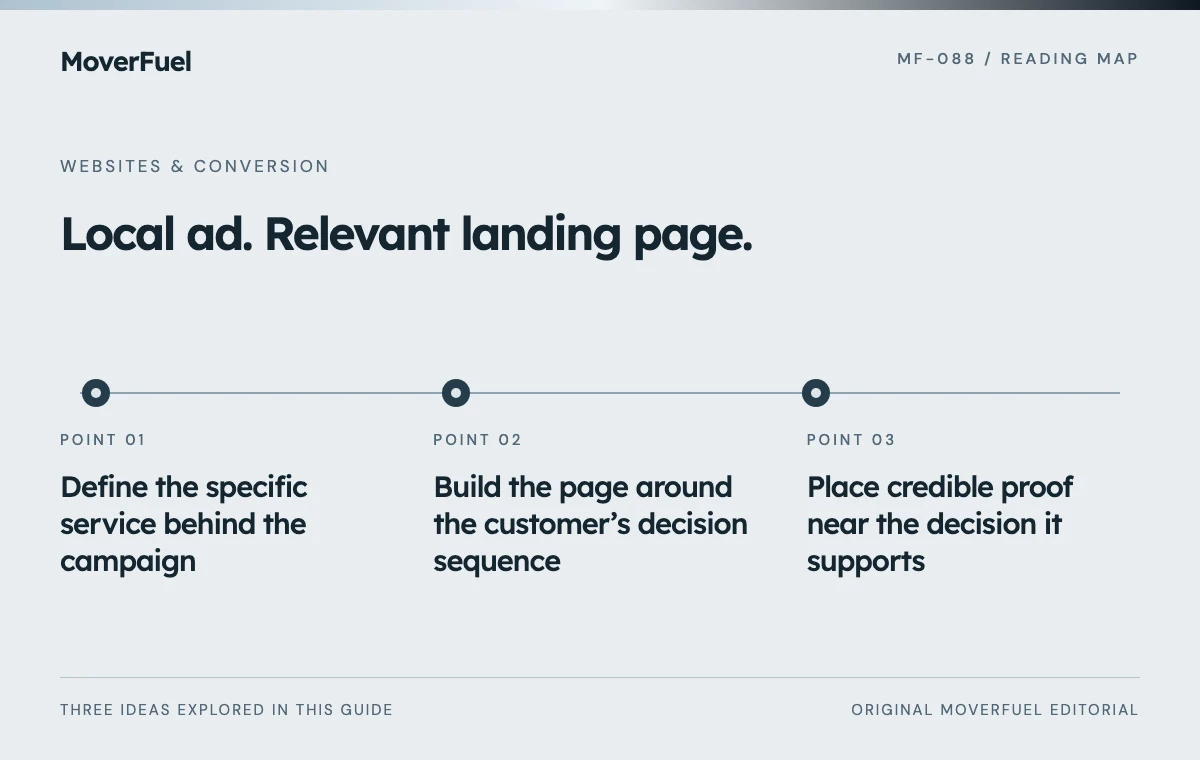
Define the specific service behind the campaign
Write the intended search task before designing the page. Local household moving, apartment moves, labor-only help and truck rental are different needs. State which the campaign serves and which it excludes, then align keywords, ad copy and landing content around that distinction.
Google’s Quality Score documentation treats landing-page experience as one diagnostic component, alongside expected click-through rate and ad relevance. Use it as a signal to investigate the page, not as a substitute for evaluating actual qualified inquiries. [1]
Scroll the table horizontally to compare all columns.
| Input | Landing-page implication |
|---|---|
| Intended service | Headline and scope explain the same offer as the ad |
| Pickup territory | Coverage is clear without invented offices |
| Customer urgency | Contact options match real response capacity |
| Important exclusions | The page prevents predictable mismatched requests |
| Next sales action | Form fields support that action |
Build the page around the customer’s decision sequence
Scroll the table horizontally to compare all columns.
| Section | Job it performs | Evidence or input needed |
|---|---|---|
| Headline and context | Confirm service and geography | Actual offer and coverage |
| Primary action | Start an appropriate inquiry | Working form or monitored phone route |
| Scope and options | Explain what the customer can request | Operations-approved inclusions and exclusions |
| Relevant proof | Reduce uncertainty about the team | Approved reviews and authentic assets |
| Estimate process | Explain what happens next | Real intake and scheduling procedure |
| Focused questions | Resolve remaining fit concerns | Common sales questions |
The structure is a reasoning sequence, not a fixed visual template. A concise page may combine sections, while a complex offer may need more explanation. Keep each block tied to a customer decision rather than adding content solely to make the page longer.
Be precise about local coverage
Describe the pickup areas the operation actually serves and how unusual requests are reviewed. Do not imply a physical office in every advertised suburb. If minimum-job or travel conditions apply, explain them at the appropriate point instead of allowing the ad to create a contradictory expectation.
Place credible proof near the decision it supports
A real crew image can answer who will arrive; a relevant review can explain a customer experience; a clear estimate process can reduce uncertainty about next steps. Use each for its actual purpose. A generic badge collection does not explain whether the company can handle the visitor’s move.
If the page advertises a price or offer, state the actual conditions and keep them consistent with the ad and sales process. Do not use a low headline number that the team cannot explain for the advertised service. Have the responsible business reviewer approve pricing language before launch.
Test the phone and form paths as a customer
Open the page from the campaign URL on a phone. Check the headline, tap targets, form labels and whether fixed elements cover the action. Confirm that the number reaches the intended team and that the form produces a real intake record.
Use the quote form specification to define validation and delivery states. Keep a successful submission distinct from a confirmed booking.
Preserve appropriate campaign context through the handoff so the team can evaluate which inquiries belong to the campaign. Exclude test submissions and duplicate retries. If the page uses a separate domain or embedded form, verify that source collection survives those transitions.
Optimize from inquiry fit through booked outcomes
Review campaign inquiries by requested service, pickup area, timing, estimate status and booking outcome. If many visitors want truck rental while the company sells full-service moves, investigate targeting and message match before redesigning the button.
If suitable inquiries arrive but fail to book, check response, estimate clarity and capacity. The landing page cannot correct a phone queue that goes unanswered or a service calendar that cannot support the advertised availability.
Change one meaningful hypothesis at a time where feasible and retain the prior version. Compare similar traffic and mature outcome cohorts. Report volume and fit together so a higher form-completion rate does not conceal a rise in unusable inquiries.
Common questions
Does every city need a separate paid landing page?
Only when the page serves a real difference in offer, coverage or customer needs. Duplicating the same page with city names alone may add maintenance without improving clarity.
Should a local landing page remove all navigation?
Evaluate the customer task. Keep access to information needed for trust and service understanding, then test whether unnecessary choices distract from the primary action.
Your next step
Match the campaign’s service promise, explain real coverage and make the estimate path work. Judge improvements by suitable inquiries and booked outcomes, with the operating context included.
Sources & editorial notes
Platform claims cite the documents below. Operating frameworks and labeled examples are MoverFuel editorial analysis, not client results or industry benchmarks.
- Google: Quality ScoreQuality Score diagnostic components include landing-page experience; the page wireframe and commercial review process are original recommendations. Reviewed .