
A long-distance inquiry can look promising until the team discovers that the pickup market, shipment size or timing does not fit the operation. The landing page should help establish those conditions early. Its purpose is to start a useful route-specific conversation while accurately explaining who provides the service and how an estimate is developed.
 View full-size graphic ↗
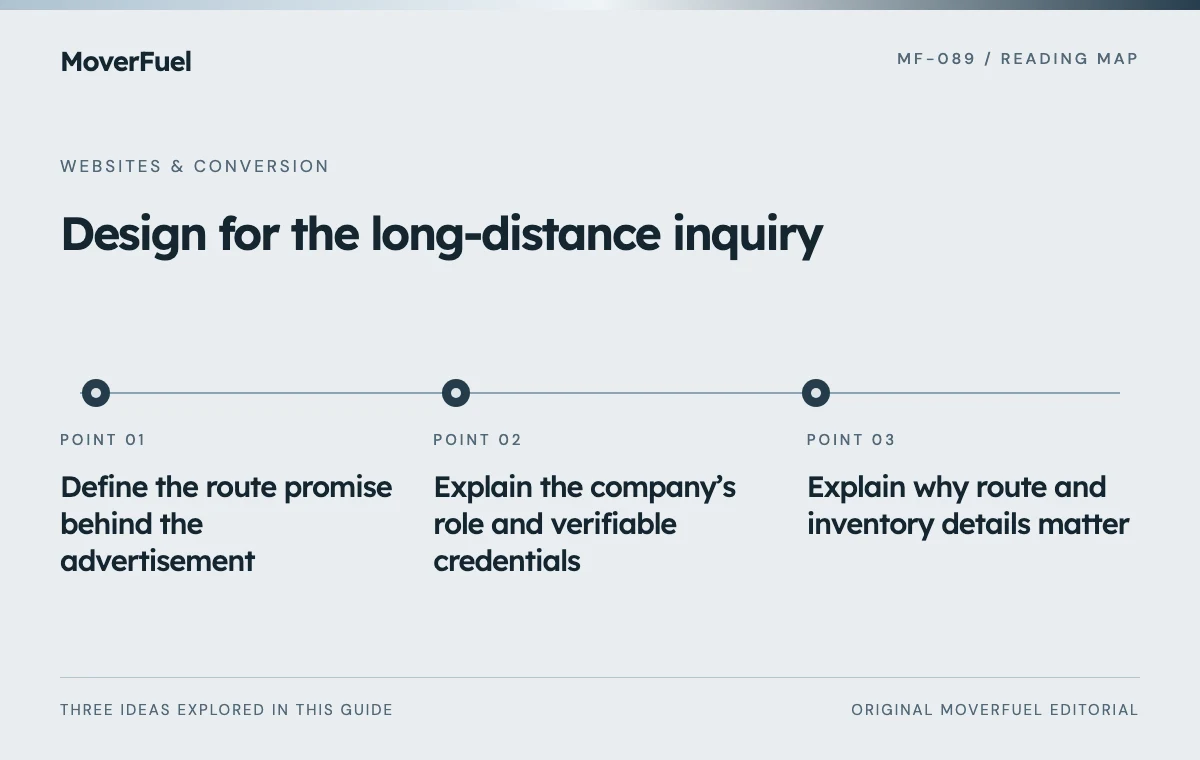
Define the route promise behind the advertisement
Identify supported origin markets, destination coverage and the service model. A mover may accept pickups from selected regions while delivering much farther away. ‘Nationwide moving’ alone does not explain that distinction and can attract inquiries the business cannot serve.
Scroll the table horizontally to compare all columns.
| Input | Question the page should resolve |
|---|---|
| Origin | Where can the company collect the shipment? |
| Destination | Which delivery markets or route types can be considered? |
| Timing | What information is needed to review pickup and delivery expectations? |
| Scope | What shipment and service requirements fit? |
| Access | Which details may affect planning or the estimate? |
| Business role | Who arranges and who performs the transportation? |
Use campaign segmentation to send different route intents to appropriate content. Do not create a separate page for every origin-destination combination unless there is genuinely useful, accurate information to provide. A large route matrix with copied paragraphs can obscure the actual offer.
Explain the company’s role and verifiable credentials
FMCSA distinguishes interstate movers, which transport household goods, from brokers, which arrange transportation rather than performing it. Its consumer guidance explains registration and provides a way to check the business. The landing page should describe the company’s real role clearly. [1]
Verify the relevant identity and registration information before publishing it. Make sure the credentials belong to the entity providing or arranging the service described. A logo, badge or number without a clear relationship to the company can create false reassurance.
Use imagery and proof that match the operation
Do not show another company’s fleet as your own or imply that a partner facility is owned by every branch. Approved project descriptions can demonstrate relevant experience without inventing outcomes. If no comparable project is available, explain the actual process instead of manufacturing a case study.
Explain why route and inventory details matter
Describe the information the estimating team needs: origin and destination, inventory or shipment scope, packing needs, access conditions and timing preferences. Explain what happens after the initial request and which details still require confirmation.
Scroll the table horizontally to compare all columns.
| Topic | Useful explanation |
|---|---|
| Initial request | Whether this begins a callback, survey or estimate review |
| Inventory | How the company collects and confirms the shipment scope |
| Access | Which pickup and delivery conditions need discussion |
| Timing | How preferences differ from confirmed commitments |
| Optional services | How packing or storage enters the scope |
| Changes | Who to contact when the move details change |
Avoid universal promises about delivery dates, final prices or included work unless the operation and agreement support them. A concise explanation of uncertainty is more useful than a confident headline that sales must later retract.
Make the form route-aware without demanding a full survey
Collect enough location detail to qualify the route. If the destination address is not known, allow an appropriate city or region entry and explain what will be needed later. Support flexible dates rather than requiring the customer to invent a precise day.
Use conditional fields for packing, storage and unusual access when those details affect routing or the next conversation. Keep a clear path for uncertainty. A customer who does not know shipment volume should not be forced to guess a technical quantity they cannot estimate reliably.
The moving quote form guide covers accessible validation and genuine delivery feedback. The long-distance version should add route qualification, not a different standard of reliability.
Test the receiving team’s view as well as the customer’s form. Origin, destination and flexibility should arrive in usable fields, not disappear into an unstructured email that staff must reconstruct.
Measure suitable route opportunities over a mature sales window
Classify inquiries by route fit, timing fit and service scope before comparing campaign costs. An inexpensive form submission from an unsupported origin is not equivalent to an estimate-ready opportunity on a route the company wants.
Track estimate progression, booking and cancellation separately. Long-distance decisions may take time, so compare acquisition cohorts at a consistent maturity point. Do not label a recent campaign unsuccessful merely because its open estimates have not yet resolved.
When qualification is weak, inspect targeting and the page’s coverage promise. When qualified estimates fail to book, investigate follow-up, scope clarity and customer expectations. Keep those diagnoses separate so the next change addresses the actual loss point.
Common questions
Should a long-distance page ask for both endpoints?
Usually the team needs both to assess route fit. Allow appropriate uncertainty when the customer knows the destination market but not the final address.
Can a broker use the same page wording as a carrier?
The page should accurately explain the business’s role. Do not imply that the company performs transportation when it arranges service through another mover.
Your next step
Qualify the route, explain the business role and make the estimate process understandable. A strong long-distance page produces better-informed opportunities rather than simply more form submissions.
Sources & editorial notes
Platform claims cite the documents below. Operating frameworks and labeled examples are MoverFuel editorial analysis, not client results or industry benchmarks.
- FMCSA: movers versus brokersFMCSA distinction between interstate movers and brokers and registration-check guidance. Page architecture and qualification recommendations are original editorial guidance. Reviewed .