
The difficult part of managing several moving-company profiles is keeping each branch accurate while preserving company-wide control. A central team knows the brand, but a local manager knows when access, staffing or services change. Build a system that combines those responsibilities instead of letting either side edit in isolation.
 View full-size graphic ↗
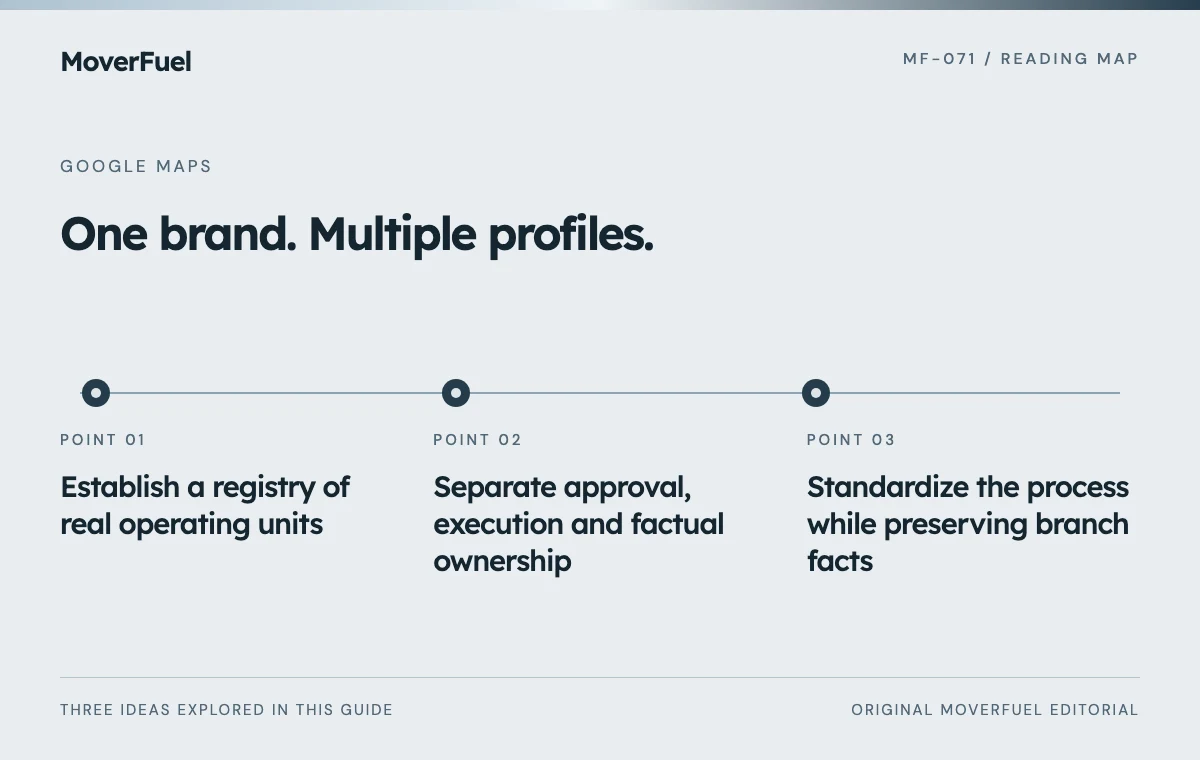
Establish a registry of real operating units
List each proposed or existing branch with its operating base, service model, local owner and profile identifier. Distinguish a genuine branch from a service territory, temporary staging point or delivery destination. Do this before assigning marketing targets to a new listing.
Validate each entry against the service-area and physical-location framework. Serving several markets does not make every market a separate office.
Google’s business representation rules govern which locations can be listed. Apply the current location requirements to each branch individually; a legitimate headquarters does not establish eligibility for every address associated with the company. [1]
Scroll the table horizontally to compare all columns.
| Field | Purpose |
|---|---|
| Operating-unit ID | Join marketing, sales and branch records without relying on names |
| Profile ID and public URL | Identify the exact listing under review |
| Location and service model | Document the real operation and customer access |
| Local accountable owner | Confirm hours, services and evidence |
| Central administrator | Coordinate access and significant changes |
| Phone and landing page | Send inquiries to the right branch |
Separate approval, execution and factual ownership
Scroll the table horizontally to compare all columns.
| Task | Central role | Branch role |
|---|---|---|
| Name and identity changes | Review consistency and documentation | Confirm the real-world facts |
| Hours and availability | Maintain update process | Report current operating changes |
| Photos and service evidence | Review quality and permissions | Supply authentic local material |
| Review responses | Set tone and escalation boundaries | Investigate the actual customer case |
| Access changes | Maintain authorized account ownership | Report staffing changes promptly |
| Lead routing | Test measurement and handoffs | Confirm calls reach the right team |
Use individually authorized access rather than a shared password passed between employees and agencies. Maintain a record of who needs access and why. When a manager leaves, include profile access in the same handover process as phone systems and customer records.
Define an emergency path for wrong phone numbers, unexpected closures or account restrictions. Routine photo updates and urgent customer-contact defects should not wait in the same approval queue.
Standardize the process while preserving branch facts
A central template can establish naming conventions, evidence requirements and review frequency. It should not force every branch to claim identical services, facilities or hours. A branch with storage capacity and one without it need different customer information.
Give every branch its own evidence owner
Ask the local owner to verify photographs, customer access arrangements and contact instructions. Do not reuse a warehouse image across branches in a way that implies each has that facility. The same principle applies to equipment and services supplied only by selected teams.
Maintain a local exception log. For example, a branch may use a central estimating desk while dispatch remains local. Document that arrangement so the profile, website and answering team give a consistent explanation.
Treat openings, relocations and closures as coordinated changes
Before announcing a new branch, confirm the operating facts, contact routing, website destination and responsible staff. For a relocation, inventory the old references and prepare the new information together. For a closure, decide how existing customers will reach the continuing business.
Investigate duplicates before trying to simplify them. Historical ownership, acquired brands and separate legal or operating entities can make two similar listings materially different. Keep a record of the decision and use the relevant official process when a correction is needed.
Compare branches using compatible measures
Separate profile interactions from unique qualified opportunities and booked moves. Assign each opportunity to the branch responsible for delivery, while preserving the acquisition source. A central phone team should not cause every location’s marketing to appear as headquarters demand.
Compare equivalent service mixes and periods. A commercial branch with long sales cycles is not directly comparable with a household branch handling short-notice local moves. Note capacity changes and market differences before judging performance from a single conversion rate.
Use the Maps lead-tracking worksheet to connect observations to outcomes, and review the broader multi-location growth approach when allocating resources between markets.
A monthly governance review should end with named actions: correct an inaccurate field, resolve an access gap, replace old evidence or investigate a routing problem. A dashboard without owners can display the same preventable error for months.
Common questions
Should every branch use identical profile content?
Use consistent standards, but preserve real differences in services, access, hours and facilities. Uniform wording should not make inaccurate claims.
Who should own the profile relationship with an agency?
The company should retain accountable control and a documented access arrangement. The agency’s execution role should not leave the business dependent on an undocumented shared login.
Your next step
Govern profiles through a branch registry, clear responsibilities and local evidence. Central consistency works best when it makes real branch differences easier to maintain and measure.
Sources & editorial notes
Platform claims cite the documents below. Operating frameworks and labeled examples are MoverFuel editorial analysis, not client results or industry benchmarks.
- Google: representing your businessLocation eligibility must be assessed against Google's business representation rules. Governance matrix and branch measurement framework are original recommendations. Reviewed .