
A missed call is an unanswered contact attempt, not proof of a lost moving job. It may be a repeat caller, a booked customer, a vendor or an inquiry outside your service area. To understand the commercial impact, connect call handling to recovery, qualification and eventual job outcomes before attaching a revenue estimate.
 View full-size graphic ↗
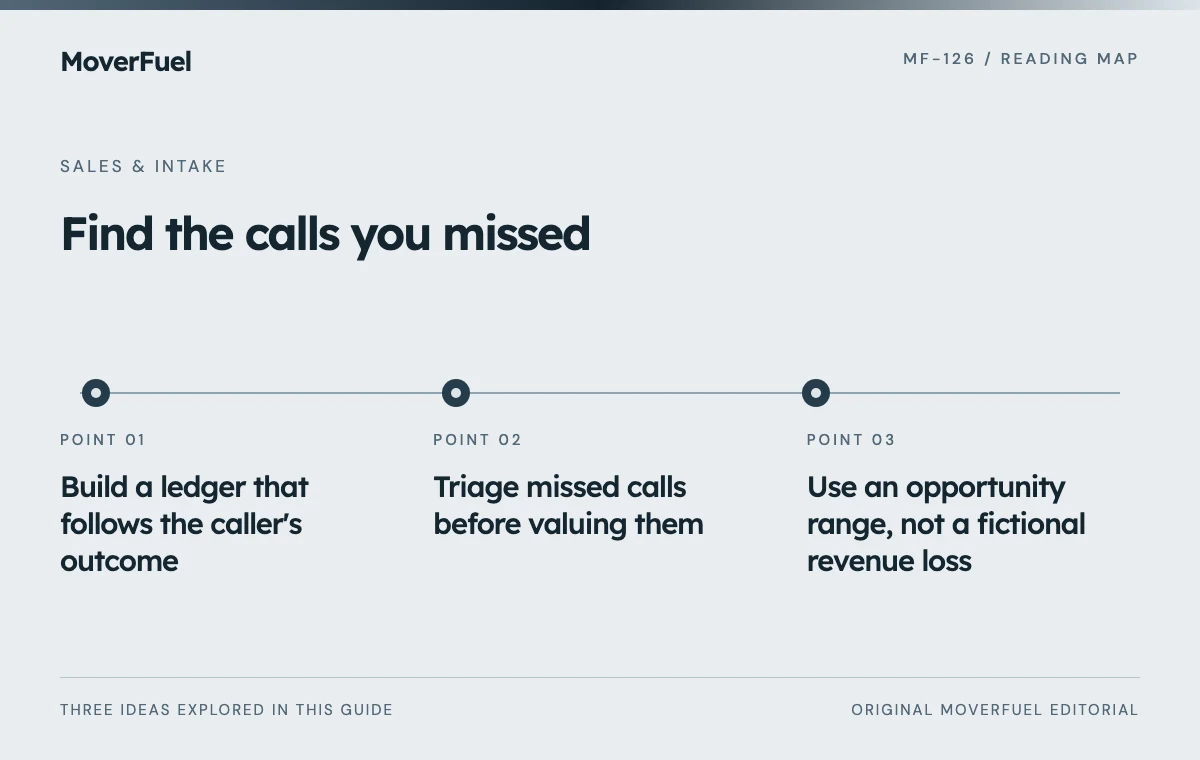
Build a ledger that follows the caller's outcome
CallRail documents separate answered, missed and voicemail states in its API. A platform's answer status is a starting point for reviewing contact handling; it is not a reliable substitute for a qualified inquiry or booking decision. [1]
Scroll the table horizontally to compare all columns.
| Field | Purpose |
|---|---|
| Call ID and receipt time | Find the original event |
| Caller or inquiry link | Group repeat attempts when supported |
| Call purpose | New move, existing job, vendor or unknown |
| Assigned owner | Make recovery responsibility explicit |
| Recovery attempt and result | Separate attempted from successful contact |
| Service fit and outcome | Connect to estimate, booking or disposition |
Use appropriate access controls for phone numbers and other customer data. Keep reporting views limited to what their users need. A recovery list should not become an unrestricted export of private customer information. [2]
Define how calls become one opportunity. Two missed calls followed by an answered callback about the same relocation represent three call events but usually one inquiry. Preserve the events for service analysis while keeping the commercial denominator deduplicated.
Triage missed calls before valuing them
Separate new-sales candidates from existing-job support and noncustomer calls. Unknown calls remain unknown until there is enough evidence to classify them. A short call duration alone does not establish spam; an apparently long call does not establish sales value.
Give each recoverable inquiry a next action
Use the customer's permitted contact channel and the company's contact policy. Record who attempts recovery, when it occurs and what happened. If the caller has already connected with another branch, reconcile the records before creating a second follow-up.
Escalate time-sensitive booked-job issues to operations. They may matter greatly even though they are not new revenue opportunities. Keeping support separate prevents the marketing report from undervaluing service problems or overcounting new leads.
The speed-to-lead guide explains how to distinguish an attempt from a successful conversation.
Use an opportunity range, not a fictional revenue loss
Start with unresolved, unique, potentially relevant new inquiries. Then model plausible qualification and completion rates using comparable business evidence where available. If evidence is weak, present a broad scenario rather than a claimed forecast.
Scroll the table horizontally to compare all columns.
| Input or output | Conservative case | Higher case |
|---|---|---|
| Unique unresolved new inquiries | 20 | 20 |
| Assumed service-fit rate | 50% | 70% |
| Assumed completion rate among fitting inquiries | 20% | 30% |
| Expected completed-job equivalents | 2 | 4.2 |
| Assumed average completed-job revenue | $2,000 | $2,000 |
| Illustrative revenue opportunity | $4,000 | $8,400 |
The arithmetic is 20 × fit rate × completion rate × job revenue. Fractional job equivalents are expected values in a scenario, not literal bookings. These fictional inputs demonstrate the method and are not industry benchmarks or MoverFuel results.
If deciding whether additional coverage is worthwhile, consider contribution and the cost of that coverage, not revenue alone. Avoid deducting the same fulfillment or acquisition cost twice when moving from a revenue scenario to a contribution estimate.
Find the failure pattern that can be repaired
Compare missed unique inquiries by hour, line, branch and routing destination. Look for a queue that rings an unavailable employee, a timeout that ends before overflow, an inaccurate holiday schedule or a transfer that nobody owns. Verify suspected behavior through controlled routing tests.
Keep the denominator visible. Ten missed calls out of twenty differs from ten out of two hundred. Report both call-level answer rate and unique-inquiry recovery rate; they describe different problems. Check whether repeat dialing is inflating the apparent call demand.
Review connection quality after a change. A system that marks calls answered immediately but leaves customers waiting may improve the dashboard without improving service. The customer's ability to reach a useful next step is the operating goal.
Close the recovery loop with observed results
Track how many missed inquiries were later contacted, qualified, estimated, booked and completed. Use a consistent observation window and retain open outcomes. Compare the actual recovered contribution with the cost of the specific coverage change.
Keep recovered bookings separate from the modeled opportunity range. Once an outcome is observed, replace uncertainty with the real record rather than adding the booking on top of the same forecast. Explain whether the intervention changed staffing, routing or follow-up ownership.
A lead tracking review can connect call handling to the booking record so coverage decisions rely on recoverable demand rather than an inflated loss estimate.
Common questions
Can I multiply missed calls by average job value?
That assumes every call is a unique suitable customer who would have completed a job. Deduplicate, classify and model qualification and completion before estimating an opportunity range.
Is voicemail a lost lead?
Not necessarily. It is a contact state that needs an owner and an outcome. The customer may leave useful details, reconnect later or already have an existing job.
Your next step
Treat missed calls as a recoverable-contact workflow first. Use observed bookings for results and clearly labeled scenarios for unresolved opportunities.
Sources & editorial notes
Platform claims cite the documents below. Operating frameworks and labeled examples are MoverFuel editorial analysis, not client results or industry benchmarks.
- CallRail API v3 documentationCallRail API distinguishes answer states, which do not establish a booked-job outcome. Reviewed .
- FTC: protecting personal informationFTC guidance supports limiting access and retaining only needed customer information. Reviewed .