A moving customer with a date approaching may contact several companies. Prompt, useful follow-up gives your team an earlier opportunity to establish service fit and arrange an estimate. How much that changes booking odds depends on your own market, lead mix and intake process; a universal conversion multiplier would hide those differences.
 View full-size graphic ↗
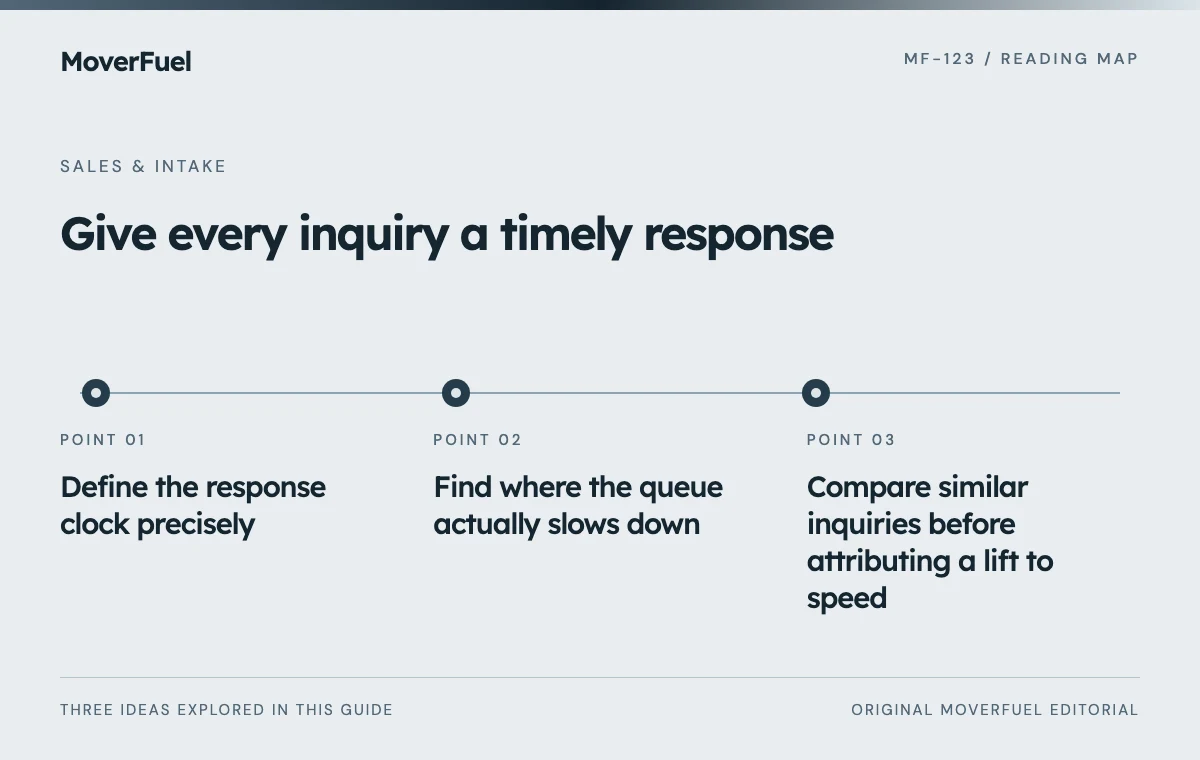
Define the response clock precisely
Start the clock when the business receives a valid inquiry, not when a salesperson opens the CRM. Record separate timestamps for automated acknowledgment, first staff attempt, first two-way conversation and agreed next step. Each measures a different part of the experience.
Scroll the table horizontally to compare all columns.
| Measure | Start and end | What it reveals |
|---|---|---|
| Acknowledgment delay | Receipt to confirmation sent | Whether the customer knows the request arrived |
| First attempt delay | Receipt to staff contact attempt | Queue and coverage speed |
| Conversation delay | Receipt to successful two-way contact | Actual connection, influenced by availability |
| Next-step delay | Conversation to agreed estimate action | Handoff and qualification friction |
An instant automated email cannot substitute for a person resolving a customer's route or date question. Report it separately. If a callback goes unanswered, retain the attempt time and the eventual conversation time rather than treating the first attempt as a successful connection.
Use both elapsed time and an explicitly defined staffed-hours view. A Friday evening inquiry answered Monday should not appear to have waited only a few minutes without a visible explanation of the clock.
Find where the queue actually slows down
Group inquiry arrivals and first attempts by hour, weekday, branch and contact channel. Review periods with available crews but no intake coverage, as well as peaks when everyone is handling estimates. Averages alone can hide a small group of customers waiting far longer.
Give the queue an owner and a backup
Each new inquiry needs an assigned owner, a visible next action and a fallback if that person is unavailable. A shared inbox is not an ownership rule. Specify who checks unassigned records and who takes over when a callback commitment is missed.
For Google Local Services Ads, Google's ranking guidance includes responsiveness among relevant factors. That platform-specific relationship does not prove a particular booking uplift for all moving inquiries. Use it as a reason to maintain coverage, then measure your own outcomes. [1]
For platform-specific handling, connect the workflow with Local Services Ads management rather than applying one generic contact rule to every source.
Compare similar inquiries before attributing a lift to speed
A quick response may coincide with easier work: daytime calls, local routes and near-term availability. Slower responses may include overnight commercial requests that need a survey. Comparing their raw booking rates can confuse lead mix with the effect of response time.
Scroll the table horizontally to compare all columns.
| Cohort field | Why preserve it |
|---|---|
| Receipt period | Controls for operating conditions |
| Service and route fit | Separates different acquisition tasks |
| Move-date window | Urgency and available capacity differ |
| Source and contact mode | Phone and form paths are not identical |
| Response interval | The behavior being evaluated |
| Mature outcome | Allows enough time for booking decisions |
Use intervals that make operational sense for your volume, and display counts with rates. Four bookings from five contacts is not stable evidence that a response rule will work at scale. Track qualification and estimate completion as well as eventual bookings.
Test a coverage improvement without deliberately neglecting customers
Choose a fix such as overflow ownership, a queue alert or a clear after-hours callback promise. Define the affected hours, the staff responsible and the customer-facing expectation. Keep the qualification standard and estimate process consistent while the change is evaluated.
Compare the changed period with a reasonably matched baseline and, where practical, an unaffected operating group. Record seasonal demand, capacity changes and campaign changes that could explain the outcome. Avoid manufacturing an untreated group by intentionally delaying urgent customer requests.
Measure whether first attempts become faster, whether conversations become more frequent and whether mature bookings improve. Also check complaints, repeated contacts and staff workload. Faster attempts that overwhelm customers or bypass accurate qualification are not a successful process improvement.
Make the first response useful
A productive first reply acknowledges the actual request, confirms the service area and asks for the information needed to choose the next step. For a commercial project, that might be the site, access window and survey contact. For a local home move, it may be the date, route and inventory scope.
If staff cannot provide an estimate immediately, give a realistic callback or survey commitment and fulfill it. Do not imply a crew is reserved merely because someone submitted a form. Clear expectations can prevent another follow-up from becoming a correction.
Connect response timestamps to lead tracking and automation so the team can improve the delay that matters instead of chasing an arbitrary speed score.
Common questions
What is the ideal response time for a mover?
Set a realistic service commitment based on staffed coverage and customer needs, then measure your own results. No single time threshold guarantees a booking increase across every service type and market.
Should an automated reply stop the response clock?
It can stop the acknowledgment clock. Keep first staff attempt and successful conversation as separate measures so automation does not conceal an unanswered inquiry.
Your next step
Improve coverage and useful contact together. A trustworthy speed-to-lead program tracks real timestamps, comparable cohorts and customer outcomes without turning a correlation into a universal promise.
Sources & editorial notes
Platform claims cite the documents below. Operating frameworks and labeled examples are MoverFuel editorial analysis, not client results or industry benchmarks.
- Google: About Local Services ad rankingsGoogle Local Services Ads ranking guidance includes responsiveness; it does not establish a universal booking uplift. Reviewed .