
Customer acquisition is the process of turning demand into a new customer the moving company can serve. Different channels can contribute, but their headline metrics are rarely comparable. A purchased inquiry, an organic call and a referred estimate may involve different qualification work, timing and costs. Compare them using the same outcome definition and include the work required to reach it.
 View full-size graphic ↗
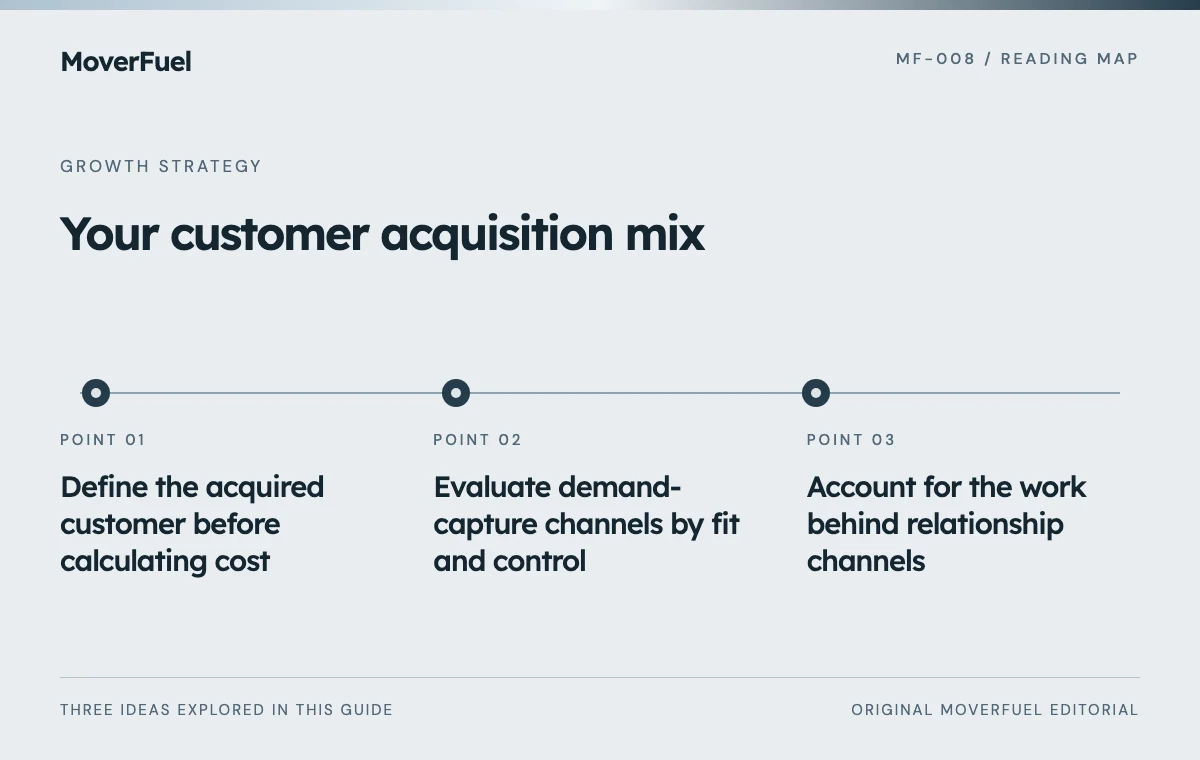
Define the acquired customer before calculating cost
Choose the event your analysis is meant to explain: a booked move, a completed move or another clearly defined customer outcome. Keep raw inquiries and qualified opportunities as earlier stages. If cancellations are material, a booked-job measure should be accompanied by a completion measure.
Record whether the analysis includes only media, the full marketing program or marketing plus sales effort. Those are different cost definitions. Label them accurately instead of calling every ratio customer acquisition cost. A source that requires many unsuccessful calls can appear inexpensive when intake time is excluded.
Scroll the table horizontally to compare all columns.
| Measure | Numerator | Denominator |
|---|---|---|
| Media cost per inquiry | Advertising spend in the defined cohort | Unique inquiries attributed under the stated method |
| Media cost per booked move | The same advertising spend | Booked moves from that cohort |
| Broader acquisition cost | Defined marketing and sales costs | New customers reaching the stated acquisition event |
Avoid mixing customers and jobs without explanation. A repeat customer buying another service is useful revenue, but it may not be a newly acquired customer. Decide how repeat work, referrals and storage add-ons will be treated before comparing channels.
Evaluate demand-capture channels by fit and control
Search advertising can present an offer around an expressed search need. Organic service pages can help customers investigate a relevant business. A local profile can support discovery and comparison. Each still depends on truthful coverage, a useful destination and the ability to handle inquiries.
Local Services Ads is another option where the service and market qualify. Its screening and availability should be checked against current requirements. Do not treat eligibility as established simply because another mover advertises in a different area. [1]
Scroll the table horizontally to compare all columns.
| Channel | Control to inspect | Outcome to inspect |
|---|---|---|
| Search advertising | Service intent, geography, offer and budget | Qualified inquiries and mature booked outcomes |
| Organic service discovery | Content, site access and service clarity | Relevant entry pages and resulting inquiries |
| Local discovery | Accurate profile and operating information | Contact paths and serviceable requests |
| Eligible LSA | Profile, service areas and response process | Lead fit, estimates and booked work |
Control does not mean certainty. A company can improve its pages or targeting without controlling every auction, ranking or customer decision. The plan should identify what can be changed and what remains an external condition.
Account for the work behind relationship channels
Customer referrals, local partnerships and repeat business may arrive without a media charge, but they are not necessarily cost-free. The business invests in service delivery, relationship management, communication and the process that receives the introduction. Record those costs where the comparison requires them.
A warm introduction still needs qualification
A trusted referral can concern an unavailable date or an unsupported service. Preserve the same fit criteria used elsewhere while recognizing that the customer may arrive with different context. Do not skip route or scope checks because the inquiry came from a valued partner.
Evaluate whether the relationship produces work the operation wants and whether the arrangement can be maintained responsibly. Any incentives, data sharing or outreach process should be reviewed for the applicable requirements. This channel comparison does not establish legal permission for a particular referral arrangement.
Read purchased-inquiry terms before comparing prices
Ask what the vendor is selling: an inquiry, a transfer, an appointment or something else. Clarify whether the record is shared, how recency is defined, what service and geography checks occur and which conditions govern credits. Do not assume the word ‘exclusive’ answers every question about distribution or customer expectations.
- What did the customer request, and what were they told about contact?
- How is the inquiry's age measured?
- Which service and route fields are supplied?
- How many buyers may receive or contact the prospect under the actual terms?
- What evidence is available when a record is duplicated or unsuitable?
- Who owns the follow-up process and its cost?
Compare the purchased channel with your own campaigns only after using the same qualification and outcome definitions. A vendor's reported lead count and your CRM's unique customer count may describe different units. Reconcile duplicates and repeat contacts before calculating performance.
Model cost and time together
Use a cohort that has had time to mature. An inquiry generated today may not become a booked move today, particularly for complex or longer-planned work. Compare service mix and sales delay so a faster journey is not automatically rewarded by a short reporting window.
The SBA recommends measuring marketing and sales costs against the revenue generated while recognizing that some tactics are harder to attribute. For a moving company, supplement revenue with the relevant fulfillment and acquisition costs. Be consistent about what is observed and what is estimated. [2]
The marketing budget guide shows how qualification, booking and completion assumptions change a spending decision.
Choose a mix the business can operate and understand
A diversified plan can reduce dependence on one source, but adding channels also adds work. Before launching another, identify the risk or opportunity it addresses. It might reach a different service need, support a new market or reduce reliance on purchased inquiries. ‘More channels’ is not itself a commercial objective.
Set ownership and review rules for each channel, then compare the combined customer journey. Do not add platform-reported bookings together without checking for overlap. Keep unknown attribution visible and use customer feedback as context rather than forcing every outcome into a single confident explanation.
Choose the next experiment from the business constraint. If existing suitable inquiries are not receiving estimates, another source may multiply the problem. If the handoff works and capacity remains, a bounded channel test can answer whether additional demand is worthwhile.
Common questions
Are organic and referral customers free to acquire?
They may not carry a direct media charge, but content, website work, relationship management and sales effort still consume resources. Include the costs relevant to the decision and label the calculation clearly.
Can purchased leads be compared with Google Ads leads?
Yes, after aligning units, qualification criteria, cost scope and cohort timing. Vendor lead counts, duplicate contacts and different service mixes can otherwise make the comparison misleading.
How many acquisition channels should a mover use?
Use a manageable mix with clear roles and ownership. Add a channel to answer a defined growth or concentration-risk question, not simply to increase the number of tactics in the plan.
Your next step
Compare channels using the same customer outcome, complete cost definition and mature cohort. Account for operational effort and the work each source produces. Then choose a mix that fits the company's capacity and reduces uncertainty about the next investment.
Sources & editorial notes
Platform claims cite the documents below. Operating frameworks and labeled examples are MoverFuel editorial analysis, not client results or industry benchmarks.
- Google: Local Services verificationEligibility and screening vary by service and market. Reviewed .
- SBA: marketing and salesMarketing/sales cost measurement and attribution limitations. Channel comparisons and calculations are original editorial analysis. Reviewed .