
A budget is an authorization; pacing is the process of deciding how that authorization should be used over time. Dividing a monthly allowance by the number of days gives a planning average, not a guarantee of identical daily charges. A useful moving-company pacing sheet combines spending, remaining opportunity, sales delay and available capacity so the owner can approve corrections before a month-end surprise.
 View full-size graphic ↗
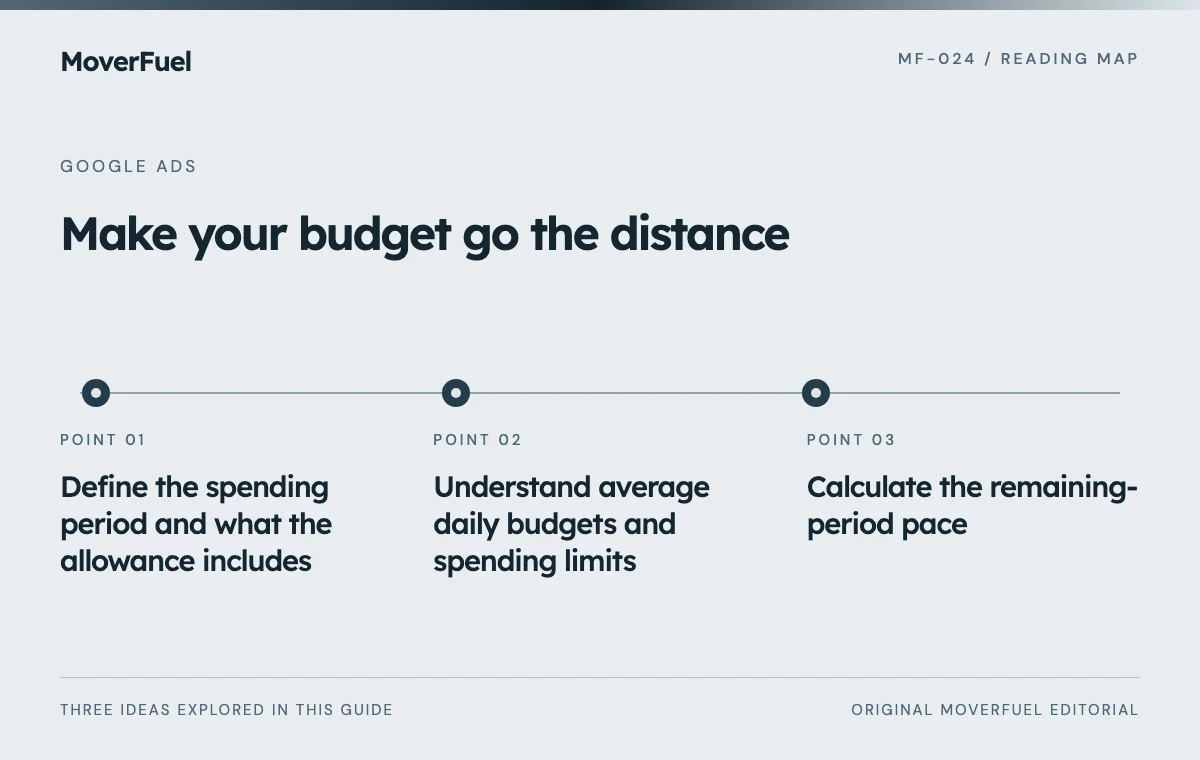
Define the spending period and what the allowance includes
Write down the media allowance, start and end dates, account currency and person authorized to change it. Separate platform media from management fees, creative work and tracking costs. A campaign manager cannot pace correctly against a number that finance intended to include several different expenses.
For multiple campaigns, show both campaign allocations and the account total. A saving in one market is not automatically permission to overspend in another. Record whether the owner permits transfers and under what conditions.
Use the moving-company marketing budget guide to establish affordability and broader acquisition economics. This worksheet addresses delivery against an approved media plan, not how much every mover should spend.
Understand average daily budgets and spending limits
Google states that, for most campaigns, the daily spending limit is twice the average daily budget and the monthly limit is 30.4 times that budget. Exceptions and budget changes affect the applicable limits. The platform budget report should be checked for the actual campaign rather than treating these multipliers as a universal account ceiling. [1]
Current guidance also explains that ad scheduling does not simply reduce the monthly pacing target in proportion to scheduled days. Served cost and billed cost are different: billed cost reflects applicable adjustments. Use the appropriate cost basis in your financial reconciliation. [1]
Calculate the remaining-period pace
Start with an unambiguous cut-off time. Subtract reported spend through that time from the approved allowance. Divide the remainder by the remaining calendar days for a simple baseline, then review demand and scheduled activity before applying changes.
Scroll the table horizontally to compare all columns.
| Input or calculation | Example |
|---|---|
| Approved media allowance | $6,000 |
| Spend through day 12 | $2,700 |
| Remaining allowance | $6,000 − $2,700 = $3,300 |
| Remaining days | 30 − 12 = 18 |
| Simple remaining daily pace | $3,300 ÷ 18 = $183.33 |
| Straight-line spend expected by day 12 | $6,000 × 12 ÷ 30 = $2,400 |
| Variance from straight line | $2,700 − $2,400 = $300 ahead |
Being ahead of a straight line is not automatically a mistake. The plan may intentionally concentrate investment around demand or availability. The worksheet reveals a difference that needs an explanation; it does not decide whether the difference is good.
Handle edge cases explicitly
If no days remain, do not divide by zero or present an infinite rate. Close the period and reconcile. If spend already exceeds the allowance, show a negative remainder and escalate the decision. Do not hide it by replacing the result with a normal-looking daily budget.
Overlay service availability and expected demand
Ask operations which dates and job types remain desirable. A campaign can be under its allowance while the company is already full for the dates most inquiries request. Spending the remainder merely to reach the plan can create work the sales team must reject.
Distinguish the date of inquiry from the date of service. Advertising today may fill a later period. Record the booking horizon by service so a pacing reduction intended to protect this week does not unintentionally empty a future week.
Use actual historical demand where available and label estimates when it is not. Do not invent seasonal multipliers or assume every market follows the same calendar. Keep a note of holidays, staffing changes or major local events when they plausibly affect the observation.
Diagnose underdelivery before increasing the budget
Scroll the table horizontally to compare all columns.
| Observation | First investigation |
|---|---|
| Spend below plan and few impressions | Eligibility, coverage, demand and restrictive settings |
| Spend below plan with limited conversions | Goal accuracy, destination and bidding constraints |
| Spend above plan with unsuitable requests | Query fit, geography and misleading offers |
| Spend on plan with missed calls | Response staffing and routing |
| Useful demand but unavailable service dates | Capacity and the advertised promise |
Choose one corrective action with an owner and a review date. Raising a budget does not fix a broken form, and expanding geography does not fix unreturned calls. A pacing meeting should produce a specific intervention rather than a reflexive request to spend more.
After a budget change, recheck platform limits and update the worksheet. Preserve the original authorization and the revised one with timestamps. Otherwise a retrospective report can make the plan appear to have always matched what happened.
Report spending and acquisition outcomes on separate clocks
The spending report answers how much media was delivered in the period. The acquisition report follows inquiries from that period into qualification, estimates and bookings. Keep them connected but distinct. Jobs completed this month may have been acquired long before the current campaigns ran.
Show preliminary and mature outcomes separately. Recent cohorts need time; old cohorts may need cancellation or value corrections. The owner should be able to see both the current spending exposure and whether earlier investment created suitable work.
Close each review with the current allowance, expected remaining delivery, operational constraint, approved correction and next check. That compact record is more actionable than a chart that only shows whether a line sits above or below an arbitrary daily target.
Common questions
Is the average daily budget a hard daily cap?
For most Google Ads campaigns it is not. Google documents a higher daily spending limit and a monthly limit, with exceptions and adjustments for changes. Check the campaign budget report and current official guidance.
Should I spend an unused allowance at month end?
Only when the demand, lead response and capacity justify it. An unused authorization is not a requirement to buy unsuitable traffic. Document the reason for underspend and the next period’s plan.
Your next step
Pace against an explicit authorization, then adjust for real demand and capacity. Keep platform billing rules, planning arithmetic and mature booking outcomes separate enough to explain each decision.
Sources & editorial notes
Platform claims cite the documents below. Operating frameworks and labeled examples are MoverFuel editorial analysis, not client results or industry benchmarks.
- Google: spending limitsMost-campaign daily/monthly limits, scheduling behavior and served-versus-billed costs. The worksheet is an original hypothetical planning example. Reviewed .