Completing moves in a city does not establish an office there. That distinction matters when a moving company plans its Google Business Profile, website location claims and expansion strategy. Treat the operating base, places where customers are served and long-distance destinations as separate facts.
 View full-size graphic ↗
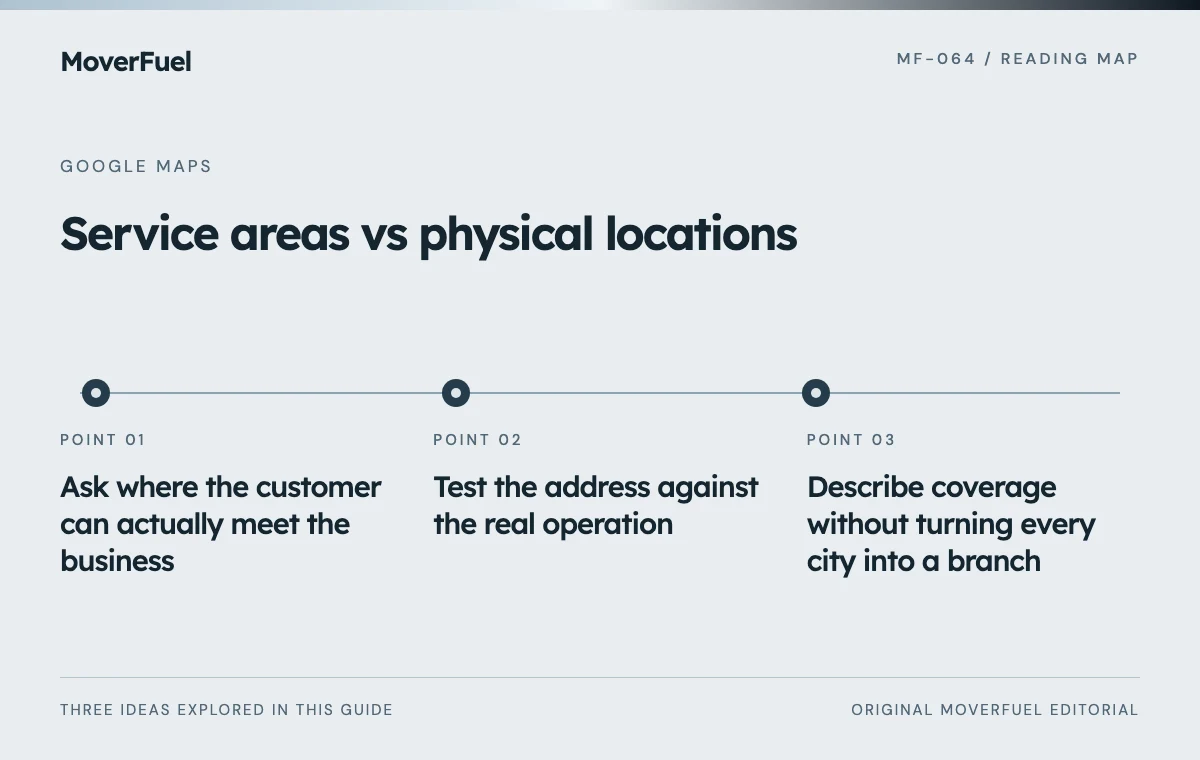
Ask where the customer can actually meet the business
A crew may leave a warehouse every morning while all customer consultations happen by phone or at the customer’s property. Another mover may have a staffed reception area where customers arrange storage and meet estimators. Those models should not be described identically.
Google distinguishes service-area businesses, which visit customers without serving them at their own address, from hybrid businesses that also serve customers at the business location. Businesses that do not serve customers at their address should remove that address from public profile display. [1]
Scroll the table horizontally to compare all columns.
| Question | If yes | If no |
|---|---|---|
| Do you travel to customers to perform moves? | Document the real service territory | Check whether the business description matches actual work |
| Do customers receive service at your business address? | Evaluate storefront or hybrid requirements | Use the service-area model rather than advertising walk-in access |
| Is the proposed branch a real operating location? | Assess its eligibility separately | Do not present it as an office |
| Is the city only a delivery destination? | Describe destination coverage accurately on the website | Evaluate its actual role in the business |
Test the address against the real operation
Google’s representation guidelines reject a rented mailing address where the business does not operate. A co-working office must meet conditions including signage, customer reception and staffing by the business during its hours. Address display also requires permanent business signage. [2]
Before signing a location agreement for marketing reasons, ask operations what will happen there. Who works at the site? What service can a customer receive? Who answers an unexpected visit? A lease and a map pin do not answer those questions.
A warehouse requires a specific explanation
Storage activity can make an address operational without making it a public reception point. Clarify access rules, appointment arrangements and which staff are present. Do not infer customer-facing eligibility simply because vehicles or stored goods are kept there.
Describe coverage without turning every city into a branch
Google currently allows up to 20 named service areas and says the overall boundary generally should not exceed about two hours of driving time from the base. The editor uses areas such as cities or postal codes rather than a radius setting. Recheck current guidance when planning changes. [1]
A long-distance mover should distinguish local pickup operations from the destinations it can serve. A cross-country delivery capability is useful website information, but it does not establish a staffed branch at every destination. Explain route qualification, scheduling and origin requirements on the relevant service page.
Build a territory worksheet from actual operational capacity: typical pickup zones, travel considerations, minimum-job requirements and excluded work. Marketing should use that worksheet to qualify inquiries. If a distant area is only occasionally served, do not imply immediate routine availability.
Make website location language match the evidence
Scroll the table horizontally to compare all columns.
| Claim | Evidence needed | Alternative when it is only coverage |
|---|---|---|
| Our office in a city | A real office with accurate contact and access details | Moving services for customers in that city |
| Visit our storage facility | A facility and genuine customer access arrangement | Explain storage arrangements and how to inquire |
| Local branch team | A real branch and identifiable operating responsibility | Explain which base serves the area |
A useful local page can explain coverage without inventing an address. See location pages without doorway content for a separate editorial framework.
Check footers, structured data, directory profiles and paid landing pages as well as the main contact page. One inaccurate office claim can survive a redesign in a forgotten page template and create a different expectation from the current profile.
Add a branch only after the operating plan is real
Assign a branch owner before creating public listings. Document the location, staff, service model, phone routing and customer access arrangements. Have someone independent of the expansion sales target review the evidence so marketing enthusiasm does not substitute for eligibility.
When two bases serve nearby markets, record which team handles inquiries and what happens when a move crosses territories. That assignment belongs in the operating process; duplicating profiles for every overlapping suburb is not a substitute for clear responsibility.
After a relocation, audit old address references and incoming calls. Customers may continue to use saved links or printed material. Maintain an orderly transition that explains the real change without leaving a fictional office behind.
Common questions
Does adding a city as a service area create a location there?
No. Coverage describes where the company works. It does not establish a physical branch or guarantee visibility throughout that city.
Can a long-distance mover list every destination as an office?
Only real eligible locations should be described as offices. Explain destination capabilities separately from the company’s actual operating bases.
Your next step
Start with the operating facts, choose the matching profile model and keep coverage claims separate from branch claims. Accurate geography helps customers reach the right team and makes future expansion easier to govern.
Sources & editorial notes
Platform claims cite the documents below. Operating frameworks and labeled examples are MoverFuel editorial analysis, not client results or industry benchmarks.
- Google: service areasService-area/hybrid distinction, address visibility, current area limits and geographic guidance. Reviewed .
- Google: representing your businessVirtual-address, co-working and signage requirements; operational examples are editorial applications. Reviewed .