
A lead score should help the intake team decide what to do next. It should not become a mysterious number that causes useful jobs to be ignored. For movers, the strongest starting point is an explainable priority system based on service fit, scheduling needs and readiness for the next step, with an explicit path for missing information.
 View full-size graphic ↗
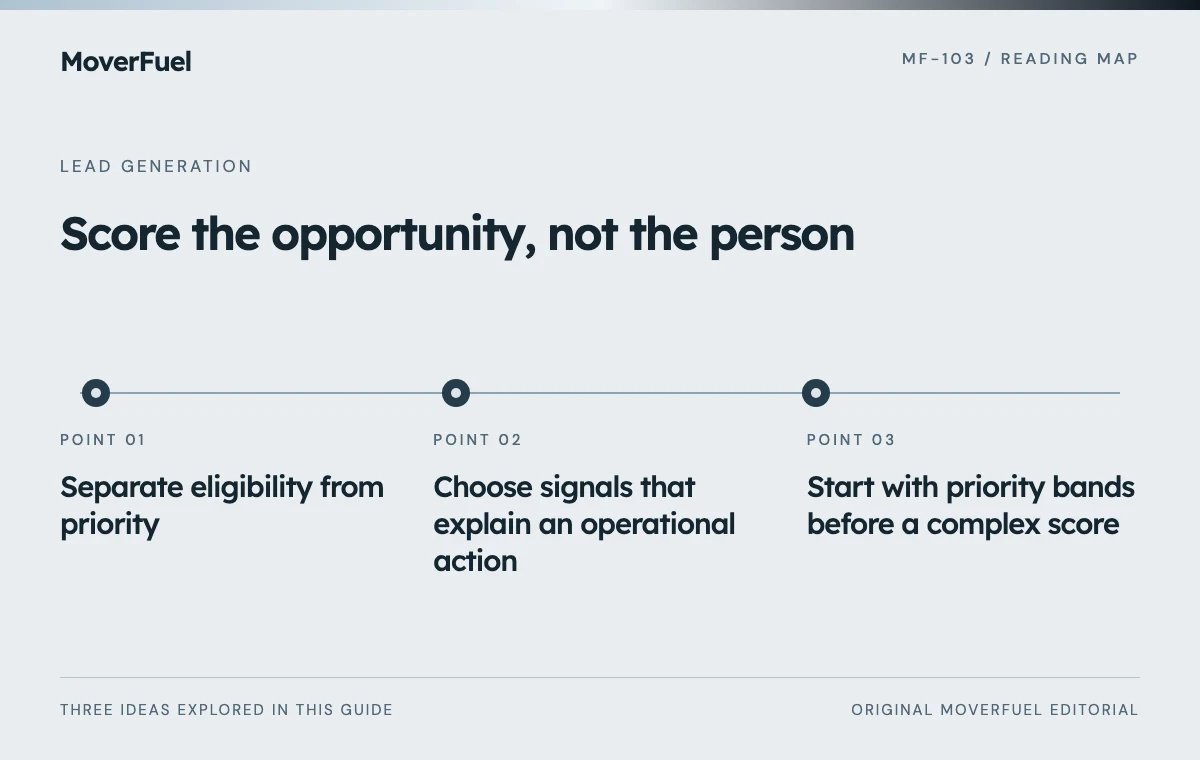
Separate eligibility from priority
Qualification asks whether the inquiry represents work the company can plausibly serve. Scoring asks how to prioritize eligible or still-uncertain opportunities. Mixing the two can cause a low score to be treated as a rejection even when the customer simply has not supplied enough detail.
Establish the moving lead qualification rules before designing a score. Record service, geography, timing and contact validity as explicit fields.
Google's qualified and converted lead categories describe stages in an advertiser's lead process. They do not prescribe a universal numerical score for moving companies. Define your own business stages accurately before sending any outcome signals to advertising systems. [1]
Scroll the table horizontally to compare all columns.
| Decision | Example | Appropriate action |
|---|---|---|
| Known service mismatch | A service the business does not offer | Explain the limitation and record the reason |
| Missing information | Destination area is not yet supplied | Ask for the missing detail |
| Qualified priority | Serviceable move with a near-term survey need | Assign an appropriate next action |
Choose signals that explain an operational action
Use information that changes the next useful action: a requested date, service fit, survey requirement, confirmed contact preference or a pending decision. Avoid adding fields simply because they are available in the CRM.
Treat unknown as unknown
A missing inventory does not prove that a lead is poor. A customer may be using a phone, researching on behalf of a parent or waiting for a lease date. Route missing information into clarification rather than automatically assigning the lowest possible priority.
Do not use sensitive characteristics or vague proxies for a customer's worth. A neighborhood label, writing style or device type can introduce unfair and commercially unhelpful assumptions. Focus on the work requested and the operational ability to serve it.
Scroll the table horizontally to compare all columns.
| Signal | Useful interpretation | Misuse to avoid |
|---|---|---|
| Move window | Schedule the appropriate response or survey | Assume every distant date is worthless |
| Service fit | Route to the right estimator | Reward only the largest-looking job |
| Information completeness | Identify what must be clarified | Treat missing detail as dishonesty |
| Next-step agreement | Follow through on a scheduled action | Treat a page view as a commitment |
Start with priority bands before a complex score
A small team may need three queues rather than a hundred-point formula: time-sensitive qualified work, routine qualified work and clarification needed. Give each queue an owner and a response expectation the team can meet. Keep existing-customer support separate from new-sales priority.
If a numerical score is useful, document each component, weight and threshold. Use a versioned rule set and show the reasons beside the score. The estimator should be able to explain why an opportunity is in a particular queue without asking a developer.
Avoid claiming predictive accuracy before testing it. A rules-based score is an operational classification until evidence shows how it relates to outcomes. Even a statistically evaluated model needs review when services, markets or customer behavior change.
Test the system without withholding service
Run the proposed rules in shadow mode while the team continues its normal handling. Compare suggested priorities with estimator judgment and eventual outcomes. Review false negatives carefully: useful work that the rules would have delayed or ignored.
Keep a human override with a reason field. An estimator may know that a commercial inquiry needs planning despite a distant date, or that a seemingly small local move is a good fit for an available crew. Capture that information to improve the rules rather than treating every override as noncompliance.
Review whether the score merely reflects the attention already given to a lead. If high-priority records receive better follow-up, their stronger outcomes do not by themselves prove that the original score correctly identified inherent quality. This feedback loop can reinforce a bad rule.
Scroll the table horizontally to compare all columns.
| Record | Purpose |
|---|---|
| Rule version and reasons | Reconstruct the original decision |
| Human override | Capture context the model missed |
| Handling received | Separate source quality from treatment |
| Mature outcome | Compare with actual estimates and work |
Deploy with a minimum service standard
Every legitimate inquiry should have an appropriate path, including those not placed at the top of the queue. Define what happens to clarification requests and older opportunities so they do not disappear indefinitely.
Monitor queue age, unassigned records, overrides and lost reasons. If the score creates a backlog or systematically misses a useful service category, revise it. Keep commercial outcome reporting separate from the operational score so the team cannot manufacture performance by changing a threshold.
Use automation for transparent routing and reminders before delegating consequential rejection decisions. An effective scoring system reduces ambiguity for the intake team while leaving room for the real circumstances of a move.
Common questions
Is lead scoring the same as lead qualification?
No. Qualification establishes fit; scoring prioritizes the next action among fit or uncertain opportunities. Keep explicit disqualification reasons separate.
Should low-scoring leads be automatically discarded?
Not by default. Check missing information, provide an appropriate service path and retain human review for uncertain cases.
Your next step
Make priority explainable, preserve an unknown state and test for useful jobs the rules might miss. A score should support intake judgment rather than replace it blindly.
Sources & editorial notes
Platform claims cite the documents below. Operating frameworks and labeled examples are MoverFuel editorial analysis, not client results or industry benchmarks.
- Google: qualified and converted leadsGoogle lead-stage definitions do not prescribe a mover-specific numerical scoring model. Priority system and safeguards are original recommendations. Reviewed .