
The customer's current location, the move origin and the destination are three different places. Treating them as the same thing can waste advertising spend or exclude valuable relocation inquiries. To reduce out-of-area leads, define the routes you can serve and trace where the mismatch enters the acquisition process.
 View full-size graphic ↗
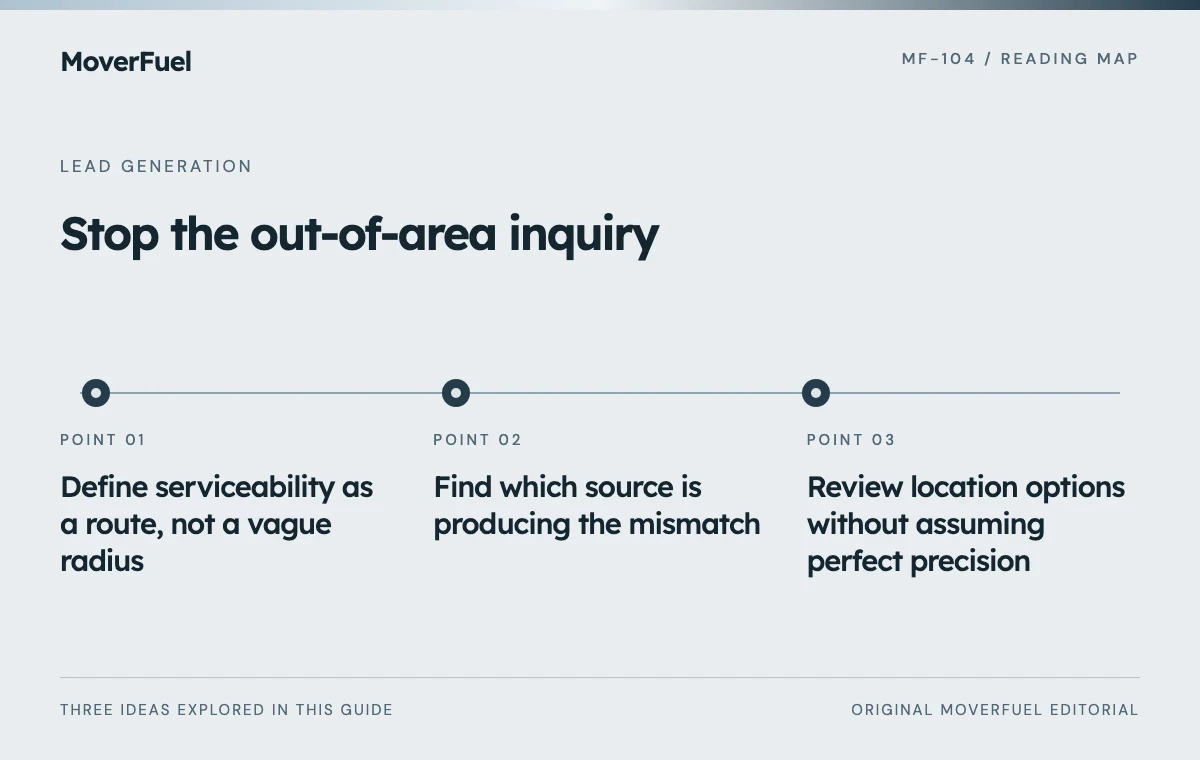
Define serviceability as a route, not a vague radius
Write the actual operating rules with the team responsible for estimating and dispatch. A local service may require both addresses within a defined area. A long-distance service may accept particular origins and wider destinations. Storage or labor-only work may have different boundaries.
Scroll the table horizontally to compare all columns.
| Field | What it describes | Why it can differ |
|---|---|---|
| Customer's current location | Where the person is searching or contacting you | They may be traveling or arranging a family move |
| Move origin | Where goods will be collected | May be a future or former residence |
| Move destination | Where goods will be delivered | May be outside the local service area |
| Operating branch | Which team can fulfill the work | May differ from the nearest office to the customer |
Create explicit examples of acceptable and unacceptable routes. If staff disagree on whether a move fits, the marketing system cannot reliably filter it. Resolve those decisions before changing campaign geography.
Find which source is producing the mismatch
Review a sample of unserviceable inquiries with source, landing page, origin, destination and disqualification reason. Separate truly out-of-area work from unavailable dates, unsupported services and incomplete information. Those should not all be labeled ‘bad location.’
Compare the customer record with the campaign or supplier specification. A form submitted from outside the region might still describe a serviceable move. Conversely, a customer physically inside the region may request transportation you do not offer.
Scroll the table horizontally to compare all columns.
| Pattern | Likely place to investigate |
|---|---|
| One campaign repeatedly attracts distant origins | Location options, queries and campaign promise |
| One page attracts unsupported routes | Coverage wording and internal links |
| One supplier ignores agreed geography | Buying specification and credit process |
| Many records lack origin or destination | Form and intake requirements |
| Staff classify the same route differently | Operational serviceability rules |
Review location options without assuming perfect precision
Google Ads distinguishes targeting people likely to be in or regularly in an area from targeting that also includes people showing interest in it. Google also states that location targeting uses multiple signals and is not guaranteed to be completely accurate. [1]
Choose settings around the acquisition model
For a tightly local offer, presence-based targeting may be worth testing when interest-based reach produces unsuitable demand. For inbound relocation work, people researching from elsewhere may be valuable. Do not apply one setting universally without examining the routes you want.
Inspect the actual campaign type and available controls in the current account. Keep service intent and geography aligned in the advertisement and destination page. Review exclusions carefully so they do not remove an origin or destination opportunity the operations team can serve.
After a change, monitor qualified route outcomes rather than only platform location reports. The purpose is fewer unserviceable inquiries at sustainable acquisition cost, not simply fewer clicks from unfamiliar places.
Make coverage clear before the customer submits
Describe coverage in plain language and avoid unsupported claims such as nationwide service when only selected routes are offered. If coverage depends on move type, say so. A long list of city names without an explanation can create more ambiguity than confidence.
Ask for origin and destination at the appropriate level of detail. Postal codes or city fields may be enough for an initial fit check; do not require a full address earlier than necessary. Explain why the information is needed and provide a path when a customer does not yet know the final destination.
Coordinate these changes with your moving quote form design so qualification improves without making the inquiry unnecessarily difficult.
For purchased leads, put origin and destination rules into the written specification. Record violations with enough evidence to use the agreed credit process. A supplier's generic geographic label may not match your operating definition.
Close the loop with reason-coded outcomes
Use distinct reasons for unsupported origin, unsupported destination, unsupported route and uncertain details. Review them by source and move type. This makes it possible to repair the specific promise or setting instead of broadly cutting a potentially useful market.
Track the share of inquiries requiring manual geographic clarification and the number of useful jobs that would have been excluded by a proposed filter. A stricter rule can reduce bad leads while also removing profitable work; both effects belong in the decision.
Revisit the rules when branches, capacity or service offerings change. Update advertisements, pages, forms, supplier specifications and intake documentation together. Geography is an operating agreement across the funnel, not a one-time checkbox in an ad account.
Common questions
Can location targeting eliminate every out-of-area inquiry?
No. Platform signals have limits, and customer location does not necessarily equal move geography. Combine targeting with clear coverage and intake questions.
Should we block every inquiry from outside our city?
Not automatically. The customer may be arranging a serviceable move from elsewhere. Evaluate origin, destination and the actual service requested.
Your next step
Reduce geographic waste by defining serviceable routes and correcting the point where the promise diverges from operations. Preserve useful relocation demand while tightening genuine mismatches.
Sources & editorial notes
Platform claims cite the documents below. Operating frameworks and labeled examples are MoverFuel editorial analysis, not client results or industry benchmarks.
- Google: advanced location optionsPresence versus presence-or-interest options and Google's stated limits on geographic accuracy. Route-serviceability framework is original. Reviewed .