
A customer asking for price is not automatically a low-quality lead. Moving is a significant purchase, and comparing estimates can be reasonable. The problem is when your marketing creates expectations that the service cannot meet or when the estimate conversation never explains what the customer is comparing. Improve that context before trying to repel everyone who asks about cost.
 View full-size graphic ↗
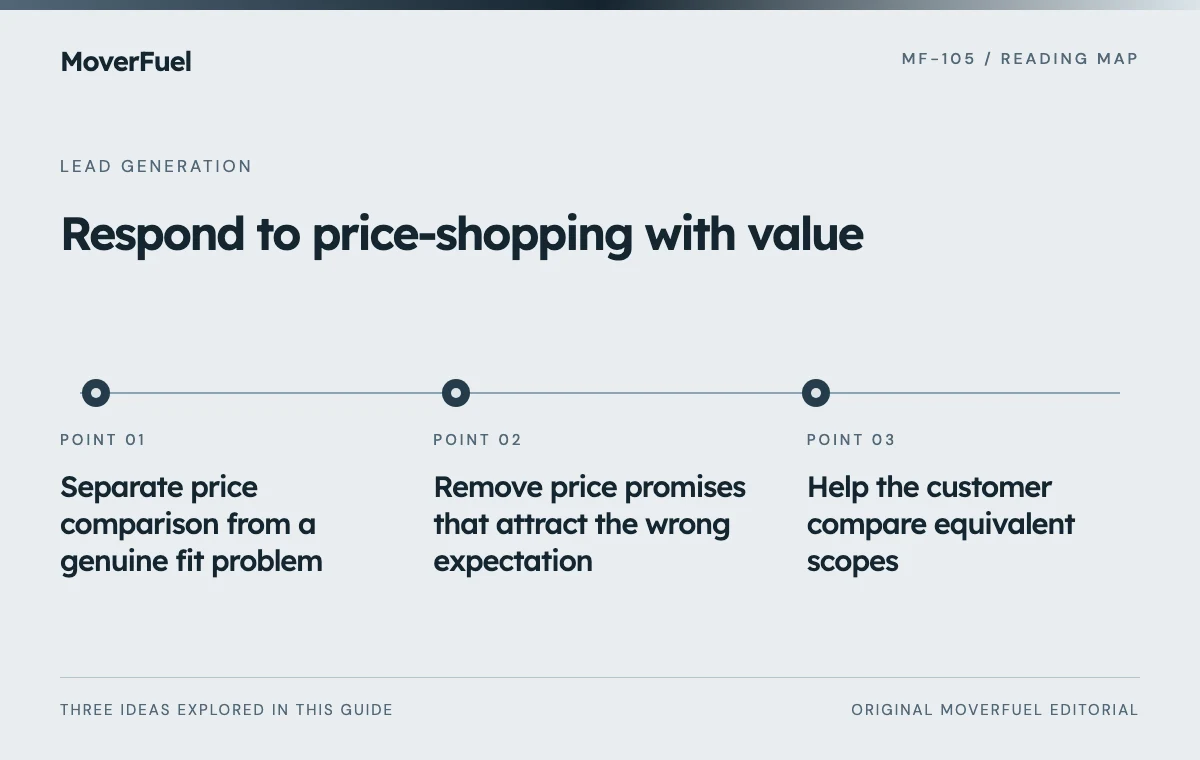
Separate price comparison from a genuine fit problem
Review actual conversations and lost reasons. A customer may be comparing different inventories, crew assumptions, packing responsibilities or service windows. Another may have a budget the company cannot serve. Those situations require different responses.
Scroll the table horizontally to compare all columns.
| Customer statement | Useful clarification | Avoid |
|---|---|---|
| Another mover quoted less | Are the scope and assumptions comparable? | Assuming the competitor is dishonest |
| I only need a rough idea | What details are needed for a useful estimate? | Inventing a precise price without scope |
| Can you reduce the cost? | Are there legitimate scope or scheduling options? | Promising a discount the business cannot honor |
| That is beyond my budget | Is there an offered service that genuinely fits? | Pressuring an unsuitable customer |
| Why does packing cost extra? | Explain what is included and who does the work | Hiding exclusions until booking |
Keep ‘price’ separate from ‘unknown’ in loss reporting. If the customer stopped responding, the team may not know why. Treating every unclosed inquiry as price shopping can conceal slow follow-up, unclear estimates or poor service fit.
Remove price promises that attract the wrong expectation
Audit ads and pages for language such as cheapest, instant final quote or flat rate when the actual offer does not support it. A low starting price without meaningful conditions can draw inquiries that were never a realistic match.
Explain the variables that matter to the estimate: move scope, access, timing, packing and the services requested. Only publish ranges or starting prices when the business has a defensible basis, clear inclusions and a process for keeping them current.
Describe value as a concrete service difference
Instead of saying ‘premium service’ repeatedly, explain the real preparation, communication or handling process. Use verified proof where available. A customer can compare an actual included service more easily than a vague claim that your company cares more.
Help the customer compare equivalent scopes
FMCSA's consumer guidance encourages customers planning interstate moves to research movers and understand the estimate process. That context supports a transparent comparison conversation; it does not justify a blanket rule that shoppers are undesirable. [1]
Provide a concise comparison checklist based on the services you actually offer. Ask customers to confirm inventory, access, packing, service dates and responsibilities across proposals. Avoid interpreting another company's contract or making unsupported claims about its practices.
Scroll the table horizontally to compare all columns.
| Item | Question to resolve |
|---|---|
| Goods and inventory | Are both estimates based on the same items? |
| Access | Are stairs, elevators and carrying conditions understood? |
| Packing | Who packs, supplies materials and unpacks if offered? |
| Schedule | What dates or windows are actually included? |
| Additional services | Which tasks are included, optional or excluded? |
| Terms | What documents explain payment and other conditions? |
The goal is clarity, not a script for discrediting cheaper competitors. If the scopes are genuinely comparable and the customer prefers another offer, record the outcome respectfully. Not every suitable inquiry will choose your company.
Give the team a useful response path
Train intake staff to acknowledge the price question, establish the scope and explain the next step. A practical response might be: ‘We can help you compare the options. First, let's confirm the items, access and services so the estimate reflects the move you need.’ Adapt the wording to the actual process.
If the company offers legitimate alternatives, explain them: a different available date, customer packing or a narrower service scope. Do not invent options or remove important protections simply to make the number smaller.
Use lead scoring as a prioritization tool, not as an automatic rejection system for anyone who asks about price.
When there is no suitable option, say so clearly and close the inquiry appropriately. A courteous decline can protect the team's time without disguising the reason or repeatedly pursuing a customer who has opted out.
Measure expectation fit rather than suppressing questions
Track how often estimates need major scope corrections, how many inquiries fall outside offered price or service boundaries and which marketing messages precede those mismatches. Review bookings and completed-work contribution alongside inquiry volume.
A clearer page may reduce raw submissions while increasing the share that reaches a useful estimate. It may also leave total volume unchanged but shorten repetitive explanation. Record the observed effect rather than assuming any drop in inquiries is an improvement.
Revisit pricing explanations when service costs, policies or capacity change. Keep marketing, estimating and operations aligned so customers hear a consistent account from the advertisement through the final proposal.
Common questions
Should we hide all pricing information to avoid shoppers?
Not automatically. Useful, supportable pricing context can improve expectations. Publish only information the business can explain and maintain accurately.
Is asking for several estimates a sign of a bad lead?
No. Evaluate service fit and intent. Comparison can be reasonable, particularly when customers need to understand different scopes and terms.
Your next step
Reduce mismatched expectations, not informed customers. Clear scope, credible value and a respectful estimate conversation help the right buyers make a sound decision.
Sources & editorial notes
Platform claims cite the documents below. Operating frameworks and labeled examples are MoverFuel editorial analysis, not client results or industry benchmarks.
- FMCSA: tips for a successful moveInterstate moving consumer guidance on researching movers and understanding estimates. Sales workflow and scope worksheet are original recommendations. Reviewed .