
A search-term report becomes useful when it produces an explainable action. A list of unusual phrases is not enough. For each pattern, ask whether the customer task fits the company, whether the destination answers it and what the available sales evidence says. Then choose to exclude, improve, expand or keep observing—with a reason another person can review.
 View full-size graphic ↗
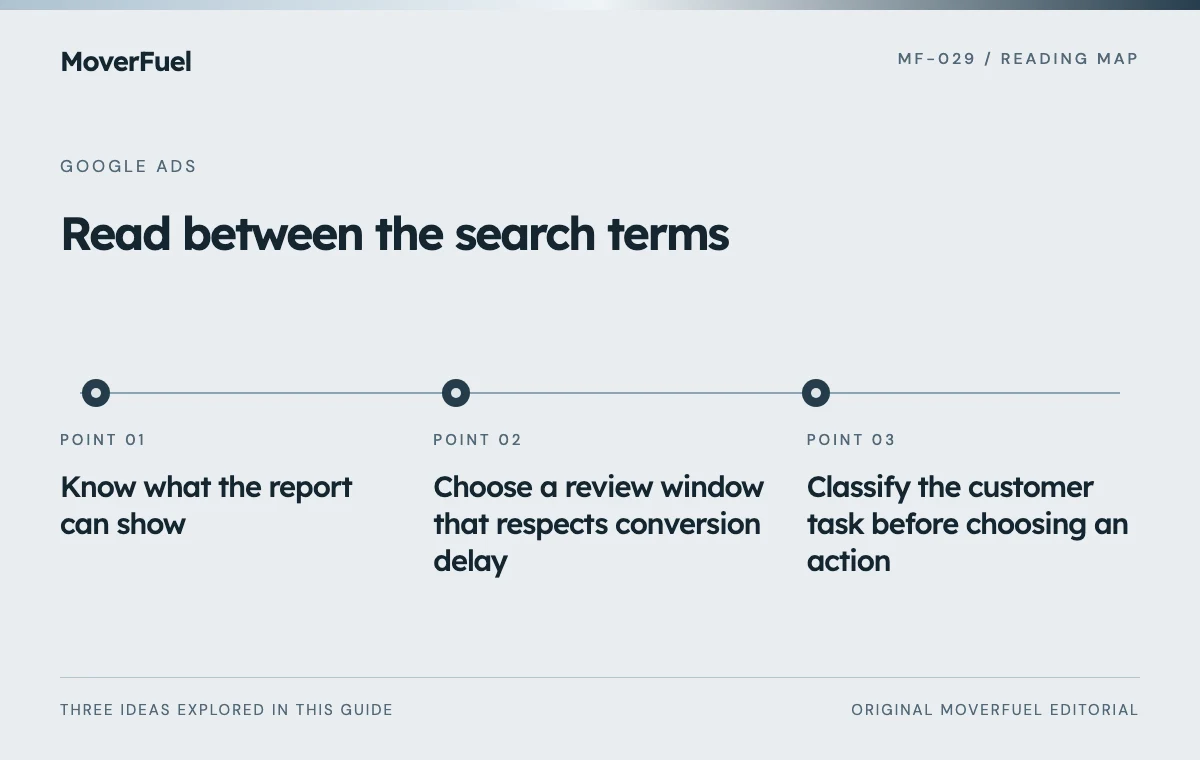
Know what the report can show
A search term is the user’s query; a keyword is an advertiser’s targeting input. Google’s report can show which keyword matched a visible query, but some low-activity queries are omitted for privacy. Search terms insights group demand into themes and can include aggregated information that does not expose individual queries. [1]
Treat the report as a useful view of demand, not a complete customer transcript. Do not promise to identify the exact search behind every call. Where your systems only support campaign-level attribution, analyze at that level and label the limitation.
Choose a review window that respects conversion delay
Set the date range and cost basis before exporting. Recent traffic is useful for catching obvious incompatibility or broken destinations. It is less reliable for judging eventual bookings when customers are still gathering estimates.
Keep separate views for immediate quality control and mature outcome evaluation. A query that has spent money today without a booking may simply be too new to assess. A query clearly seeking employment can be incompatible immediately, regardless of sales delay.
Record what else changed
Note budget changes, new ads, altered service areas, unavailable dates and sales staffing. The same query theme can produce different outcomes when the offer or response process changes. Without this context, every fluctuation can be misdiagnosed as a keyword problem.
Classify the customer task before choosing an action
Scroll the table horizontally to compare all columns.
| Query theme | Interpretation to verify | Action candidate | Reason |
|---|---|---|---|
| Office movers near me | Commercial project request | Improve destination | Current page explains only household moves |
| Moving truck rental | Vehicle rental request | Exclude if not offered | Service incompatible with a full-service-only mover |
| Packing help before a move | Potential packing service | Investigate or expand | Offer and staffing need confirmation |
| Moving company careers | Employment request | Exclude from acquisition | Different campaign purpose |
| Cost to move an apartment | Price comparison for possible purchase | Observe and clarify | Price research alone does not establish poor fit |
Use themes to avoid reviewing every spelling as a separate business decision. Preserve the individual query evidence where useful, but group related requests into a task the estimator can understand. Ask sales whether the pattern reflects work the company wants.
Keep an unresolved category. Ambiguous language may need more evidence, a clearer landing page or a call review conducted under the company’s approved practices. Guessing a customer’s intent with certainty can lead to broad exclusions that are difficult to reverse.
Connect the available evidence without inventing precision
Compare visible themes with serviceability, contactability and booking reasons at the granularity your systems support. If several campaigns feed one undifferentiated inbox, first improve attribution and disposition. A sophisticated query spreadsheet cannot recover facts that were never recorded.
Distinguish unsuitable demand from unsuccessful selling. A customer outside coverage, a valid customer whose call went unanswered and a suitable customer who selected another provider should not all be labeled “bad keyword.” Each outcome suggests a different owner for the next action.
Use the qualified moving leads definitions to make sales feedback consistent. The query review should consume that information rather than inventing a separate qualification standard.
Keep customer details out of shared review files when aggregate reasons answer the question. A campaign analyst usually needs the fit pattern and outcome, not a household’s full address or personal moving circumstances.
Choose among four actions and document the risk
Exclude a clearly incompatible request with appropriate match behavior and scope. Improve the ad or page when the request fits but the promise is weak. Expand through a controlled test when a useful theme appears underrepresented. Observe when the evidence is insufficient.
Scroll the table horizontally to compare all columns.
| Field | Purpose |
|---|---|
| Observed theme | The specific problem or opportunity |
| Evidence | Query data and available sales feedback |
| Change | Text, destination, exclusion or bounded expansion |
| Collateral risk | Useful demand that might be affected |
| Owner and date | Who implements and reviews it |
| Success condition | The outcome expected to change |
Check proposed exclusions against services the company offers elsewhere in the account. A warehouse term might be wrong for a household group and right for a commercial campaign. Apply the smallest scope that enforces the intended boundary.
Build a review cadence around decisions, not ritual
Use more frequent checks after a launch, major targeting change or sudden lead-quality issue. Use a cadence appropriate to volume once the campaign stabilizes. A fixed weekly meeting is not useful if no one can supply dispositions or implement decisions.
At the next review, revisit prior changes before adding more. Did the incompatible pattern fall? Did suitable opportunity volume also fall? Did a clearer page improve estimate progression? This closes the loop and prevents an ever-growing negative list with no evidence of its effect.
Report the most consequential findings in plain language. “Rental requests were reaching a full-service campaign; we narrowed the exclusion and retained labor-loading demand” tells the operator more than a count of keywords added. The review is successful when it improves a decision about work, not when it generates a longer export.
Common questions
Why are some searches missing from the report?
Google omits some low-activity queries for privacy and may represent demand in aggregated insights. The visible query list is not a complete record of every search interaction.
Should every expensive query with no booking be excluded?
No. Allow for conversion delay, sample size and the reason the opportunity did not book. Clearly incompatible intent differs from a suitable request that has not yet matured.
Your next step
Review queries as customer tasks, connect only the evidence your systems can support and record a specific action. Revisit the outcome before making the next round of changes.
Sources & editorial notes
Platform claims cite the documents below. Operating frameworks and labeled examples are MoverFuel editorial analysis, not client results or industry benchmarks.
- Google: search terms reportSearch terms versus keywords, privacy omissions, grouped insights and report match-type interpretation. Reviewed .