The right image depends on what the page asks the viewer to believe. A photo used as proof of your crew should show your actual approved crew. A generic illustration explaining a planning step may not need a real customer scene. Make that distinction before deciding whether real photography or stock is the better choice.
 View full-size graphic ↗
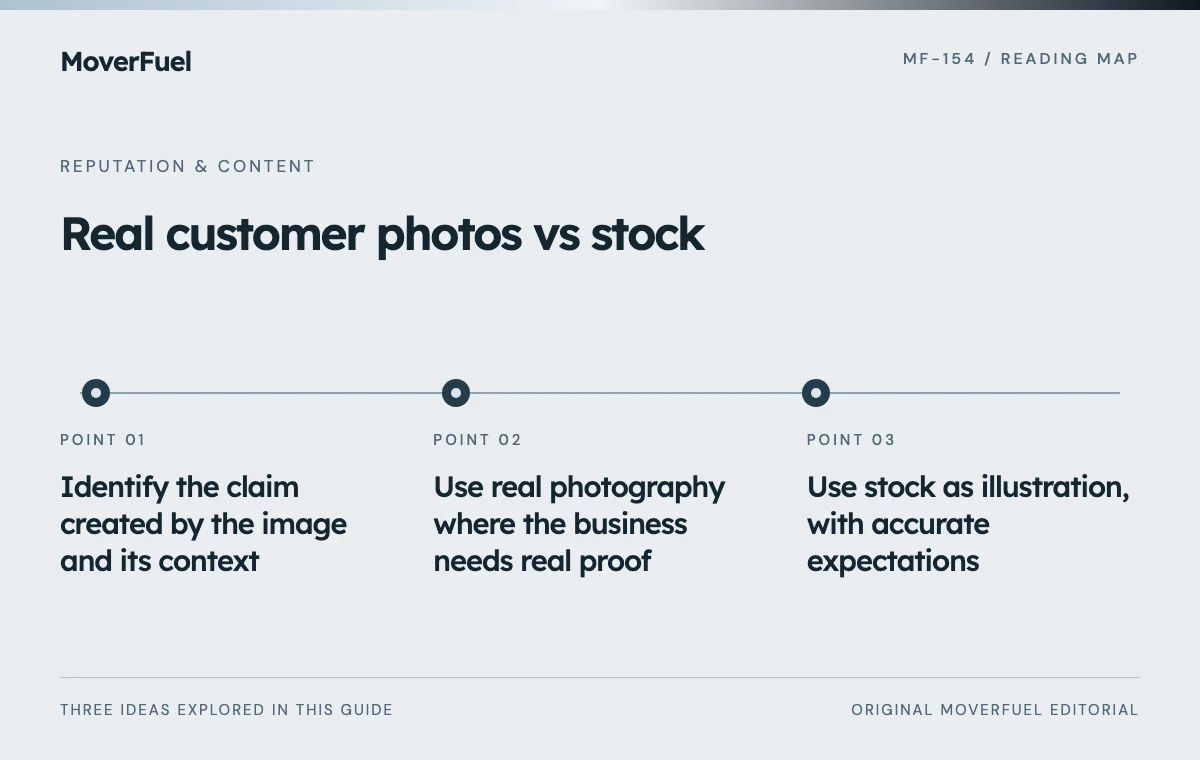
Identify the claim created by the image and its context
An image can imply a fact even when the caption says very little. A stock fleet beside ‘our trucks’ suggests ownership. A staged living room beside a named case study can imply that it belongs to that customer. Review the image, nearby text and page purpose together.
Scroll the table horizontally to compare all columns.
| Use | Preferred evidence | Acceptable alternative with clear context |
|---|---|---|
| Meet the team | Approved current team photography | A truthful text introduction until imagery exists |
| Describe a generic planning concept | Purpose-built illustration or relevant photo | Licensed stock that does not imply client proof |
| Show a completed project | Approved real project material | A clearly labeled concept, kept separate from verified work |
| Explain equipment or service process | Actual approved process imagery | Accurately labeled demonstration |
| Provide atmospheric background | Appropriate licensed or owned scene | Illustration that does not misrepresent operations |
FTC advertising guidance requires truthful, supported claims. Apply that standard to implied visual claims as well as headlines. A technically licensed image can still be misleading in the way it is presented. [1]
Use real photography where the business needs real proof
Actual crew, equipment and process images can answer who will arrive and what the company does. They are especially useful on service and about pages when the setting and people remain current. Their value comes from accurate context, not from being unpolished.
Real does not automatically mean publishable
A live-job image may reveal a customer's address, documents or possessions. Confirm the relevant permissions and remove private details before considering it for marketing. Also verify the photographer's rights and any restrictions on paid advertising.
Do not ask a crew member to capture a risky moment or distract from the job for a photo. If the scene cannot be photographed safely and appropriately, use a controlled demonstration or another explanatory format. The content plan should fit the operation, not interfere with it.
The crew and truck photography guide provides a shot-list and asset-management workflow.
Use stock as illustration, with accurate expectations
Stock can support a general concept or atmosphere when original material is unavailable or unnecessary. Choose imagery that fits the service without implying a specific customer, crew, location or outcome. Avoid a polished image that depicts equipment or a service the business does not actually offer.
Check the license for the intended use, edits, distribution and any restrictions. Copyright Office guidance explains that photographs can be protected works and that permission or licensing is separate from simply obtaining a file. [2]
Scroll the table horizontally to compare all columns.
| Check | Question |
|---|---|
| Implied identity | Could viewers mistake these people for our staff? |
| Implied project | Does the placement suggest a verified customer job? |
| Service accuracy | Does the scene match the work described? |
| License | Does it cover this commercial use and edit? |
| Context | Would a caption or different placement prevent confusion? |
If clarity depends on a tiny disclaimer that conflicts with the main visual impression, choose a different image or layout. A straightforward illustration often explains a process more honestly than a generic scene made to resemble proof.
Evaluate communication quality after accuracy
Once the image is accurate and permitted, assess whether it helps the reader understand the page. Check the subject, crop, contrast and placement on mobile. A relevant detail can be lost when a wide scene is reduced to a small card.
Use alt text according to the image's role. An informative image needs a meaningful description; a decorative background should not add repetitive noise for assistive technology. Do not fill alt text with service keywords unrelated to what the image communicates.
For generated illustrations, apply the same accuracy and disclosure principles. Do not use synthetic people or scenes as evidence of real customers, staff or completed work.
Track provenance and review the library over time
Keep the asset's origin, rights record, approved uses, context and review date. Retain original files and edited versions separately. The person publishing a campaign should be able to confirm whether the asset is proof, stock or an illustration without guessing from its filename.
Review images when staff, branding, equipment or service scope changes. A once-accurate team photo can become misleading if it continues to imply that departed staff will serve customers. Update the context or retire the asset as appropriate.
Evaluate usefulness through customer understanding and relevant conversion research, not an unsupported rule that every real image outperforms every stock image. The task, execution and context determine what should be tested.
Coordinate website design and creative production so the same asset does not acquire contradictory meanings across channels.
Common questions
Are stock photos always bad for a moving website?
No. They can illustrate a general concept when licensed and presented accurately. They should not masquerade as the company's staff, fleet, customers or verified project results.
Does owning a customer photo mean I can use it anywhere?
Not necessarily. Image rights, subject permissions, privacy and usage restrictions need separate review for the intended placement.
Your next step
Choose images by the claims they create. Use real approved material for real proof and clearly contextualized illustration where proof is not the purpose.
Sources & editorial notes
Platform claims cite the documents below. Operating frameworks and labeled examples are MoverFuel editorial analysis, not client results or industry benchmarks.
- FTC: advertising and marketingFTC guidance requires truthful, substantiated advertising claims, including the overall presentation. Reviewed .
- US Copyright Office: What is Copyright?Copyright Office guidance distinguishes protected photographs and permission/licensing from possession of a file. Reviewed .