
A website visit does not mean someone still needs a mover. They may have booked, moved already, researched a job opening or arrived outside your service area. Retargeting is useful only while the offer remains relevant and the audience can be formed and used appropriately. Begin with a re-engagement task, not every visitor the platform can collect.
 View full-size graphic ↗
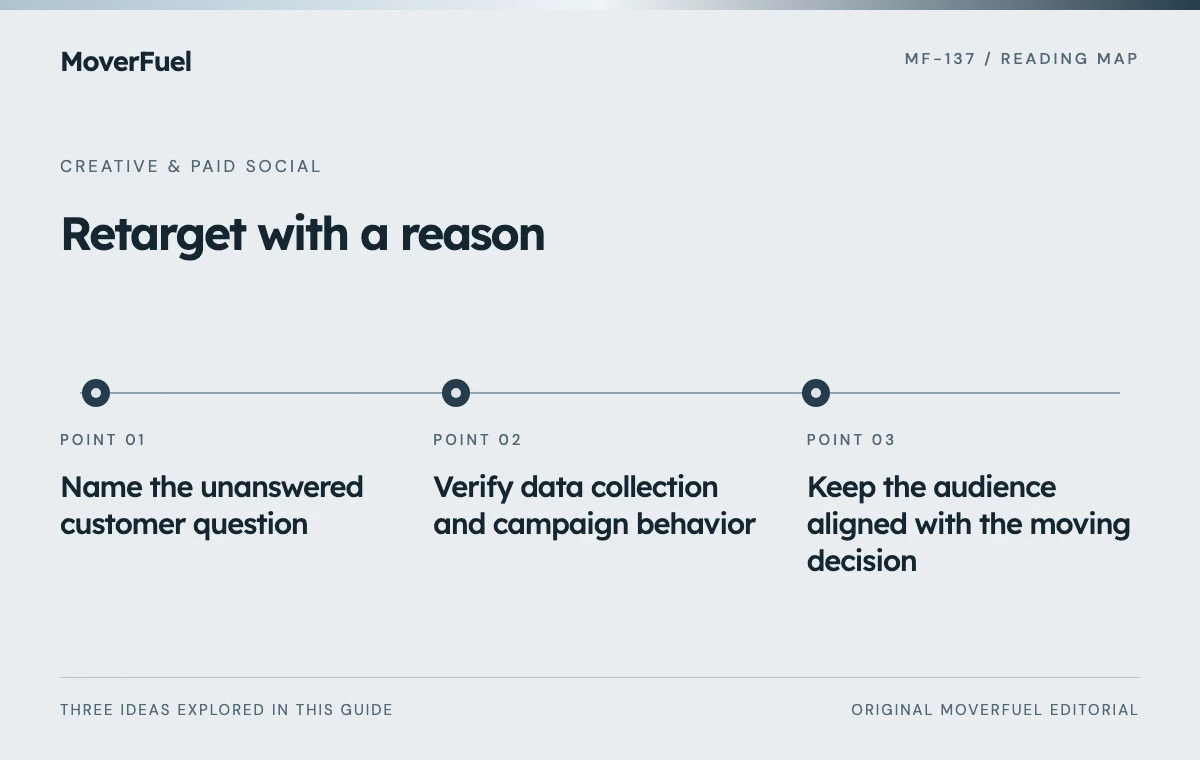
Name the unanswered customer question
Choose a reason to show another message: explain the estimate process, clarify packing services or provide verified operational proof. An ad that repeats the company name without helping the decision may add impressions without resolving anything.
Scroll the table horizontally to compare all columns.
| Observed behavior | Possible useful message | Important limitation |
|---|---|---|
| Viewed a local moving service page | Explain the estimate next step | A page visit does not confirm an active move |
| Read packing information | Clarify available packing scope | Research interest is not purchase intent |
| Started but did not complete an inquiry | Offer a clear route back to the request | Verify tracking and avoid assuming abandonment cause |
| Visited commercial relocation content | Explain survey and project planning | Longer decisions may need a different relevance window |
Treat these as hypotheses. Do not infer sensitive personal circumstances from a page visit or use messaging that implies the company knows private details about the person. Keep the creative focused on the service and the customer's voluntary next step.
Verify data collection and campaign behavior
Google's data-segment documentation describes rules for adding website visitors and a membership duration. It also notes that serving eligibility depends on the network and segment conditions. A website's total traffic is not the same as an eligible advertising audience. [1]
For each platform, verify the current collection method, required notices and permissions, audience eligibility, exclusions and whether selected audiences restrict delivery or merely influence expansion. Do not label an expanded campaign a pure retargeting test without checking how it actually serves.
Test the permitted data flow
Confirm that the site's consent behavior and the platform configuration match the reviewed requirements. Inspect what events and fields are transmitted. A technically accepted event is not proof that collecting or using it is appropriate. Avoid sending private form content to advertising tools.
If the audience is too small to serve reliably, do not force it by extending relevance indefinitely or combining unrelated visitors. A broader acquisition campaign or a better website may be the more appropriate use of the budget.
Keep the audience aligned with the moving decision
Scroll the table horizontally to compare all columns.
| Condition | Planning response |
|---|---|
| Already booked | Remove from prospect messaging where supported and appropriate |
| Requested no marketing | Apply the applicable suppression process |
| Known service mismatch | Avoid continuing an irrelevant offer |
| Old or expired moving need | Review the relevance window |
| Employee, vendor or recruitment traffic | Separate from customer acquisition where practical |
| Active service issue | Avoid promotional pressure; route to support |
Exclusions depend on reliable identifiers, current records and supported platform controls. They are not a guarantee that every person will stop seeing an ad immediately. Test the update path and document gaps rather than promising perfect suppression.
Google recommends choosing membership duration in relation to how long the offer is relevant and the sales cycle. For movers, use your observed inquiry-to-decision patterns and service differences; do not copy a maximum platform duration as the default business choice. [1]
Control repetition and offer fatigue
Review reach, frequency where available, spend and customer feedback together. A small audience can receive repeated impressions quickly. Verify the campaign's supported controls rather than assuming every objective offers the same frequency cap or placement behavior.
Rotate messages when they answer a different useful question, not simply to make repeated ads look new. Remove outdated availability or seasonal offers promptly. A customer who has already decided should not keep seeing a claim that a previous move date is still available.
Use creative and video production to supply accurate explanations and approved proof, with Facebook Ads management reviewing the actual delivery settings.
Judge the additional value cautiously
People who previously visited the site may already be more likely to book. A high attributed conversion rate therefore does not prove that the ads caused all those bookings. Keep platform-reported credit separate from unique business outcomes.
Where scale and supported tools permit, use a controlled comparison to estimate additional value. Otherwise report the observed association and its limits. Record spend, deduplicated inquiries, mature bookings and contribution, including overlap with search and direct return visits.
Pause or revise a campaign when the message is no longer relevant, the audience cannot be maintained reliably or the economics do not justify the spend. Retargeting should earn its place in the plan rather than run indefinitely because its dashboard looks efficient.
The marketing attribution guide explains why assigning credit and proving incrementality are separate tasks.
Common questions
How long should movers retarget website visitors?
Choose a relevance window from the service and observed decision cycle, subject to current platform and legal limits. The platform's maximum duration is not a recommendation for every moving campaign.
Why can retargeting look better than prospecting?
It reaches people with prior interaction, who may already be more likely to convert. Compare additional value carefully rather than treating a higher attributed rate as proof of causal lift.
Your next step
Retarget a defined, relevant decision with appropriate data and maintained exclusions. Measure the campaign's contribution honestly and stop paying for messages whose usefulness has expired.
Sources & editorial notes
Platform claims cite the documents below. Operating frameworks and labeled examples are MoverFuel editorial analysis, not client results or industry benchmarks.
- Google Ads: How your data segments workGoogle documents website segment rules, eligibility and membership duration, recommending duration aligned with relevance and the sales cycle. Reviewed .