
The most useful way to discuss marketing mistakes is to connect each one with a failure signal and a reproducible check. A moving company can waste money by targeting work it cannot serve, but it can also waste suitable demand through a broken form or an unowned estimate. Diagnose the point of loss before deciding that the solution is a different channel or a larger budget.
 View full-size graphic ↗
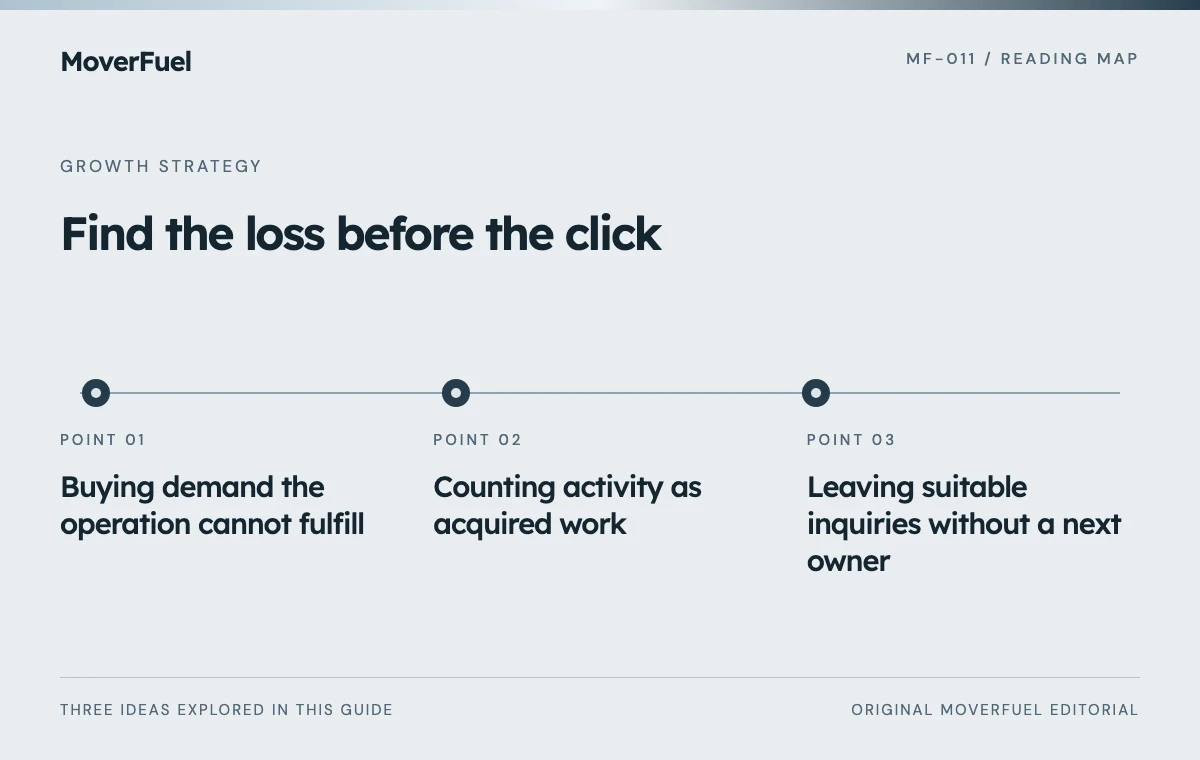
Buying demand the operation cannot fulfill
A campaign may accurately reach people looking for movers while promoting the wrong service, route or date for your operation. Review the offer with dispatch and sales. Confirm what work is accepted, which exceptions are possible and what the customer is told before submitting a request.
Do not infer job fit solely from the searcher's device location. Google's geographic settings use presence and interest signals with stated accuracy limitations. A person outside the local area may be planning a serviceable move, while a nearby person may request an unsupported destination. Inspect the actual inquiry before changing exclusions. [1]
Scroll the table horizontally to compare all columns.
| Failure signal | Check | Likely owner |
|---|---|---|
| Unsupported service requests | Compare search terms, page promises and disposition accuracy | Campaign and content leads |
| Unavailable dates | Compare the offer with dispatch's saleable calendar | Operations and marketing |
| Unsuitable routes | Review both origin and destination, not only device location | Intake and campaign leads |
Counting activity as acquired work
Clicks, calls and form submissions describe interactions. They do not establish that the business can serve the request or that a customer accepted an estimate. A report becomes misleading when it presents every interaction as a new qualified lead or every booking as completed revenue.
Check whether one customer creates several counted leads
Trace a known record through the website, call system and CRM. A customer may submit a form and then call; an integration may also create an imported event. Decide which events are useful observations and which represent the unique acquisition outcome. Keep stable identifiers and document the deduplication rule.
Google's qualified and converted lead concepts support deeper outcome distinctions, but the labels still depend on business definitions and reliable data. Fix the definition before using the reported total to justify more spending. [2]
Leaving suitable inquiries without a next owner
Review what happens after the customer acts. A form can display a confirmation while a notification fails. A call can connect to a line that nobody is assigned to cover. An estimator can receive a record without enough information to know the next step. These failures can make a productive source appear weak.
- Test the form's record creation and delivery, not only its visual confirmation.
- Check call routing during the hours the company says it responds.
- Identify a backup owner for absences and overflow.
- Review unresolved inquiries with dates and next actions.
- Keep service mismatch separate from a failure to reach the customer.
The marketing funnel audit provides a step-by-step way to trace those handoffs.
Publishing claims the business cannot substantiate
Review statements about coverage, availability, experience, credentials, customer results and reviews. Each should have an accountable source inside the business or an appropriate public record. A copied competitor claim can become inaccurate even when it sounds like ordinary marketing language.
The FTC's review and testimonial guidance addresses deceptive practices involving customer evidence. Do not manufacture reviews, imply an endorsement that was not given or present a fictional example as a client result. Label concepts and illustrative calculations so the reader understands what they demonstrate. [3]
Operational claims also need review. ‘Available this weekend’ should reflect an approved offer, and ‘nationwide service’ should not hide route restrictions. Where a claim depends on legal or regulatory status, obtain the appropriate factual and professional review instead of improvising the wording.
Scroll the table horizontally to compare all columns.
| Claim | Evidence needed | Owner |
|---|---|---|
| Service coverage | Current operating boundaries and exceptions | Operations |
| Customer testimonial | Authentic statement and permission for the intended use | Authorized business contact |
| Performance result | Defined metric, period and verified underlying records | Reporting owner |
| Availability | Current offer and confirmation process | Dispatch or sales |
Changing so much that the result cannot be interpreted
If pricing, targeting, page copy, qualification rules and sales coverage all change together, a booking movement becomes difficult to explain. Some simultaneous changes are unavoidable, but record them. Do not attribute the entire result to the campaign edit that happens to appear in the advertising log.
Define the question behind a test. Identify the main change, the outcome to observe and the other conditions that may affect it. Allow for the service's sales cycle. An incomplete inquiry cohort should not be treated as a finished experiment just because the calendar month ended.
A result can be inconclusive. That is a useful finding when it prevents an unsupported claim. Decide whether more observation, a cleaner test or a different question is warranted instead of announcing a winner from a small unexplained difference.
Build controls before increasing the budget
Create a short pre-change checklist for material launches: approved offer, working destination, tested routing, defined conversion events and a responsible review owner. Use the same checks after changes to phone systems, forms, CRM integrations or service coverage.
Scroll the table horizontally to compare all columns.
| Risk | Routine control | Verification |
|---|---|---|
| Demand mismatch | Keep an approved service-market brief | Sample inquiry reasons against the brief |
| Lost inquiries | Test routing after changes | Confirm one record reaches the intended owner |
| Misleading totals | Maintain event definitions and identifiers | Reconcile known records across systems |
| Unclear causality | Record material changes and assumptions | Review mature outcomes with context |
Prioritize the failure with the clearest business consequence and strongest evidence. Some companies need better demand; others need to stop losing the demand they already have. A disciplined prevention routine makes that difference easier to see before the next spending decision.
Common questions
Is a high cost per lead always a marketing mistake?
No. It needs context: service fit, booking outcomes, contribution and the cost definition. A cheaper source can be less valuable if it produces unsuitable inquiries or requires substantially more sales effort.
Should we pause every campaign when tracking looks wrong?
Assess the scope and consequence of the defect. Resolve known measurement failures before using the affected numbers for optimization or scaling. The operating response should match what is broken, not a blanket rule.
How can we distinguish a source problem from an intake problem?
Review actual inquiries against service-fit criteria, then trace response and estimate handling. Unsuitable demand and unhandled suitable demand leave different evidence and need different owners.
Your next step
Translate a suspected mistake into an observed failure, a reproducible check and an accountable owner. Repair the loss and verify the result before buying more traffic. That sequence is more useful than a universal list of tactics to avoid.
Sources & editorial notes
Platform claims cite the documents below. Operating frameworks and labeled examples are MoverFuel editorial analysis, not client results or industry benchmarks.
- Google: advanced location optionsGeographic targeting options and accuracy limitations. Reviewed .
- Google: qualified and converted leadsDistinguishing lead stages from raw interactions. Reviewed .
- FTC: reviews and testimonials rule FAQAuthenticity and deceptive-practice considerations for reviews and testimonials. Reviewed .