
A customer who needs to move tomorrow may be urgent but impossible to serve. Another planning three months ahead may be ready to schedule a survey and choose a provider. High intent is not simply urgency, a long form submission or a specific search phrase. It is evidence that a person has a real moving need and is willing to take a relevant next step.
 View full-size graphic ↗
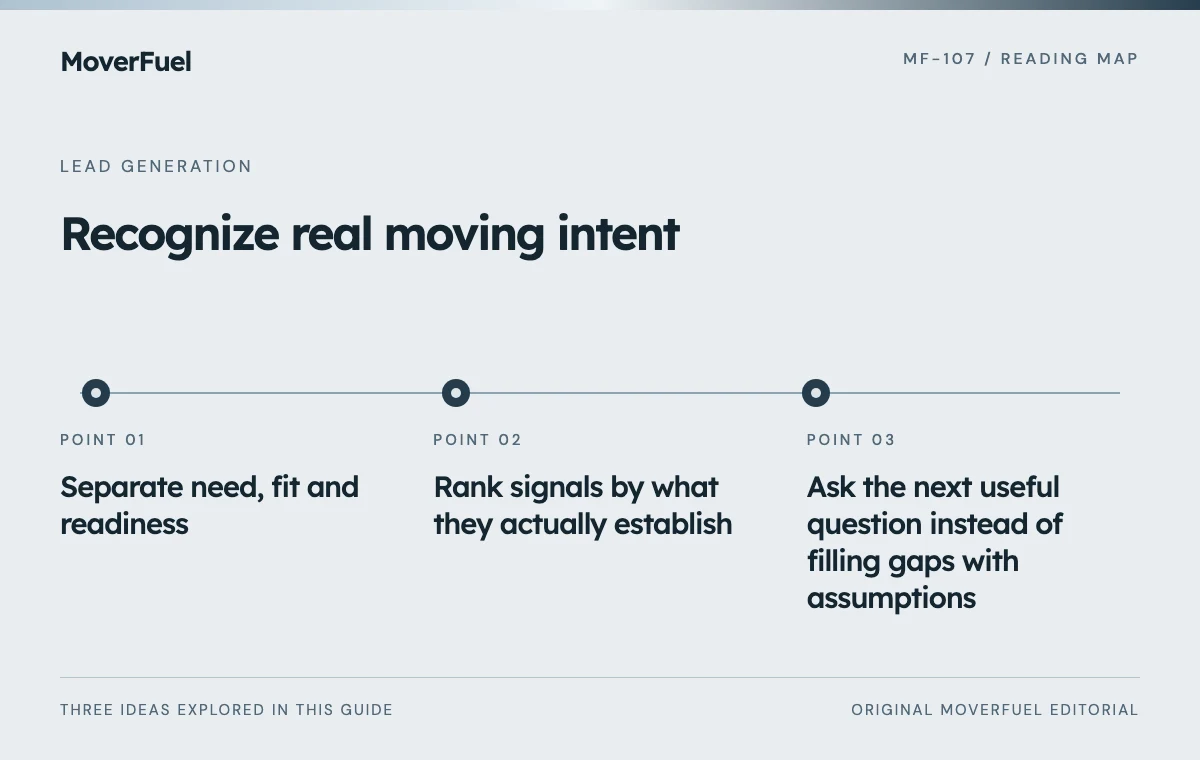
Separate need, fit and readiness
Need describes the move the customer is trying to arrange. Fit describes whether your company can serve it. Readiness describes the next decision or action the customer is prepared to take. Keeping these dimensions separate prevents an urgent but unsuitable inquiry from crowding out a useful future project.
Scroll the table horizontally to compare all columns.
| Dimension | Evidence to seek | Question it cannot answer alone |
|---|---|---|
| Stated need | Move type, route and likely timing | Will this person choose us? |
| Service fit | The business can plausibly fulfill the request | Is the customer ready for an estimate? |
| Readiness | Agreement to a relevant next step | Will the move ultimately complete? |
| Constraints | Unknown date, decision-maker or destination | Is the customer dishonest or low value? |
Google's GA4 event recommendations distinguish a generated lead from qualification and active contact. That separation is useful because an initial submission does not establish every later stage of the customer relationship. [1]
Rank signals by what they actually establish
A stated moving date is more specific than a page view, but it can still change. A scheduled survey is evidence of an agreed action, but the customer may cancel. Treat each signal as evidence with limits rather than converting it into an unsupported probability of booking.
Scroll the table horizontally to compare all columns.
| Signal | Reasonable interpretation | Overreach |
|---|---|---|
| Reads a pricing article | Research interest | Definitely ready to hire |
| Submits route and timing | A stated moving requirement | Verified serviceability and budget |
| Answers scoping questions | Willingness to progress | Guaranteed booking |
| Agrees to a survey | A concrete next-step commitment | Completed sale |
| Asks detailed comparison questions | Active evaluation | Only interested in the cheapest mover |
Interpret behavior in context
Repeated visits may reflect careful evaluation, a shared device or confusion. A short phone call may be enough to arrange a survey. A lengthy conversation may concern an existing booking. Behavioral data is useful for forming questions, not for reading a person's mind.
Search language also has limits. A phrase containing ‘quote’ may indicate commercial interest, but the requested route or service can still be unsuitable. Do not use a keyword label to bypass actual qualification.
Ask the next useful question instead of filling gaps with assumptions
Identify which missing detail prevents progress. If the customer lacks a final destination, establish the likely area and when it will be known. If a coordinator is collecting options, ask who needs to participate in the next discussion. These questions should help scope the move, not interrogate the customer's seriousness.
Use a respectful conversation sequence: understand the need, confirm fit, explain the process and agree on the next action. Keep room for customers arranging a move for someone else or working around uncertain property dates.
Once intent and fit are clearer, use an explainable lead-priority system to organize work without automatically discarding uncertain opportunities.
Match the response to the customer's decision stage
A research-stage customer may need a clear explanation of the estimate process. A serviceable customer with enough scope may need a survey or proposal. A customer comparing estimates may need help understanding inclusions. Sending everyone the same aggressive booking request ignores those differences.
Scroll the table horizontally to compare all columns.
| Current evidence | Useful next action |
|---|---|
| General research with no move details | Offer relevant planning information |
| Real move with missing scope | Request the specific details needed |
| Fit and scope established | Arrange the appropriate estimate step |
| Estimate received, questions unresolved | Address the actual comparison or concern |
| Customer declines contact | Respect the preference and update the record |
Do not equate persistence with usefulness. Repeated contact without a new reason can damage the relationship. Follow the customer's preferences and applicable contact requirements, and make the next step clear when a conversation ends.
Check whether your labels help the team
Review a sample of records initially labeled high, uncertain and low intent. Compare the evidence available at the time, the handling each received and the eventual outcome. Look for patterns where useful customers were underestimated or activity was mistaken for commitment.
Update the rubric with examples from real, appropriately handled records. Keep definitions understandable to new staff. A label that different team members interpret differently cannot support reliable reporting or automation.
Report intent assessments as assessments. Only describe a booking, completed job or revenue outcome when the corresponding event has actually occurred. Good marketing intelligence preserves the boundary between evidence, inference and result.
Common questions
Does an urgent move always mean high intent?
Urgency indicates timing pressure, not necessarily fit or readiness to choose your company. Confirm the requested service and feasible next step.
Can someone comparing several movers still be high intent?
Yes. Detailed comparison can be part of active evaluation. Assess the move and the customer's willingness to progress rather than penalizing comparison itself.
Your next step
Assess intent from specific evidence and preserve uncertainty. The purpose is to choose a helpful next action, not to predict a booking with unjustified confidence.
Sources & editorial notes
Platform claims cite the documents below. Operating frameworks and labeled examples are MoverFuel editorial analysis, not client results or industry benchmarks.
- Google Analytics: recommended eventsDistinct lead-generation, qualification and contact event stages. Intent rubric and examples are original analysis, not a validated predictive model. Reviewed .