
The reason to hire a marketing manager is a recurring business responsibility that needs an accountable owner. It is not simply that the company has reached an arbitrary truck count or advertising budget. Identify the work that is being missed, the decisions the role should own and the support needed to make the hire effective.
 View full-size graphic ↗
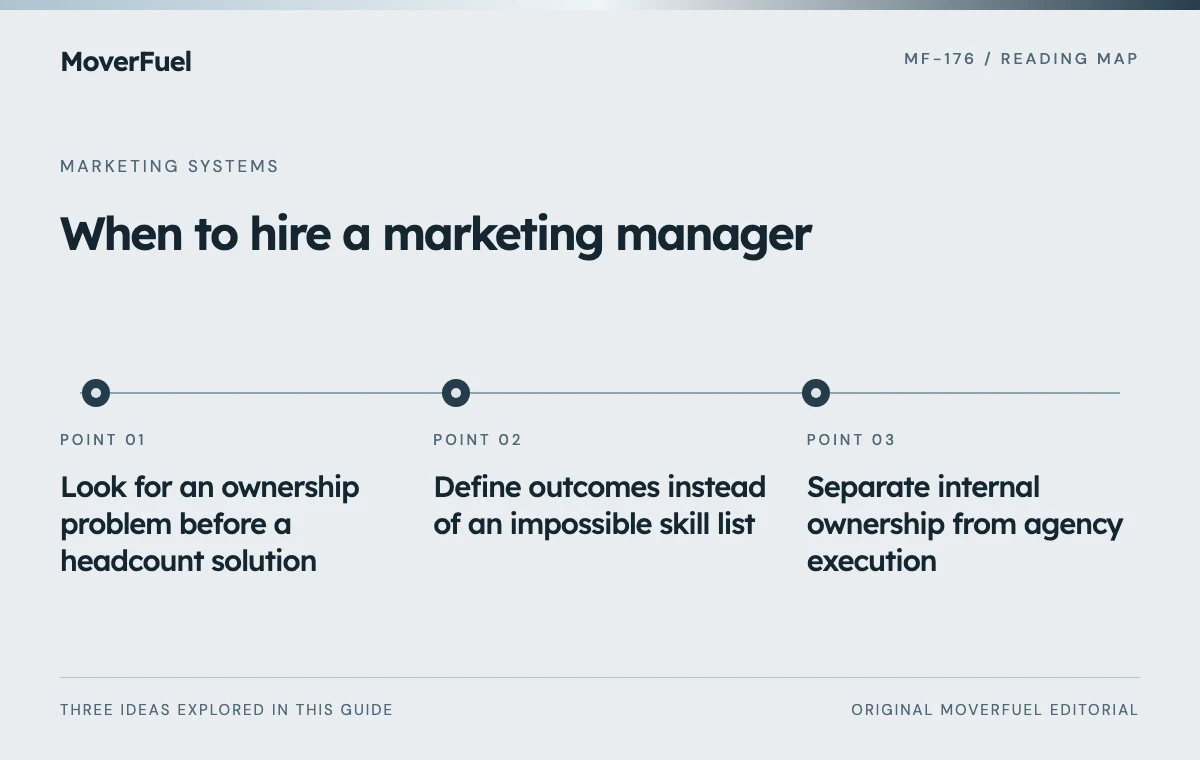
Look for an ownership problem before a headcount solution
Scroll the table horizontally to compare all columns.
| Observed problem | Possible need | Check first |
|---|---|---|
| Campaign and operations priorities conflict | Cross-functional coordination | Can existing owners resolve the decision? |
| Agency work lacks internal direction | A clear business-side owner | Is the scope and authority defined? |
| Content and approvals repeatedly stall | A maintained production process | Are required facts and reviewers available? |
| Reports do not lead to decisions | Measurement and planning ownership | Are the underlying records reliable? |
| Marketing work exceeds current capacity | Additional dedicated capability | Is the workload recurring and funded? |
A temporary project may need specialist support rather than a permanent role. A recurring coordination gap may justify internal ownership even when technical execution remains with outside specialists. Separate those needs before writing the job description.
Ask what would be different three months after the person starts. If the answer is only more marketing, the role is not yet specific enough to evaluate.
Define outcomes instead of an impossible skill list
Specify the business outcomes and operating responsibilities: maintain the plan, coordinate campaigns with capacity, improve reporting discipline, manage approvals or oversee acquisition partners. Do not assume one hire will be an expert media buyer, developer, designer, analyst and videographer.
Give the role matching decision authority
Clarify which budgets, priorities and vendor decisions the manager can make, which need approval and who resolves conflicts. Accountability without access or authority produces frustration rather than ownership.
SBA marketing guidance links goals, activities, budgets and measurement. Those elements can form the manager's planning responsibility while specialists remain accountable for their defined technical work. [1]
Separate internal ownership from agency execution
Scroll the table horizontally to compare all columns.
| Area | Internal manager | Agency or specialist |
|---|---|---|
| Business priorities | Confirm services, markets and capacity | Translate into acquisition recommendations |
| Campaign delivery | Approve direction and constraints | Execute the agreed technical work |
| Proof and service facts | Obtain accurate internal information | Use it appropriately in content |
| Reporting | Connect results with business decisions | Provide defined measures and analysis |
| Experiments | Coordinate operational dependencies | Design and implement scoped tests |
Adapt the split to the actual team. A strong internal specialist may execute some channels directly, while another manager focuses on planning and coordination. The agreement should reflect real skills rather than a fixed agency model.
Keep one final owner for each decision. Shared collaboration is useful; shared ambiguity is not. Document who approves a new service claim, a budget change and a campaign pause.
Evaluate candidates through relevant work
Ask candidates to explain a past decision, the evidence available, the tradeoffs and what they learned. Distinguish direct responsibility from work performed by a larger team. Do not require disclosure of confidential client data.
A bounded, fair evaluation exercise can use a fictional moving-company scenario: incomplete lead definitions, a constrained schedule and several competing priorities. Assess how the candidate clarifies the problem, not whether they produce a polished speculative strategy overnight.
Use consistent job-relevant criteria and the company's appropriate hiring process. This guide does not establish employment-law requirements, compensation benchmarks or a claim that any particular hiring method guarantees performance.
The agency-reporting questions offer useful examples of the analytical conversations the role may need to lead.
Build a practical first-90-days scorecard
Scroll the table horizontally to compare all columns.
| Period | Focus | Reviewable output |
|---|---|---|
| First 30 days | Understand services, records and existing commitments | Ownership map and documented gaps |
| Days 31–60 | Fix a priority coordination or measurement problem | Verified workflow improvement |
| Days 61–90 | Run the agreed plan and review evidence | Decision record and next-quarter priorities |
This sequence is an example, not a promise of revenue growth within ninety days. The right timing depends on access, data quality and the work inherited. Adjust the plan when a material dependency is discovered.
Include required access, introductions and decision support in the onboarding plan. The manager cannot reconcile source-to-job performance without cooperation from the people who own the records.
Judge the role by better decisions and execution
Review whether priorities are clearer, approvals move reliably, reports reconcile and agreed work gets completed. Connect those improvements with acquisition and booking outcomes where evidence supports it. Do not attribute every business change to one new hire.
Revisit the scope if the manager spends most of the week on work that was not part of the need. The role may require administrative support, specialist execution or a different decision process rather than a broader job description.
Use MoverFuel's process to understand how an external marketing partner can work with an internal owner. The relationship should make responsibilities clearer, not add another approval layer without purpose.
Common questions
Should a mover hire a manager or an agency first?
Identify the missing responsibility. Internal coordination and business decisions may need an owner, while channel execution may need specialist support. Some companies need both with a clear division of work.
Should the manager be judged only on lead volume?
No. Evaluate suitable demand, execution quality, reliable measurement and coordination with operations. Lead volume alone can reward work that does not help the business.
Your next step
Hire for a defined recurring responsibility with the authority to perform it. Clear scope, realistic support and reviewable early outcomes give the role a better foundation.
Sources & editorial notes
Platform claims cite the documents below. Operating frameworks and labeled examples are MoverFuel editorial analysis, not client results or industry benchmarks.
- SBA: marketing and salesSBA marketing planning connects objectives, actions, budgets and measurement; the hiring and onboarding framework is original editorial guidance without a universal staffing benchmark. Reviewed .