
An agency report should help a moving-company owner make a decision. If the meeting ends with more charts but no clearer explanation of suitable inquiries, booked work or the next action, ask different questions. A useful review connects definitions, evidence and responsibility rather than relying on a favorable headline metric.
 View full-size graphic ↗
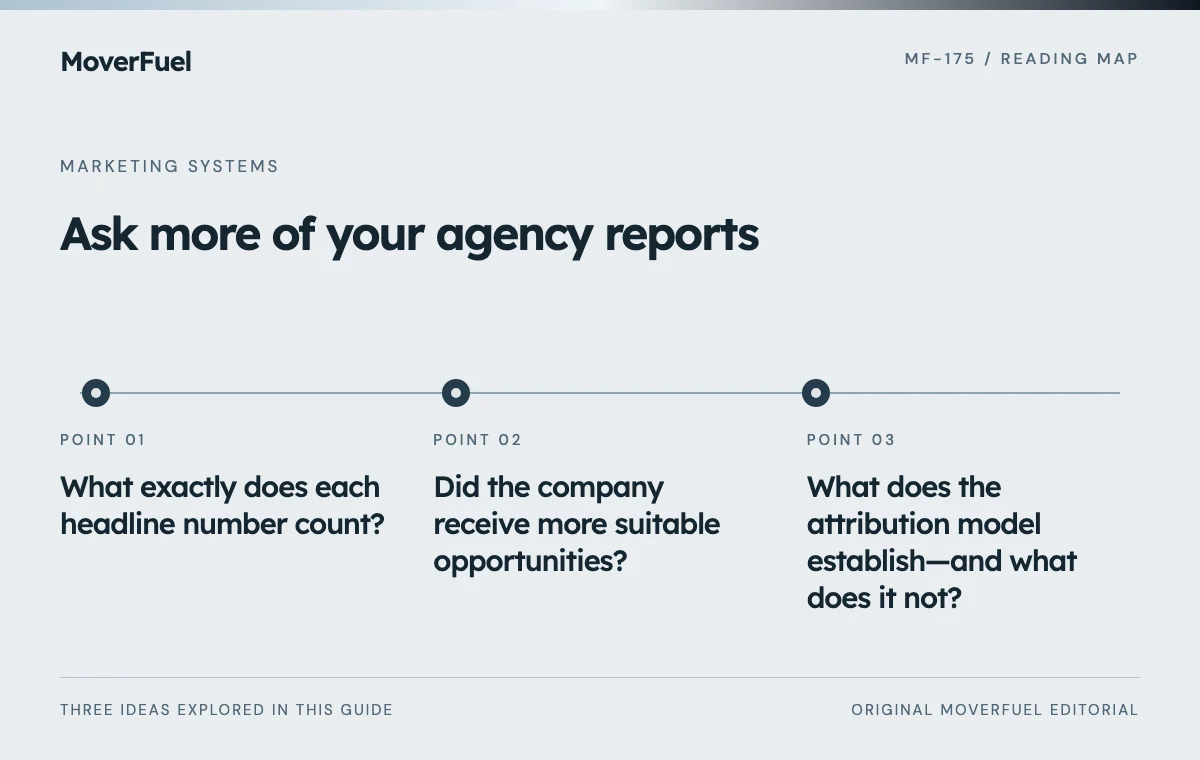
What exactly does each headline number count?
Scroll the table horizontally to compare all columns.
| Ask | Evidence to request | Why it matters |
|---|---|---|
| What is a lead here? | Event and qualification definitions | Calls, submissions and opportunities differ |
| Which date determines this period? | Creation, booking or job-date rule | Prevents mismatched cohorts |
| How are duplicates handled? | Identity and deduplication method | Protects counts |
| What costs are included? | Spend and fee scope | Makes efficiency figures comparable |
| What remains unknown? | Missing data and unresolved records | Prevents false certainty |
Ask the agency to show one representative record moving through the report, with private details appropriately protected. This can reveal definition problems more quickly than another dashboard tab.
Supermove milestone documentation distinguishes creation, booking and job dates. That is one concrete reason a monthly report must state its date basis rather than assume every system's monthly total describes the same work. [1]
Did the company receive more suitable opportunities?
Request the qualification criteria and the distribution of unsuitable reasons. Unsupported geography, wrong service, timing mismatch and duplicate contact are different problems. A single bad-lead percentage does not explain what should change.
What happened after a suitable inquiry arrived?
Review contact, assessment and estimate outcomes with the internal team. Marketing should not claim every unresolved lead is a sales failure, and sales should not label every lost estimate poor marketing. The evidence should identify the stage and the documented reason.
Ask whether recent opportunities have had time to decide. A report comparing immature current leads with fully resolved prior leads should say so. Otherwise, an apparent conversion decline may simply reflect timing.
The qualified moving lead guide provides a shared definition that can anchor this discussion.
What does the attribution model establish—and what does it not?
Google Analytics attribution models distribute credit among observed interactions. That credit is not, by itself, proof that a channel caused an incremental booking. Ask which model and data scope the report uses and what remains unobserved. [2]
Compare platform-reported conversions with deduplicated CRM outcomes carefully. Multiple platforms may claim influence on the same customer. Adding their totals can exaggerate the number of unique jobs without any individual platform being configured incorrectly.
Request a clear distinction between tracked outcomes, modeled estimates and illustrative scenarios. A modeled figure should not be presented as a verified count of completed moving jobs.
What changed, why, and what did the team learn?
Scroll the table horizontally to compare all columns.
| Question | Useful answer | Weak answer |
|---|---|---|
| What was changed? | Specific campaign, page or process action | We optimized everything |
| Why was it changed? | Observed problem and hypothesis | Best practice without context |
| What evidence followed? | Relevant outcome with limits | A selected favorable metric |
| What happens next? | Owner, action and review point | Continue optimizing |
Not every month produces a proven winner. An inconclusive test can still be useful when its design and limitations are clear. Ask what evidence would change the team's view and whether the next action addresses that uncertainty.
Distinguish necessary maintenance from experiments and expansion. Fixing a broken form, testing a new offer and increasing market coverage have different purposes and should not all be summarized as campaign optimization.
How do the outcomes relate to useful business contribution?
Ask for booked and completed outcomes where reliable data is available, not just traffic and cost per inquiry. Include cancellations and service mix when they materially change interpretation. A larger quoted job value does not automatically establish a better acquisition result.
Contribution analysis subtracts variable costs from revenue. The company's actual cost treatment is needed before an agency can connect marketing to useful contribution; reported revenue alone is not profit. [3]
If cost data is unavailable, state that limitation and report what can be measured accurately. It is better to show a supported acquisition view than to invent a return-on-investment calculation from incomplete inputs.
Use the contribution calculation guide to agree on the inputs before comparing channels.
Leave the meeting with a short decision record
Record the decision, evidence, owner and next review date. Include internal dependencies such as estimate coverage or approved creative assets. The agency cannot complete a change that depends on information no one has agreed to provide.
Keep unresolved data questions visible until they are answered. Repeated uncertainty about source capture or booking definitions is a system problem, not a permanent footnote. Assign the repair and verify it in the next report.
A tracking and attribution review can improve report reliability. Use the quarterly review guide for broader strategic decisions beyond the monthly agenda.
Common questions
What is the most useful first question in an agency review?
Ask what the headline result counts, which date and cost definitions it uses, and how it connects to real moving opportunities. Clear definitions make every later comparison more useful.
Should all platforms show the same conversion total?
Not necessarily. Attribution windows, models, event definitions and timing can differ. Require a documented reconciliation rather than assuming equality proves accuracy.
Your next step
Ask for definitions, evidence and decisions. A useful agency report explains suitable opportunities and business outcomes while making uncertainty and responsibility visible.
Sources & editorial notes
Platform claims cite the documents below. Operating frameworks and labeled examples are MoverFuel editorial analysis, not client results or industry benchmarks.
- Supermove: Marketing Milestones SummarySupermove milestone reporting distinguishes event and date bases. Reviewed .
- Google Analytics: get started with attributionGA attribution models assign credit to observed interactions; attribution credit alone does not establish incrementality. Reviewed .
- OpenStax: contribution margin and cost behaviorContribution differs from revenue and depends on relevant variable costs. Reviewed .