
A quarterly marketing review should decide what the moving company will do next. It is not three monthly reports stitched together. Use the longer view to examine assumptions, service mix, operating constraints and accumulated learning, then choose a small set of priorities with owners, resources and a clear review point.
 View full-size graphic ↗
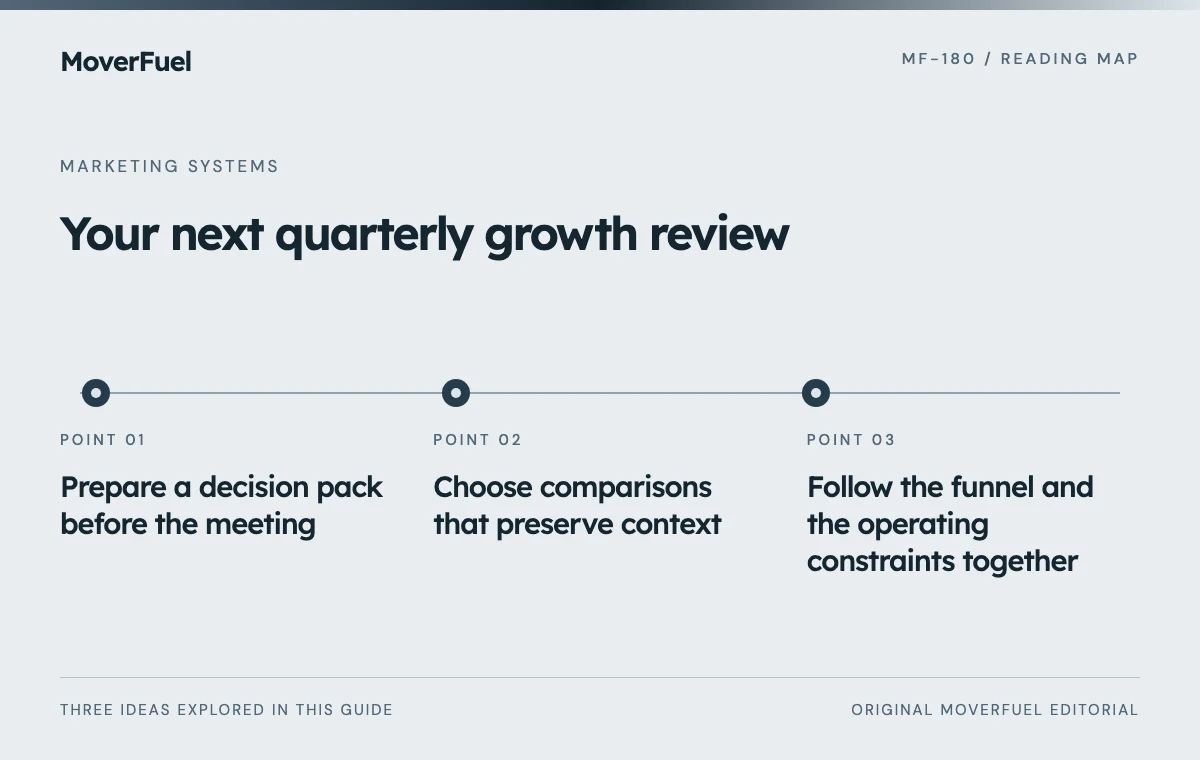
Prepare a decision pack before the meeting
Scroll the table horizontally to compare all columns.
| Section | Contents | Decision it supports |
|---|---|---|
| Business context | Services, markets, capacity and material changes | What growth is useful now |
| Acquisition outcomes | Defined inquiries through completed work | Where demand and conversion need attention |
| Economics | Relevant costs and contribution where available | Which activity deserves investment |
| Learning log | Tests, repairs and unresolved questions | What to keep, change or investigate |
| Next-quarter options | Scoped choices with dependencies | What the team will commit to |
Share the definitions and unresolved data issues before the meeting. Participants should not spend the entire review discovering that booked revenue and completed revenue were mixed together.
Ask sales and operations to contribute their evidence, not just marketing. A campaign outcome can depend on estimate coverage, available dates or a service restriction that never appeared in the ad report.
Choose comparisons that preserve context
Compare the quarter with relevant prior periods while noting seasonality, service mix and measurement changes. A sequential decline after a busy period is not automatically deterioration. A year-over-year increase can also conceal a less useful mix of work.
Keep inquiry, booking and job-date cohorts distinct. Supermove's milestone documentation separates those event bases, which is a reminder to reconcile the date definitions before combining systems. [1]
Start with data quality where it changes the decision
Identify missing outcomes, duplicate events and incomplete cost data. Decide whether each gap merely limits precision or makes a proposed decision unreliable. Assign repairs instead of allowing uncertainty to remain a permanent excuse.
Follow the funnel and the operating constraints together
Review suitable inquiries, assessments, estimates, bookings and completed work by meaningful service or market segments. Ask where progress improved and where it stalled. Keep the analysis detailed enough for a decision without creating dozens of segments that no one can interpret.
Use relevant contribution where the company's records support it. Revenue less variable costs differs from revenue alone; fixed costs and broader financial choices require their own treatment. Do not present an incomplete acquisition calculation as total business profit. [2]
Bring capacity into the discussion. A promising market may still need operational preparation, while an existing market may benefit more from better qualification than additional traffic. Growth priorities should reflect the work the company can deliver well.
The capacity framework and revenue scenario guide provide useful supporting worksheets.
Review decisions and experiments, including inconclusive ones
Scroll the table horizontally to compare all columns.
| Prompt | Useful record | Next implication |
|---|---|---|
| What did we expect? | Original hypothesis and assumptions | Makes hindsight visible |
| What did we change? | Specific intervention and timing | Separates causes from coincidences |
| What happened? | Relevant evidence and limitations | Supports a measured conclusion |
| What remains uncertain? | Unresolved question | Defines the next investigation |
| What will we do? | Keep, revise, stop or scale | Turns analysis into a decision |
Do not bury failed tests. A well-designed test that rules out an unsuitable offer can prevent future waste. Equally, do not declare success from a favorable metric that was not the intended outcome.
Distinguish maintenance achievements from growth experiments. Repairing a broken integration may be essential even when it produces no immediate lift. Record the operational value without inventing an incremental revenue claim.
Choose a few priorities with explicit tradeoffs
List the options competing for attention: improve an existing funnel, enter a market, prepare creative, repair measurement or build useful content. Evaluate the expected purpose, effort, dependencies and downside of each. Avoid giving every option top priority.
SBA marketing guidance connects goals, actions, budgets and measurement. Apply those elements to the selected priorities so the plan can be executed and reviewed, rather than ending with a list of aspirations. [3]
For each commitment, name an owner, resource requirement, decision authority and review point. Include what will not be pursued so staff do not inherit an impossible workload behind a short presentation.
Use conditional commitments when evidence is incomplete. A bounded market test can be approved with an exposure limit and a stop condition, while a broader expansion waits for operating readiness.
Carry the decisions into the next operating cycle
Publish a concise internal decision record in the company's approved workspace. Link each priority to the evidence, responsible team and next action. Keep sensitive customer records in their controlled systems rather than copying them into the planning summary.
Review progress between quarterly meetings and escalate material changes. A new capacity constraint or tracking failure should not wait three months for attention. The quarterly plan provides direction; it should remain responsive to verified changes.
Use the monthly agency-review questions for ongoing accountability and MoverFuel's process for coordinated research, execution and optimization.
Common questions
How is a quarterly review different from a monthly report?
It revisits strategic assumptions, service mix, capacity and accumulated learning, then allocates resources for the next period. Monthly reviews usually focus more closely on current execution and corrective actions.
Should every quarter end with a larger marketing budget?
No. The evidence may support expansion, a conversion repair, better measurement or reduced exposure. The decision should follow business needs and operating constraints.
Your next step
Use the quarterly review to make choices. A defined evidence pack, honest learning review and short list of accountable commitments create a plan the team can actually execute.
Sources & editorial notes
Platform claims cite the documents below. Operating frameworks and labeled examples are MoverFuel editorial analysis, not client results or industry benchmarks.
- Supermove: Marketing Milestones SummarySupermove milestone reporting distinguishes creation, booking and job dates. Reviewed .
- OpenStax: contribution margin and cost behaviorContribution separates revenue and variable costs and is not identical to total profit. Reviewed .
- SBA: marketing and salesSBA marketing planning connects goals, actions, budgets and measurement; the quarterly pack is an original operating framework. Reviewed .