
A website can receive traffic and still fail the business in several different ways. It may attract people you cannot serve, make a suitable service difficult to understand, lose inquiries through broken contact paths or send good opportunities into an unreliable intake process. Diagnose which failure is occurring before spending money on a visual overhaul.
 View full-size graphic ↗
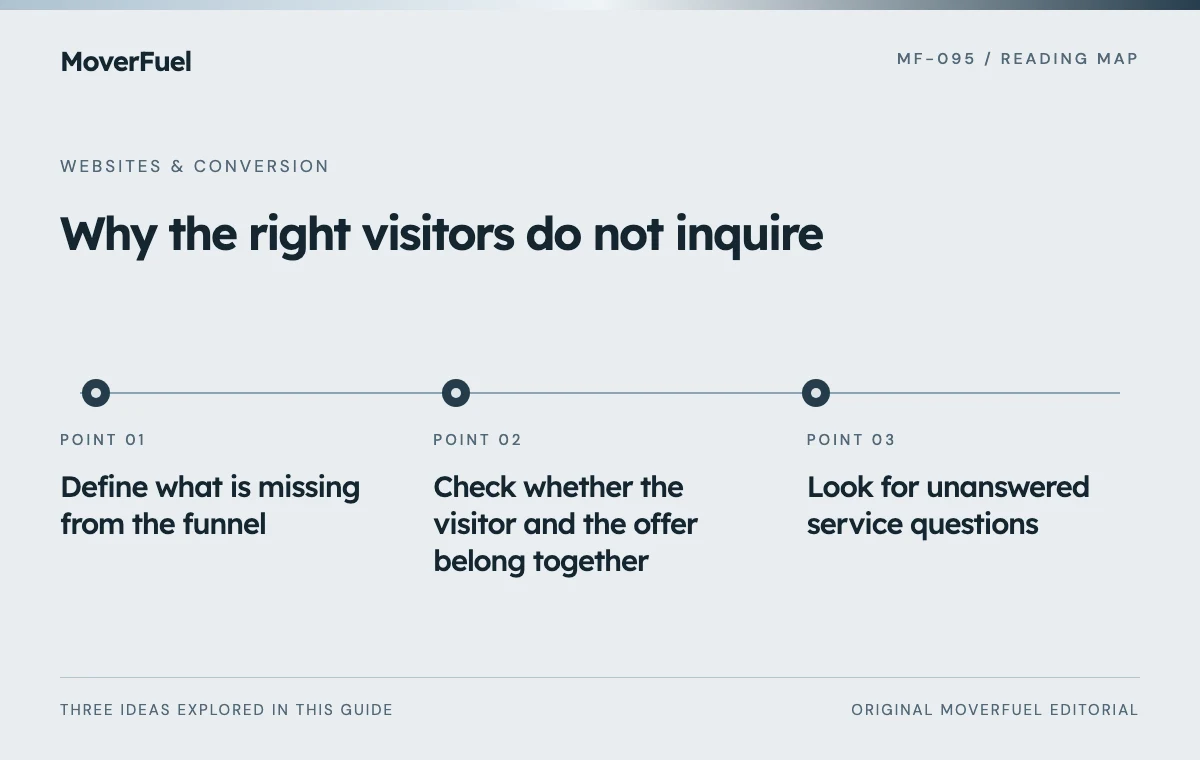
Define what is missing from the funnel
Write down the gap in observable terms. ‘The website does not work’ could mean low relevant traffic, few contact attempts, undelivered forms, poor qualification or weak estimate progression. Those problems have different owners and require different evidence.
Scroll the table horizontally to compare all columns.
| Observed symptom | First evidence to inspect | Do not assume |
|---|---|---|
| Few visits from target customers | Search and campaign audience data | The form is the main problem |
| Relevant visits but few inquiries | Page clarity and contact usability | Every visitor is ready to book |
| Contact events but no records | Delivery and event implementation | The sales team ignored every inquiry |
| Many unserviceable inquiries | Offer, geography and qualification fields | More traffic will solve it |
| Qualified leads but few estimates | Assignment and intake follow-through | The homepage needs new colors |
Review a recent, defined sample of opportunities and a comparable traffic period. Include unsuccessful inquiries, not just the few bookings everyone remembers. Label unknown outcomes explicitly instead of assigning them to a convenient cause.
Check whether the visitor and the offer belong together
A packing-only search, a cross-country move and an office relocation represent different needs. Compare the search or campaign promise with the landing page and actual service capability. An inquiry outside your business model may be a targeting problem rather than a persuasion problem.
For paid search, Google's Quality Score is a diagnostic built from expected clickthrough rate, ad relevance and landing-page experience. It is not a business profitability metric and should not replace review of qualified opportunities. [1]
Inspect query themes, locations, devices and landing pages at a useful level of detail. Avoid judging tiny segments as if they were stable patterns. A broad traffic increase from an informational article can lower the site's overall inquiry rate without making the article or service pages worse.
If the issue is geography, use the out-of-area lead diagnosis to trace the promise from targeting through intake.
Look for unanswered service questions
Ask whether the page tells a customer what is included, where the company operates, how estimates work and what happens after contact. A polished design can still be vague about stairs, packing, storage, long-distance coverage or commercial scheduling.
Find the gap between reassurance and explanation
Generic claims about stress-free moving do little to distinguish fit. Explain the actual process and limits. If the company needs a survey before pricing a complex move, make that next step clear rather than implying an instant final quote.
Check the page on a small screen using the customer's task. Can someone identify the relevant service, see credible proof and reach a working contact option without dismissing several overlays? Record specific obstacles instead of summarizing the experience as ‘not modern enough.’
Test whether an inquiry actually arrives
Submit controlled tests through every active form and confirm receipt in the intended system. Test invalid fields, slow responses, server failure and repeated submission. A thank-you screen that appears before durable acceptance can create false confidence.
W3C's form guidance recommends clear feedback about errors and successful completion. That feedback must be accessible to the user; the internal delivery check remains a separate engineering responsibility. [2]
Test phone links as well as forms. Verify the destination number, office hours, routing and fallback. A click event proves only that the interface was used. Reconcile actual inquiry records before calling the tracking implementation accurate.
Audit recent changes such as spam filters, CRM connections, email routing or consent tools. A sudden loss of records after a release is a strong reason to investigate the integration, even when the page still looks unchanged.
Inspect the handoff after the website
A qualified opportunity can stall because nobody owns it, the wrong branch receives it or the requested date is not checked. Review assignment time, contact attempts, missing information and the reason an estimate was not produced. Keep sales-process problems visible in the diagnosis.
Scroll the table horizontally to compare all columns.
| Failure | Owner | Verification |
|---|---|---|
| Incorrect service promise | Marketing and operations | Page matches offered service |
| Form delivery failure | Developer and system owner | Controlled record arrives reliably |
| Unclear estimate process | Content and sales | Customer can explain the next step |
| Unassigned inquiry | Intake manager | Every eligible record has an owner |
Prioritize broken functionality and misleading expectations before discretionary redesign. Then test a focused improvement against the diagnosed barrier. Keep a record of the evidence, repair and result so the same issue is not rediscovered every quarter.
If the evidence remains incomplete, improve measurement first and state the uncertainty. A responsible diagnosis may conclude that several causes contribute; it should not manufacture a single dramatic explanation to justify a larger project.
If the evidence does point to the website itself, rather than intake or measurement, see what a site built around the estimate journey involves.
Common questions
Should we redesign if website leads are down?
First determine whether the decline comes from traffic, audience fit, contact functionality or intake. A redesign is appropriate only when it addresses the identified problem.
Why can traffic rise while qualified leads fall?
The added visitors may have different intent or geography, or the contact and intake paths may have changed. Compare relevant cohorts and actual opportunity records.
Your next step
Treat weak lead generation as a chain of testable failures. Repair the broken link that evidence identifies instead of assuming every problem needs a new website.
Sources & editorial notes
Platform claims cite the documents below. Operating frameworks and labeled examples are MoverFuel editorial analysis, not client results or industry benchmarks.
- Google: Quality ScoreQuality Score's diagnostic components and limits; it is not a profitability measure. Reviewed .
- W3C WAI: form user notificationsAccessible feedback for form errors and successful completion. Funnel diagnosis is original analysis. Reviewed .