
A customer can read an answer, view a business profile or remember a company name without visiting its website. That makes website sessions an incomplete picture of discovery. It does not make every impression a lead. Evaluate zero-click exposure through a ladder of observable signals, keeping the gaps between them visible.
 View full-size graphic ↗
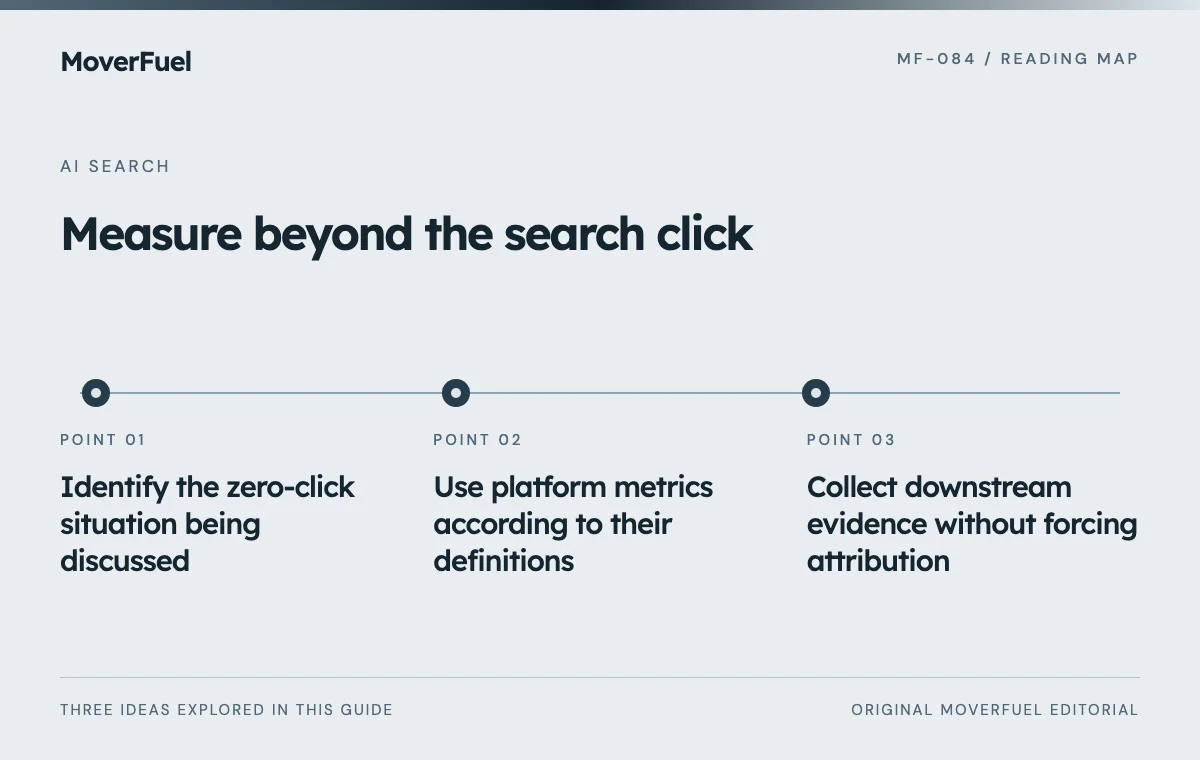
Identify the zero-click situation being discussed
A prospect may obtain an answer about move preparation, call from a business profile or compare names before searching again later. These situations differ commercially. An informational answer can be useful without creating immediate demand, while a direct call can begin a sales conversation without a website visit.
Scroll the table horizontally to compare all columns.
| Signal | What is observable | What remains unknown |
|---|---|---|
| Search impression | A recorded appearance under the platform definition | Attention, recall and buying intent |
| Profile interaction | A recorded button or link action | Whether a conversation occurred |
| Identifiable inquiry | A person contacted the business | Full discovery history |
| Qualified opportunity | The request fits agreed criteria | Whether it will book |
| Booked and completed move | An operating outcome | The causal contribution of every exposure |
State which rung a report measures. A chart titled ‘search-generated revenue’ needs a documented connection to opportunities and outcomes; an impression count alone cannot support it.
Use platform metrics according to their definitions
Search Console’s performance report provides search metrics such as clicks and impressions, with configurable dimensions and periods. Use those observations to examine discovery patterns, not as a count of qualified moving customers. [1]
Business Profile call activity counts call-button clicks. A call tap can occur without a connected conversation, so join telephone and intake records before labeling it a lead. [2]
Separate brand demand from general discovery
Review branded and nonbranded queries separately where the available data supports it. A rise in people searching the company name may reflect referrals, offline promotion, prior customers or other channels. It is useful demand evidence without proving which activity created it.
Keep service intent visible too. Exposure for moving tips and exposure for a local estimate request may support different stages of the journey. Do not assign them the same expected commercial value simply because they appear in one report.
Collect downstream evidence without forcing attribution
Ask new customers how they first heard about the company and what prompted the current contact. Use optional, neutrally worded questions and preserve the response separately from technical source data. A customer may remember a recommendation but not the exact interface where it appeared.
Scroll the table horizontally to compare all columns.
| Input | Useful comparison |
|---|---|
| Search exposure by topic | Which services gained or lost observable visibility? |
| Profile actions and connected calls | Where does interaction fail to become contact? |
| Qualified inquiries by market | Is suitable demand changing? |
| Booking cohorts | Do inquiries mature into work? |
| Customer-reported discovery | Which untracked influences are mentioned? |
Use the Maps lead-tracking process and AI referral measurement guide for the specific collection paths.
Leave unmatched activity unmatched. A booking arriving after a visibility increase may be consistent with a marketing effect, but timing alone is not proof. The report should distinguish observed association from causal evidence.
Use comparisons that acknowledge competing explanations
When evaluating a change, document other factors that could affect demand: paid budgets, seasonality, pricing, sales coverage, reviews and crew capacity. Compare suitable time periods and markets where possible, recognizing that markets are rarely identical.
If the business can run a controlled experiment, define the intervention, outcome and comparison before launch. Small samples and market differences may limit what can be concluded. A directional business test can still be useful when those limits are explicit.
Avoid assigning a fixed dollar value to every impression without a defensible model. If an economic estimate is used for planning, show the assumptions and sensitivity rather than presenting it as measured revenue.
Choose the next action from the weakest supported link
If exposure rises but contact does not, inspect relevance and the visible contact path. If contacts rise but qualification falls, review service scope and geography. If qualified inquiries rise but bookings lag, examine estimate follow-up and capacity before changing the discovery strategy.
Report what is known, what is inferred and what is still missing. The purpose of a zero-click report is to widen the view beyond website traffic while maintaining evidence standards, not to make every untracked outcome attributable to marketing.
Common questions
Are fewer website clicks always a bad sign?
No. Customers may take useful actions elsewhere, but that possibility must be checked against actual contacts and outcomes rather than assumed.
Can impressions be converted directly into booked revenue?
Not without a supported model and explicit assumptions. Impressions, inquiries and completed jobs are different measurements.
Your next step
Measure exposure and demand together, but preserve the steps between them. A clear ladder of evidence helps explain change without treating awareness as fictitious booked revenue.
Sources & editorial notes
Platform claims cite the documents below. Operating frameworks and labeled examples are MoverFuel editorial analysis, not client results or industry benchmarks.
- Google: Search Console performance overviewSearch Console performance metrics and dimensions. Reviewed .
- Google: Business Profile performance and insightsCall-button clicks are not connected calls. Measurement ladder and experiment cautions are original analytical guidance. Reviewed .