A drop in search traffic near a Google update is a reason to investigate, not a complete diagnosis. Moving demand, website releases, tracking changes and shifts in the queries people use can all affect the chart. Build a timeline and separate observed facts from explanations before making broad changes to the site.
 View full-size graphic ↗
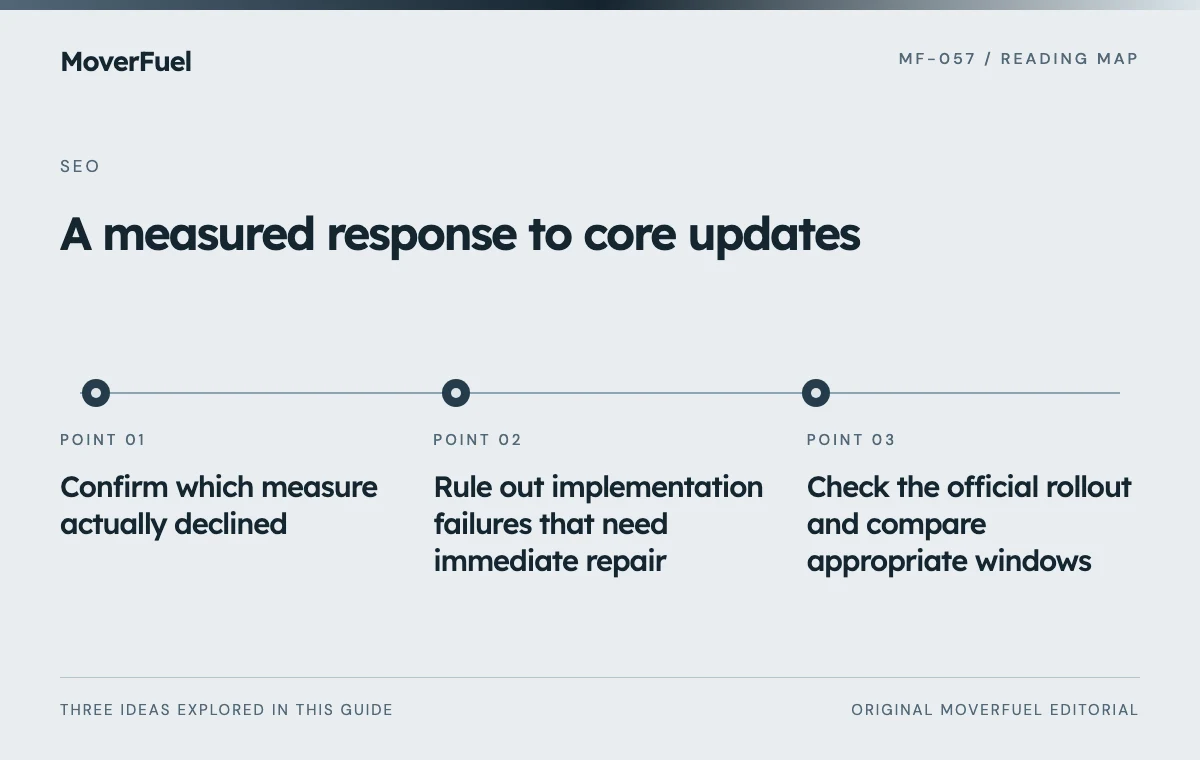
Confirm which measure actually declined
Identify whether the change concerns search impressions, clicks, positions, analytics sessions, inquiries or booked jobs. A tracking failure can reduce measured sessions without changing search visibility. A seasonal shift can reduce inquiries while the site remains technically healthy.
Use comparable dates and record the market, device, search type and page group. Avoid comparing a short incomplete period with a full prior month. Separate branded demand from service discovery where the available data permits it.
Scroll the table horizontally to compare all columns.
| Date or period | Observation | Possible explanation to test |
|---|---|---|
| Website release | Templates or routes changed | Access, canonical or rendering regression |
| Measurement change | Analytics or consent setup changed | Reporting discontinuity |
| Demand change | Service availability or seasonal mix changed | Different customer demand |
| Official update window | Google confirms rollout dates | Potential search-system change |
| Sales-process change | Inquiry handling changed | Different booking conversion |
Write “possible” beside explanations that have not been established. A timeline helps the team avoid turning the first plausible story into an expensive recovery plan.
Rule out implementation failures that need immediate repair
Check important public pages for errors, unintended noindex, blocked access, incorrect canonicals and missing rendered content. Review recent redirects and sitemap changes. These are concrete implementation questions that can be tested without waiting for a search update to finish.
Google’s technical requirements make clear that access, successful responses and indexable content are prerequisites for eligibility. Repair a confirmed defect on its own merits; do not leave a broken service page in place because the team is waiting to understand an algorithm change. [1]
Use the technical audit evidence log to assign repairs and preserve retest results.
Check the official rollout and compare appropriate windows
Google recommends confirming that a core update has finished, then waiting at least a full week before analyzing the post-update Search Console comparison. Its guidance advises reviewing affected pages, queries and search types rather than treating every small position change as a reason for drastic action. [2]
Use the official Search Status Dashboard for the actual dates. Do not assume a social-media announcement or a third-party volatility chart establishes that a particular update caused your site’s decline. A date match supports investigation; it does not prove causation.
Find the affected task before rewriting the whole site
Scroll the table horizontally to compare all columns.
| Observed concentration | Question to investigate |
|---|---|
| Service pages | Has the buying answer become weaker or less relevant? |
| Location pages | Are pages thin, duplicated or inaccurate about coverage? |
| Educational guides | Do they answer a distinct question with useful evidence? |
| One device group | Is there a mobile rendering or usability problem? |
| One market or service | Did demand, competition or operations change? |
| Nearly every page at once | Is there a shared technical or reporting issue? |
Compare the affected pages with the reader task, not merely with a keyword-density rule. Review whether the content answers the question, uses supportable evidence and offers a relevant next step. Ask a reviewer who was not involved in writing the page to identify confusing or unhelpful sections.
Preserve material that still serves the reader
Do not delete an entire library because a subset declined. Keep useful original explanations and legitimate service information. If pages overlap, investigate their purpose and evidence before choosing consolidation. A smaller site is not automatically a better site.
Make a prioritized improvement plan with honest expectations
Separate confirmed defects, supported editorial improvements and uncertain experiments. Assign an owner, expected user benefit and verification method to each. Preserve existing URLs unless a deliberate architecture change is justified.
Google states that improvements do not guarantee a noticeable search impact and that results remain dynamic. A responsible plan should therefore explain what will be improved and measured without promising a recovery date or restored position. [2]
Track the same page and query groups after changes, alongside suitable inquiries and retained jobs. Keep the change log so the team can interpret outcomes. If several changes occur together, acknowledge that the result may not reveal which one mattered most.
The recovery process should leave the website more accurate, usable and maintainable even when the search explanation remains uncertain. That is a stronger outcome than a sequence of speculative edits made to satisfy every new theory.
Common questions
Does a traffic drop during an update prove the update caused it?
No. Compare official timing with technical, measurement, demand and page-level evidence. Correlation is a starting clue, not a complete diagnosis.
Can an SEO agency guarantee recovery after a core update?
No. It can commit to a documented investigation, useful repairs and measurement. Search outcomes and timing remain uncertain.
Your next step
Confirm the decline, fix concrete defects and assess affected reader tasks before making broad changes. Keep recovery claims proportional to the evidence.
Sources & editorial notes
Platform claims cite the documents below. Operating frameworks and labeled examples are MoverFuel editorial analysis, not client results or industry benchmarks.
- Google: Search technical requirementsTechnical eligibility requirements for accessible, working pages. Reviewed .
- Google: core update guidanceOfficial rollout/comparison guidance, page-query review and no guaranteed recovery. Reviewed .