
Two pages mentioning “local movers” are not automatically competing in a harmful way. One may explain a service while another helps a customer prepare. Investigate overlapping promises and reader tasks before merging pages, changing URLs or blaming every ranking fluctuation on cannibalization.
 View full-size graphic ↗
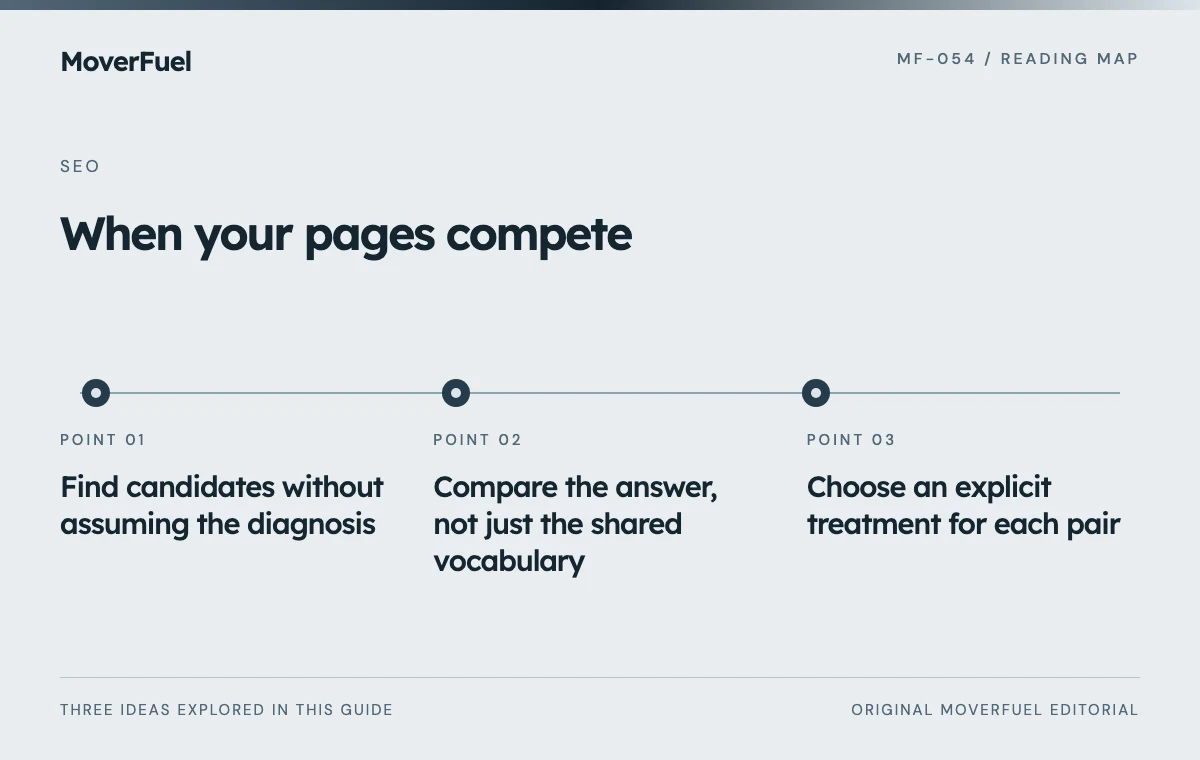
Find candidates without assuming the diagnosis
Start with pages that promise nearly the same answer, query reports that show multiple destinations for the same intent, and internal links that inconsistently point to different preferred pages. These are investigation signals, not proof that one page must be removed.
Record each URL’s title, main purpose, useful evidence, conversion step and known performance. Include older pages that still receive links or suitable inquiries. A newer design does not automatically make the newer URL the better destination.
Scroll the table horizontally to compare all columns.
| Pair | Potential distinction | Possible problem |
|---|---|---|
| Local moving service and local moving checklist | Provider selection versus preparation | Both pages actually repeat the same service pitch |
| Two neighboring city pages | Different useful local coverage | Only the city name changes |
| SEO guide and SEO service page | Education versus agency evaluation | Both target the identical commercial decision |
| Two packing-cost articles | Different cost questions or service scopes | Same assumptions and answer under different titles |
Compare the answer, not just the shared vocabulary
Read the introductions, core sections and next actions side by side. Ask whether a reader would gain something important by visiting both. If yes, make that distinction clearer through titles, scope and contextual links. If no, investigate whether one complete answer would serve the task better.
Identify what would be lost in a merge
A weaker page may still contain a useful local explanation, an approved project detail or a practical table. Preserve that material where it belongs. Consolidation should improve the surviving answer rather than erase information because it sits on the less attractive URL.
Check whether one page serves a different language, audience or service model. Similar wording can hide a legitimate difference, and a hasty merge may make the site less useful. Document the reason for retaining or combining each pair.
Choose an explicit treatment for each pair
Scroll the table horizontally to compare all columns.
| Finding | Treatment to consider | Implementation requirement |
|---|---|---|
| Different useful tasks | Retain and differentiate | Clarify titles, scope and reciprocal context |
| Same task with complementary information | Merge into a stronger answer | Preserve useful content and choose a relevant surviving URL |
| True duplicate variants that must remain accessible | Canonical preference where appropriate | Consistent canonical, sitemap and internal signals |
| Obsolete duplicate that should disappear | Relevant permanent redirect | Test the final destination and update internal links |
| No useful replacement or continuing purpose | Deliberate retirement | Use appropriate response behavior, not a misleading unrelated redirect |
Google treats canonical annotations as signals rather than commands and documents redirects for retiring duplicate pages. A canonical tag does not physically merge content or send a visitor to a different page. Choose the mechanism that matches the intended user experience. [1]
Update the whole relationship map
Before changing a URL, list its incoming internal links, relevant external references, sitemap entry, canonical declaration and any shared navigation placement. Record important section fragments where people may link directly to a specific answer.
Update internal links to the intended destination rather than relying forever on a chain of redirects. Preserve useful fragments when practical. Confirm that the surviving page’s title, body and CTA still match the links that describe it.
Use the internal-link maintenance guide to check hubs, archives and contextual references after consolidation.
Keep a reversible content snapshot and a URL decision log. If the change removes a needed answer or sends customers to an unsuitable destination, the team should be able to understand and correct the decision without reconstructing the old site from memory.
Monitor the transition without promising ranking preservation
Test status codes, final URLs, crawlable links and visible content immediately after implementation. Those checks establish whether the change was deployed as intended. They do not establish how search systems will reevaluate the site.
Review query-page patterns and qualified inquiry behavior over a meaningful period, accounting for seasonality and other changes. Search visibility can move during a transition. Do not promise that every old ranking will transfer or interpret a short fluctuation as definitive proof of failure.
Judge the editorial outcome as well: can the customer now find a complete answer more easily, and does each remaining page have a distinct purpose? A cleaner architecture is valuable when it supports useful content and customer decisions, not merely when the URL count is smaller.
Common questions
Is sharing a keyword enough reason to merge two pages?
No. Compare reader intent, content and the next decision. A service page and an educational guide can legitimately use similar vocabulary while serving different needs.
Will a canonical tag guarantee which page ranks?
No. It is a preference signal that Google evaluates with other evidence. Use it accurately for duplicate or closely equivalent versions, not as a guaranteed ranking control.
Your next step
Diagnose overlapping tasks before changing URLs. Preserve useful answers, choose the right technical treatment and maintain the links that explain the site.
Sources & editorial notes
Platform claims cite the documents below. Operating frameworks and labeled examples are MoverFuel editorial analysis, not client results or industry benchmarks.
- Google: canonical URL methodsCanonical signals versus redirects and the limits of declaring a preferred URL. Reviewed .