A useful older article does not need a new URL just because the company is updating its content library. Preserve the value that already exists, correct what has become inaccurate and improve the answer deliberately. No refresh can guarantee unchanged rankings, but a careful process can avoid unnecessary technical and editorial damage.
 View full-size graphic ↗
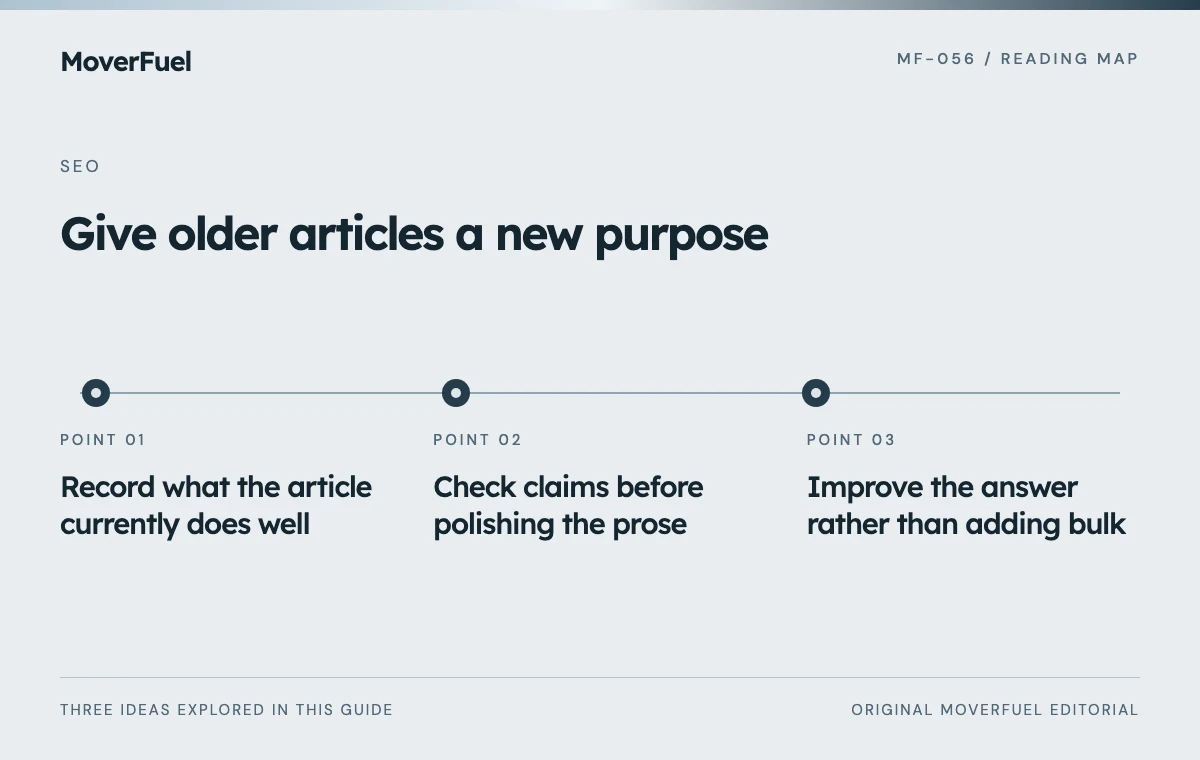
Record what the article currently does well
Save the body, title, metadata, dates, URL and important section fragments before editing. Record useful inbound and internal links, known search queries and relevant inquiry outcomes when available. This baseline makes it possible to distinguish an improvement from an accidental loss.
Read the page as a customer with its original question. Identify the explanation, example or worksheet that still helps. Do not remove useful material merely because it sounds different from a new brand template.
Scroll the table horizontally to compare all columns.
| Question | Evidence to record |
|---|---|
| What task does this page serve? | Current promise and intended reader |
| Which material remains useful? | Sections or assets worth preserving |
| What is outdated or unsupported? | Claim, source and required correction |
| What is missing? | Actual reader or sales question |
| Does the URL still fit? | Reason to preserve or genuinely restructure |
Check claims before polishing the prose
Review dates, service capabilities, platform instructions, policy statements and numerical claims. Use the appropriate official source for current technical or regulatory behavior. A competitor’s updated article is useful context, but it is not automatically authoritative evidence.
Remove or qualify a claim when the supporting evidence cannot be established. If the article uses an example, label its assumptions and verify the arithmetic. If it describes the company’s service, ask the responsible operator whether the process still works that way.
Keep the correction traceable
Record the original claim, revised claim, source and review date. That helps the next editor understand why a section changed. It also prevents a later rewrite from reintroducing an appealing but outdated instruction.
Improve the answer rather than adding bulk
Use customer questions and the page’s intended task to choose additions. A comparison table may clarify a confusing decision better than several extra paragraphs. A direct answer near the beginning can help more than a longer introduction.
Google’s people-first guidance emphasizes satisfying the audience’s need and providing useful original value. Apply that principle by removing repetition and filling real gaps, not by chasing a word-count target. [1]
Preserve the article’s distinct scope. A packing-preparation guide should not become a general moving-services landing page during optimization. Add relevant service links where they help, without replacing the answer the reader came for.
Keep the URL unless the architecture genuinely needs a change
If the topic remains the same and the existing URL is understandable, update the page in place. Preserve useful section fragments where practical. Changing a date in the text or improving a headline does not automatically require a new slug.
When a duplicate page is deliberately retired, Google documents permanent redirects as an appropriate canonicalization signal. Choose a relevant destination and update internal references; do not send every removed article to an unrelated homepage. [2]
Scroll the table horizontally to compare all columns.
| Situation | Likely editorial action |
|---|---|
| Same task, outdated facts | Revise the existing page |
| Same task, weak structure | Improve headings and explanations in place |
| Two redundant answers | Plan a careful consolidation with a relevant survivor |
| New genuinely different task | Create a distinct page and link the relationship |
| No longer useful and no equivalent answer | Choose deliberate retirement behavior after review |
The content-overlap audit helps distinguish a justified consolidation from two useful pages that merely share vocabulary.
Test the revised page and record a genuine update
Check mobile readability, tables, images, citations, internal links and the conversion path. Verify the title, description, canonical and sitemap behavior. Test old section links when they are known to be used. A content edit can introduce a broken path even when the URL stays the same.
Use an update date that reflects a real revision and retain the original publication date where appropriate. Do not change dates merely to make unchanged content appear newly researched. Explain substantial corrections when the reader needs that context.
Save the change log and monitor relevant search and inquiry behavior over time. Account for seasonality, wider site changes and external search changes before attributing every movement to the refresh. The immediate evidence is that the article is more accurate and usable; ranking effects remain an observation, not a guarantee.
Common questions
Should I change the URL when I rewrite an old article?
Usually preserve it when the reader task remains the same. A URL change should have an architectural reason and a tested transition plan, not merely accompany a new headline.
Can an update guarantee that rankings will not fall?
No. Search results change for many reasons. Preserve useful content and links, verify the implementation and monitor results without promising a fixed position.
Your next step
Refresh the answer and evidence while preserving useful history. Make each URL or structural change deliberate, traceable and tested.
Sources & editorial notes
Platform claims cite the documents below. Operating frameworks and labeled examples are MoverFuel editorial analysis, not client results or industry benchmarks.
- Google: helpful people-first contentPeople-first usefulness rather than arbitrary content expansion. Reviewed .
- Google: canonical URL methodsPermanent redirects for deliberately retired duplicate pages. Reviewed .