Local Services Ads can create a direct path from a local search to a conversation with your moving company. That conversation still needs to become an appropriate estimate and a retained booking. Build the channel as an operating process: eligible business, accurate offer, available people, disciplined spending and reliable job records.
 View full-size graphic ↗
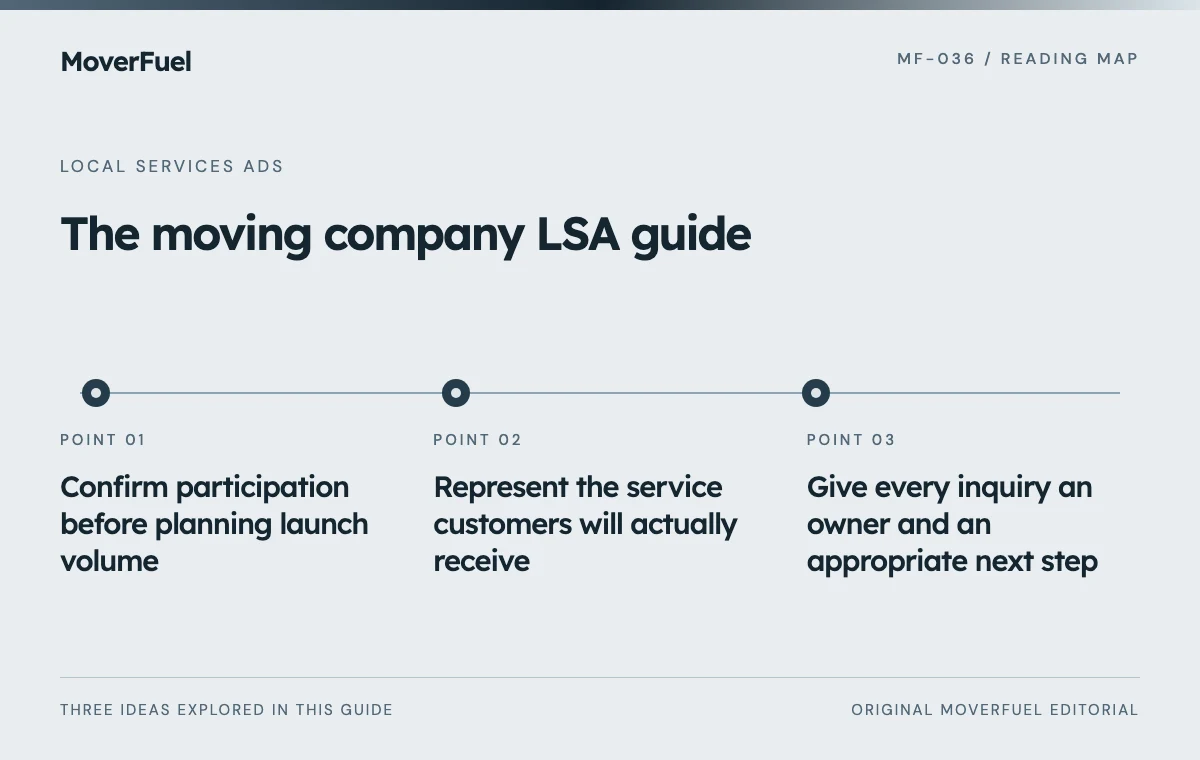
Confirm participation before planning launch volume
Google’s screening requirements depend on business category and location, and checks can be requested again. Confirm the requirements shown for the actual business rather than using an old badge checklist. A matching Business Profile may require the authorized person to establish access. [1]
Create a launch register containing the business identity, responsible owner, requested documents and current status. Use approved secure channels for sensitive records. Advertising setup should not become an informal collection of identity documents in a shared marketing folder.
Keep a separate record of the services the company is actually authorized and equipped to perform. Passing an advertising check does not replace the company’s responsibility to understand the requirements for its moving operations. Do not advertise a new route or specialist service simply because a form offers that option.
The LSA verification guide provides a practical ownership and document workflow.
Represent the service customers will actually receive
Review the business description, service categories, operating coverage, contact details and available proof with the person responsible for delivery. If one branch provides storage and another does not, resolve that distinction before customers are routed between them.
Use accurate service descriptions rather than selecting every possible job type to maximize exposure. A customer requesting unsupported work still consumes intake time even when no estimate follows. Have operations approve the offer in plain language that sales can repeat.
Scroll the table horizontally to compare all columns.
| Decision | Question for the moving company | Owner |
|---|---|---|
| Services | Which jobs can this team quote and deliver? | Operations |
| Coverage | Which origins and routes are suitable? | Dispatch or branch manager |
| Contact path | Who receives and acts on each contact? | Sales lead |
| Proof | Which photos and business facts are approved? | Business owner |
| Availability | When can the team respond and accept work? | Sales and operations |
Review the published experience after setup. An internal spreadsheet can be correct while the customer-facing profile or receiving phone number is wrong. Save the review date and the person who checked it.
Give every inquiry an owner and an appropriate next step
Google includes responsiveness among the factors considered in its LSA auction. Missed calls can negatively affect that factor. This is a reason to build reliable coverage, not a promise that answering within an invented number of seconds will secure a particular rank. [2]
Use a short first-contact qualification
Capture origin, destination, preferred date, service scope and the best contact route. Ask enough to identify a useful next action. A simple local move may be ready for an estimate process, while an office relocation may require a separate planning conversation.
When the first person cannot resolve the request, record the handoff and name the receiving owner. “Sent to estimating” is incomplete if nobody has accepted the task. Track the time of meaningful response, not only the time an automated acknowledgment was sent.
Keep wrong-fit, unreachable and lost-after-estimate outcomes separate. They suggest different repairs. A geographic mismatch points toward coverage or customer intent; a suitable inquiry that receives no follow-up points toward the sales process.
Set a commercial boundary before increasing lead volume
LSA uses lead charges rather than a simple search-click purchase. Google documents an average weekly budget and a monthly maximum; spending in a particular week can vary. Inspect the current account controls and billing view before treating a weekly setting as a strict weekly cash limit. [3]
Start with the amount the business can afford to spend acquiring a suitable retained job. Work backward through observed booking rates to an illustrative lead-cost allowance. If the data is weak, use a conservative test budget and record the uncertainty instead of borrowing an industry benchmark.
A branch with open trucks but no staff to answer inquiries has a different constraint from a branch whose sales team has room but crews are fully booked. Budget reviews should include both. Paying for demand the company cannot handle rarely solves either problem.
Use the market-level LSA budget framework to connect allocations to local capacity and mature outcomes.
Investigate unsuitable leads without assuming a refund
Record the original inquiry and its business outcome before deciding what went wrong. A charge, a qualified opportunity and a booking are different facts. A customer can be genuine yet unsuitable for a particular crew schedule or service model.
Current Google credit guidance describes automated reassessment and excludes credits for unsupported job types and geography. Do not build the channel’s economics around an assumed refund for every inquiry the company declines. [4]
Use recurring patterns to improve the offer, coverage and intake. Keep billing questions in their own queue with evidence and account status. Pending adjustments should remain pending in the financial report until confirmed.
The current lead-credit guide separates billing status from sales disposition and explains the limits of older dispute advice.
Review the channel through retained jobs
Scroll the table horizontally to compare all columns.
| Layer | Measure | Decision it supports |
|---|---|---|
| Delivery | Lead charges and posted credits | What the channel actually cost |
| Fit | Suitable unique opportunities | Whether coverage and offer match demand |
| Response | Meaningful contact and unresolved handoffs | Whether staffing is losing opportunities |
| Sales | Estimates and retained bookings | Whether suitable demand becomes reserved work |
| Operations | Completed jobs and contribution | Whether acquired work supports the business |
Choose an inquiry cohort and let it mature through the normal sales cycle. Keep later cancellations visible. Do not count the same household’s call, message and follow-up as three separate moving jobs.
End each review with a specific action and an owner: correct a service description, improve callback coverage, inspect a branch’s booking losses or adjust the budget. The dashboard is useful when it changes a decision that the team can verify.
If you would rather have help running the channel and these reviews, see our Local Services Ads management.
Common questions
Does verification guarantee leads or placement?
No. Participation checks and ad delivery are separate. Results depend on the account, market, competition, customer response and other factors; no fixed lead quantity or position is promised here.
Can a mover rely on LSA alone?
That depends on its market and evidence. Review the concentration risk and total acquisition mix. Useful website, organic and Search demand may complement LSA rather than compete with it.
Your next step
Make LSA accountable from profile accuracy to completed work. An eligible account and a busy inbox are starting conditions, not proof of a healthy acquisition channel.
Sources & editorial notes
Platform claims cite the documents below. Operating frameworks and labeled examples are MoverFuel editorial analysis, not client results or industry benchmarks.
- Google: Local Services verificationCategory/location-dependent screening and repeated verification. Reviewed .
- Google: About Local Services ad rankingsResponsiveness as an auction factor; no fixed rank guarantee. Reviewed .
- Google: How leads work in Local Services AdsLead charging and weekly/monthly budget behavior. Reviewed .
- Google: automated lead creditsAutomated credit framework and job-type/geographic exclusions. Reviewed .