
Helpful moving advice leaves the reader better prepared to make a decision or complete a task. Thin content often repeats that moving is stressful, adds a city name and ends with a quote request without resolving the question. Use a concrete reader task and an evidence boundary to decide what belongs on the page.
 View full-size graphic ↗
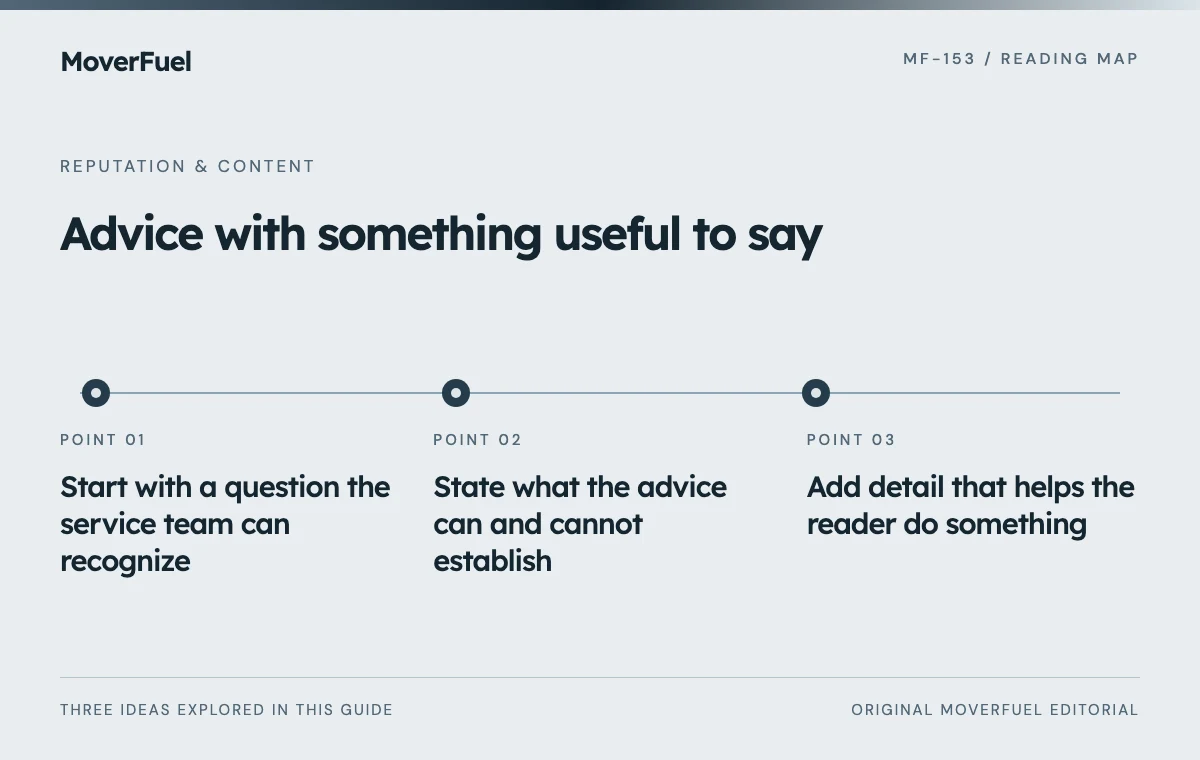
Start with a question the service team can recognize
Ask an estimator or customer-service lead what customers misunderstand repeatedly. A useful topic might explain what to prepare for an inventory review or how to identify building-access questions. Define the reader's situation and the action they should be able to take after reading.
Scroll the table horizontally to compare all columns.
| Weak approach | More useful editorial task |
|---|---|
| Moving tips in every city | Explain a verified local access or preparation issue where it genuinely differs |
| Why our movers are the best | Explain the actual service process and evidence customers can verify |
| Ten generic packing reminders | Answer a specific packing decision within the company's expertise |
| Repeated keyword definitions | Compare the options or steps the reader needs to choose |
Do not fabricate a local distinction to justify another URL. If the advice is the same across the service area, one strong page may serve the reader better than many near-identical pages.
State what the advice can and cannot establish
A general preparation guide is not a personalized estimate, a legal determination or a substitute for a qualified assessment of unusual items. Define the scope in the answer itself. Escalate questions about regulated requirements, hazardous materials or specialized handling to current authoritative guidance and the appropriate professional.
Verify facts before polishing the prose
Use official sources for platform policies and applicable public requirements. For the company's own service, verify details with the responsible operator. Record the source, review date and exact claim supported. A source about one jurisdiction or service type should not be used to imply a universal rule.
Distinguish an illustrative example from a real customer case. Hypothetical arithmetic can clarify a decision when labeled, but it should not be presented as a typical result or the company's performance history.
Add detail that helps the reader do something
Scroll the table horizontally to compare all columns.
| Element | Question for the editor |
|---|---|
| Answer-first opening | Does the page address the actual question promptly? |
| Concrete steps | Can the reader follow the process? |
| Decision criteria | Can the reader choose between relevant options? |
| Example | Does it clarify a realistic moving situation? |
| Limitations | Are uncertainty and service boundaries clear? |
| Next step | Does the reader know what information or help is needed? |
An inventory-review article, for example, can explain how to separate items that move from items that stay, identify uncertain access and prepare questions for the estimator. It need not pad the answer with an unrelated history of the moving industry.
Use tables and diagrams when they clarify comparisons or sequences. Do not add them solely to make the article appear comprehensive. A table repeating the same vague sentence in six rows adds length without usefulness.
Use writing tools without outsourcing factual responsibility
Google's guidance permits useful AI assistance but warns that generating many pages without added value can violate scaled-content policies. The relevant quality question is the value and reliability of the result, not whether a tool was involved. [1] [2]
A draft tool can help organize a verified outline or identify unclear wording. It cannot establish that an invented statistic, customer quote or service claim is true. Review every factual statement and every link before publication, including plausible-looking citations.
Keep authorship and review descriptions honest. Do not invent a named expert, certification or firsthand experience to make the page seem more authoritative. Explain the actual editorial responsibility available.
Connect advice to a relevant service without distorting the answer
A natural service link helps the reader act when professional help is appropriate. It should match the topic and actual offering. Avoid using an educational article to imply the company provides a service or market coverage that has not been verified.
Link to related questions only when they help the next decision. Check that the destinations exist and that the anchor text describes them accurately. Repeating a keyword-heavy service link in every section can make the page harder to read without adding information.
Use the moving content strategy guide to decide where the article belongs in the wider customer journey.
Apply a publication and maintenance check
Before release, ask someone who understands the service to identify unclear advice, missing exceptions and unsupported promises. Test the page on a phone, check headings and tables, and verify that the reader can reach the appropriate next step without a broken link.
After publication, monitor questions the page fails to answer and changes in the underlying facts. Consolidate overlapping pages when that improves the reader's path, preserving useful URLs and handling necessary redirects intentionally. Do not change dates merely to make unchanged advice appear newly reviewed.
Judge the article by task satisfaction, accuracy and service relevance rather than a fixed word count. A focused answer can be complete without being long, while a long page can remain thin if it avoids the decision the reader came to make.
MoverFuel's content marketing and SEO work should support that editorial standard rather than a quota of interchangeable pages.
Common questions
How long should a moving advice article be?
Long enough to answer the reader's task with necessary detail, examples and limitations. Word count alone does not establish usefulness or search performance.
Can AI help write moving content?
Yes, as an aid within a verified editorial process. It does not remove responsibility for factual accuracy, original value, appropriate sourcing or honest authorship.
Your next step
Choose a real reader task, verify the answer and add practical detail that changes what the reader can do. Publish distinct, maintainable advice instead of multiplying keywords across thin pages.
Sources & editorial notes
Platform claims cite the documents below. Operating frameworks and labeled examples are MoverFuel editorial analysis, not client results or industry benchmarks.
- Google: generative AI content guidanceGoogle guidance allows useful AI assistance while warning against mass content without added value. Reviewed .
- Google: spam policiesGoogle spam policies address scaled-content abuse and doorway practices. Reviewed .