
A blog post can mention the right phrase repeatedly and still fail to answer the reader’s question. Search-intent work starts by defining what the person needs to decide, understand or complete. Every section should help finish that task rather than expand the page simply because another keyword is available.
 View full-size graphic ↗
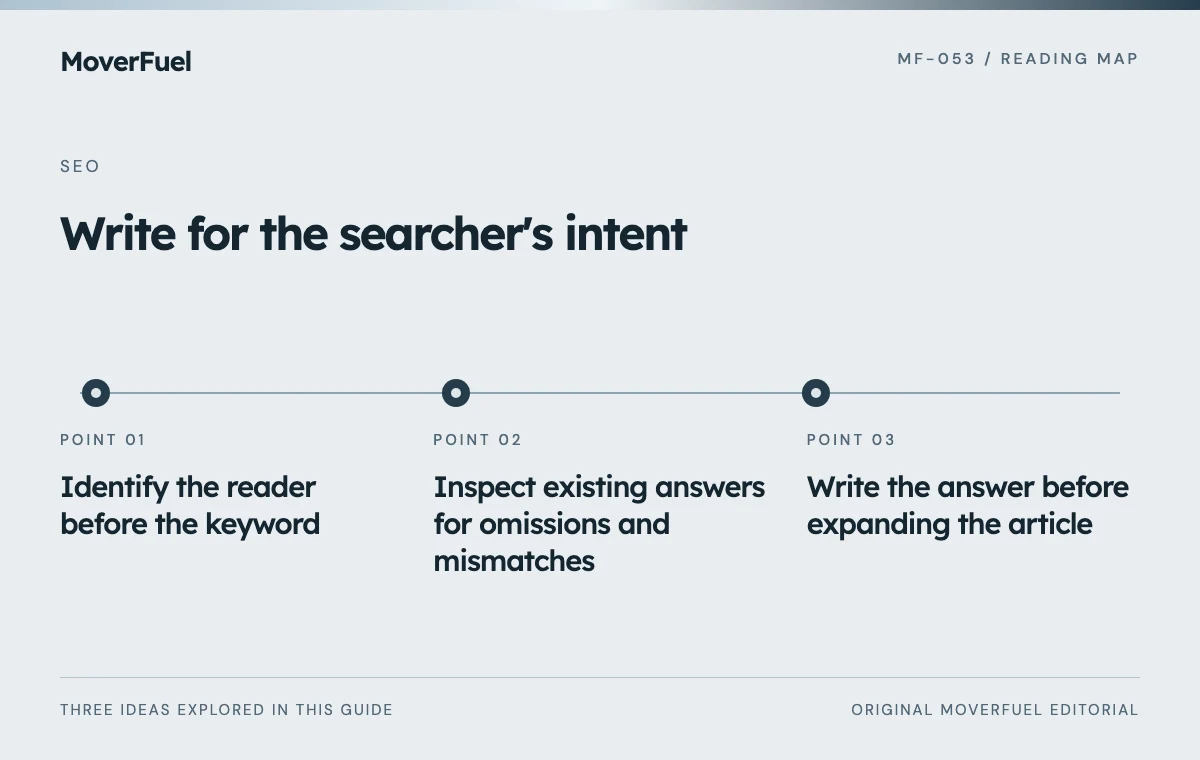
Identify the reader before the keyword
A moving company’s customer and a moving-company owner can ask very different questions using the same words. “Moving leads” may mean an owner evaluating acquisition channels; “moving checklist” usually serves a household or office planner. Do not mix audiences without a clear reason.
Scroll the table horizontally to compare all columns.
| Field | Example for a consumer preparation guide |
|---|---|
| Reader | Customer preparing for an inventory survey |
| Immediate problem | Unsure which details the estimator needs |
| Desired result | A usable preparation checklist |
| Scope boundary | Does not replace the actual survey or promise a final price |
| Evidence | Verified company process and relevant authoritative guidance |
| Next step | Prepare the information or contact the appropriate service team |
For an owner-focused article, substitute a business decision such as comparing lead sources or setting a budget. The audience determines the examples, terminology and CTA. A consumer preparation article should not suddenly ask the reader to buy agency services.
Inspect existing answers for omissions and mismatches
Review relevant results and credible sources for the exact task. Record what they answer well, what remains confusing and which claims depend on current rules or product behavior. Use this work to identify a useful difference, not to copy another article’s structure and replace company names.
Search-result observations are dated and location-dependent. Separate them from evidence about the underlying subject. A competitor ranking for a phrase does not make every claim on its page accurate, and a vendor example is not proof of your company’s results.
Choose the practical value before drafting
Decide whether the reader needs a decision table, checklist, worked calculation, comparison or illustrated process. The artifact should emerge from the task. A calculator is unnecessary when a short explanation solves the question; a long essay may be inadequate when the reader needs a usable worksheet.
Write the answer before expanding the article
Draft a direct opening that explains the main answer and its important limits. Then build the sections needed to understand or apply it. Avoid an introduction that spends several paragraphs describing how competitive or complicated the moving industry is before addressing the question.
Google’s helpful-content guidance emphasizes original value, a clear audience and satisfying the reader’s need. Treat those as editorial questions, not a formula requiring a fixed word count or a set number of headings. [1]
Use moving-specific examples where they clarify the decision: an office survey, a household with uncertain dates or a branch with limited crew capacity. Label hypothetical numbers and situations. Specificity should make the advice easier to apply, not create fictional client proof.
Place evidence near the claim it supports
Scroll the table horizontally to compare all columns.
| Claim type | Appropriate treatment |
|---|---|
| Current platform behavior | Verify official documentation and state relevant limits |
| Local requirement | Use the responsible authority and jurisdiction |
| Company capability | Confirm with the actual service owner |
| Numerical example | Label assumptions and show accurate arithmetic |
| Strategic recommendation | Explain the reasoning and uncertainty |
| Client result | Publish only with verified evidence and permission |
Do not attach a general source list that fails to support the article’s specific claims. A relevant citation should help the reader verify the statement beside it. Distinguish the source’s documented fact from your recommendation about how a mover might apply it.
Use tables for genuine comparisons, headings for meaningful sections and FAQs for unresolved questions. Repeating the main body in a formulaic FAQ block adds length without improving the answer.
Connect the article to the right next decision
A guide about preparing for packing can link to packing-service scope; an operator guide about attribution can link to a relevant tracking service. The CTA should fit what the reader has just learned and should accurately describe the destination.
The internal-linking framework helps build these paths without attaching an unrelated list of service links to every paragraph.
After publication, review actual questions, landing-page behavior and appropriate inquiries. If readers consistently ask something the article should have answered, revise the explanation. If the traffic has a different intent, reconsider the page’s scope or metadata rather than merely adding more repetitions of the target phrase.
Maintain a revision log for material factual changes. The article should become more useful as the company learns, while keeping its original URL and clear purpose whenever practical.
Common questions
Should every article lead directly to a quote request?
No. The next step should fit the reader’s task and readiness. Some guides help people prepare or compare before a service conversation is appropriate.
Does adding more headings improve search intent alignment?
Only when those sections answer necessary questions. A concise complete answer can be stronger than a long article expanded with tangential topics.
Your next step
Define one reader task, deliver a useful answer and give it evidence and an appropriate next step. Optimize the article’s usefulness before optimizing its length.
Sources & editorial notes
Platform claims cite the documents below. Operating frameworks and labeled examples are MoverFuel editorial analysis, not client results or industry benchmarks.
- Google: helpful people-first contentOriginal value, audience usefulness and people-first editorial principles. Reviewed .