
A moving company's content strategy should help customers make decisions the business is equipped to serve. That means mapping questions to the right service, format and next step before filling a publishing calendar. A useful estimate-preparation page can do more for a customer than several generic posts written only to repeat a keyword.
 View full-size graphic ↗
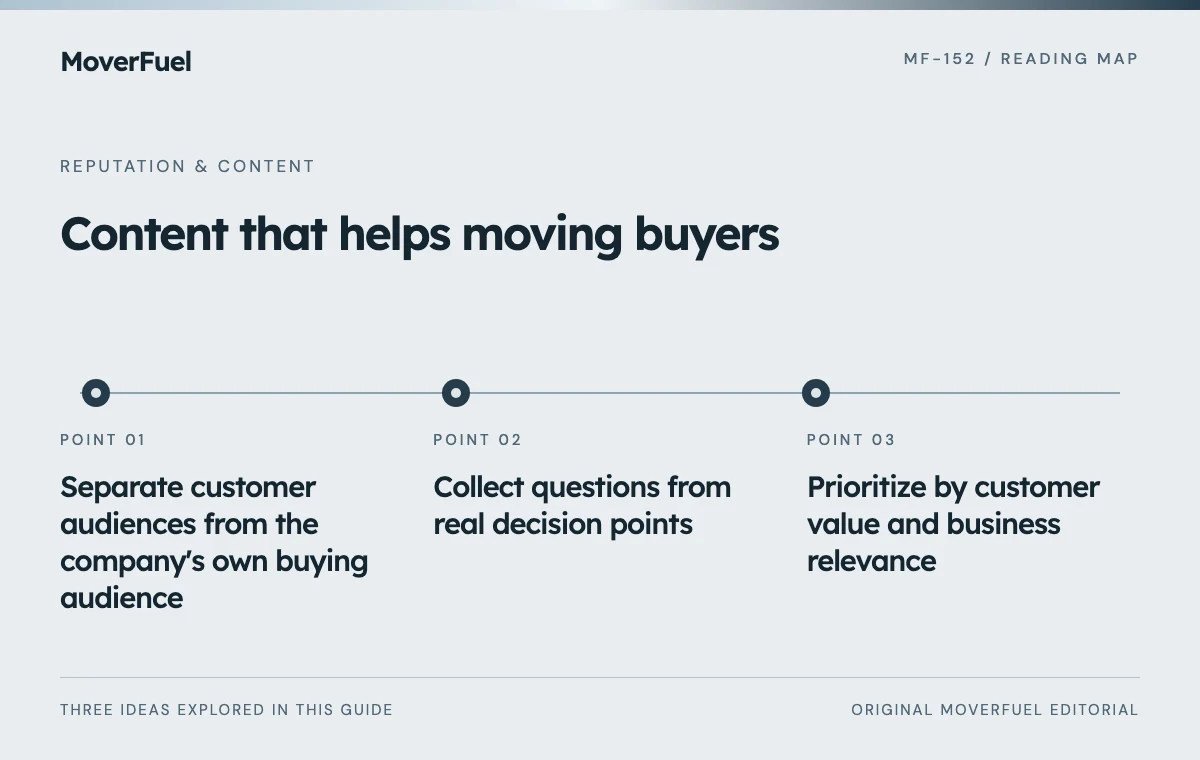
Separate customer audiences from the company's own buying audience
A mover's website usually serves households and organizations planning a relocation. MoverFuel's resource library serves moving-company operators making marketing decisions. Those are different readers with different questions. Keep the intended audience explicit in every brief so business advice does not accidentally become consumer service copy.
Scroll the table horizontally to compare all columns.
| Audience and decision | Question to answer | Possible asset | Relevant next step |
|---|---|---|---|
| Local household choosing scope | What information is needed for an estimate? | Preparation checklist | Request an assessment |
| Customer considering packing | What does the service include? | Service explanation with actual boundaries | Discuss packing needs |
| Long-distance customer qualifying a route | Can this company serve the origin and destination? | Accurate route/service information | Confirm service fit |
| Office coordinator planning relocation | How will the project be assessed and coordinated? | Commercial planning guide | Arrange a survey conversation |
Do not assume every question requires a new article. A clearer service page, FAQ, checklist or intake explanation may answer it more directly.
Collect questions from real decision points
Use appropriately handled intake notes, estimator questions, customer-service themes and search-query evidence. Identify what the customer was trying to decide and what information was missing. Remove private details before turning an internal example into public content.
Give each proposed asset a distinct job
Write the reader, problem, answer boundary, evidence needed, practical takeaway and relevant destination. Compare the proposed asset with existing pages. If the same intent is already served, improve that page instead of publishing another near-duplicate.
Google's Search Essentials emphasizes useful content and basic eligibility without guaranteeing indexing or rankings. Use that as a quality foundation, not a promise that a larger publishing volume will produce more leads. [1]
The helpful moving advice guide provides a page-level quality checklist.
Prioritize by customer value and business relevance
Scroll the table horizontally to compare all columns.
| Criterion | Evidence to seek |
|---|---|
| Recurring customer need | Repeated, meaningful questions in the service journey |
| Service relevance | The company actually offers the related work |
| Existing gap | Current pages do not already answer it well |
| Evidence availability | Facts, examples and permissions can be verified |
| Conversion usefulness | A natural next step exists without forcing a sales pitch |
| Maintenance cost | An owner can keep the information accurate |
Use qualitative priority labels when reliable search-volume data is unavailable. Do not invent keyword demand or difficulty scores to make a roadmap appear more scientific. A lower-volume question can still be valuable when it removes a serious obstacle to a suitable estimate request.
Balance near-term service clarity with broader educational resources. Avoid choosing only topics that are easy to generate or visually attractive. The strongest plan addresses the questions customers need answered to proceed responsibly.
Assign evidence, production and maintenance owners
The writer needs access to someone who understands the actual service and can verify operating details. Assign separate review responsibility for regulated or date-sensitive claims. A polished sentence should not outrun the evidence behind it.
Choose the format that helps the task: a comparison table for service options, a diagram for a process or a checklist for preparation. Use real approved images where they provide evidence and appropriately labeled illustrations where they explain a concept.
Schedule production around review capacity. A modest flow of complete, verified assets is more sustainable than a backlog of drafts that no operator has checked.
Connect the asset to an appropriate service journey
Link naturally to the service or next question the reader needs. A packing checklist may lead to the packing service explanation; a commercial planning guide may lead to a site-survey request. Avoid interrupting every paragraph with the same generic estimate button.
Keep informational and commercial intent clear. Some readers need to understand a process before they are ready to contact the company. Useful content can support that stage without pretending every visit should immediately become a lead.
Review whether people can find the asset from relevant service pages and whether it helps them reach the next step. An article that exists only in a sitemap may be technically available but poorly integrated into the customer experience.
Evaluate usefulness and maintain the library
Monitor relevant search visibility, engagement with the intended task, qualified inquiries and feedback from intake. Separate observed assistance from direct lead attribution. A guide can answer a question successfully even when the reader returns later through another channel.
Review overlapping and outdated pages periodically. Consolidate genuinely redundant content while preserving useful URLs and redirects where necessary. Record what changed and why so the next editor does not recreate the same overlap.
MoverFuel's content marketing and SEO services connect editorial decisions to actual moving services and qualified customer journeys.
Common questions
How often should a moving company publish content?
Use a pace that supports original research, operational review and maintenance. There is no universal frequency that guarantees rankings or leads; prioritize meaningful gaps in the customer journey.
Should every moving question become a blog post?
No. Some belong on a service page, in a checklist or in the estimate process. Choose the format and location that best helps the reader's decision.
Your next step
Build the content plan from customer decisions and real service knowledge. Give each asset a distinct purpose, an evidence owner and a maintenance path before adding it to the calendar.
Sources & editorial notes
Platform claims cite the documents below. Operating frameworks and labeled examples are MoverFuel editorial analysis, not client results or industry benchmarks.
- Google: Search EssentialsGoogle Search Essentials emphasizes useful content and eligibility without guaranteeing indexing or ranking. Reviewed .