
A useful local mention can introduce your moving company to people who need its services. That is a stronger starting point than buying a package of links with impressive-looking scores. Evaluate the audience, relationship and reason for the reference before treating a link as an SEO asset.
 View full-size graphic ↗
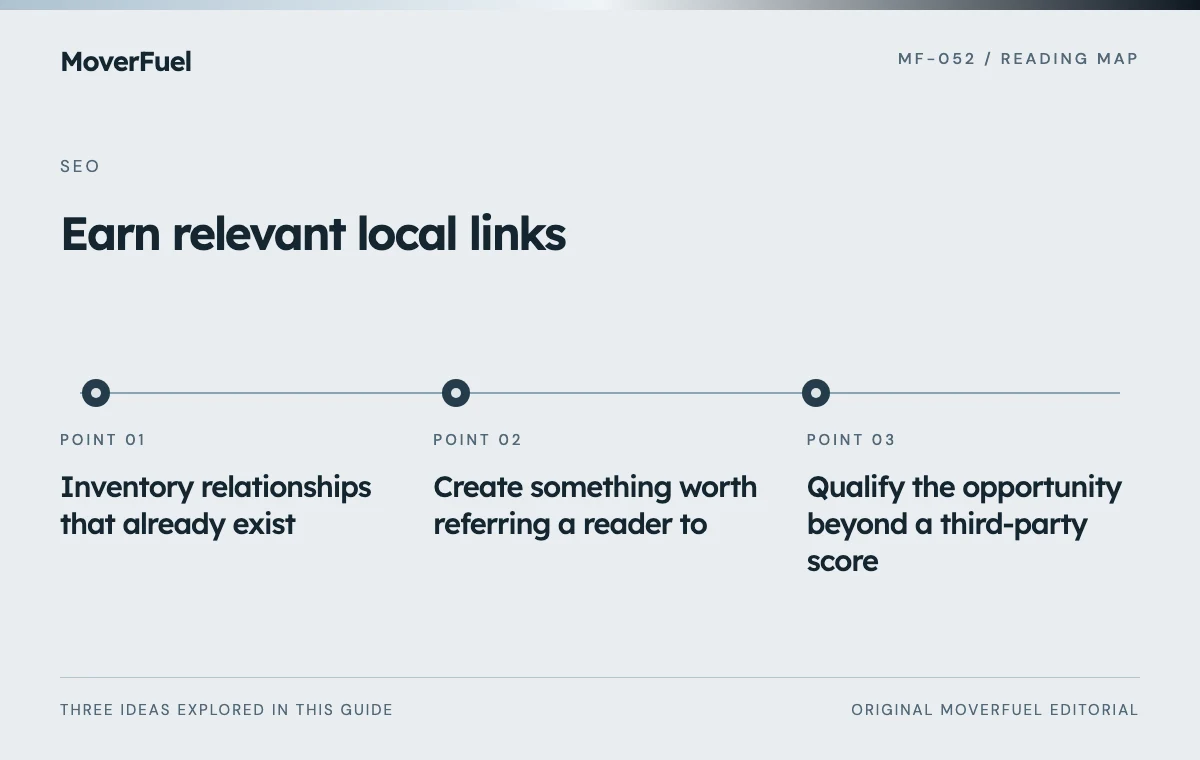
Inventory relationships that already exist
Start with genuine memberships, business partners, community projects and organizations the company actually works with. Ask which relationships have a legitimate public directory, resource page or editorial reason to mention the business. Do not invent partnerships to fill an outreach spreadsheet.
Scroll the table horizontally to compare all columns.
| Relationship or asset | Possible public value | Verification needed |
|---|---|---|
| Real business association membership | Accurate member information | Membership and listing terms |
| Property-management relationship | Useful resident moving preparation resource | Partner permission and relevant audience |
| Community project | Factual coverage of the actual activity | Participation facts and approved imagery |
| Original planning resource | Helpful reference for a local publication | Accuracy, maintenance and editorial interest |
| Approved project explanation | Practical logistics insight | Client permission and supportable details |
A relationship does not entitle the mover to a link. The publisher should decide whether the reference serves its readers. Keep the conversation grounded in the real activity or resource rather than a demand for ranking credit.
Create something worth referring a reader to
A useful asset solves a problem the intended audience recognizes. Examples include a clear inventory-preparation worksheet, an office-move responsibility checklist or a carefully verified explanation of access planning. The resource should remain useful even if it earns no external links.
Use original operational knowledge and explain its limits. If a guide discusses local parking or permit rules, check the responsible authority and include the review date. If it describes a company process, confirm that the team follows it. Do not manufacture a survey or performance statistic to make the pitch more newsworthy.
Match the asset to the publisher’s purpose
A property manager may value a resident preparation checklist; a business association may prefer a practical office-relocation article. Sending the same generic pitch to every local website ignores those differences. Explain the specific reader benefit in a short, factual proposal.
Qualify the opportunity beyond a third-party score
Scroll the table horizontally to compare all columns.
| Question | Why it matters |
|---|---|
| Who uses this site? | The audience should plausibly value the reference |
| Why would the page mention the mover? | A real editorial or directory purpose is needed |
| Is the surrounding content credible? | The company’s reputation appears in that context |
| Can readers reach a useful destination? | Referral traffic should have an appropriate next step |
| What are the commercial terms? | Advertising and editorial relationships should be understood |
A domain metric is a tool’s estimate, not a guarantee of search benefit or a substitute for reading the page. A small, relevant local publication may send useful inquiries, while an unrelated site with a high score may offer little customer value.
Record the contact, proposed asset, publication context and outcome. Keep approved facts and permissions with the task so future staff do not accidentally reuse an image or claim outside its permitted context.
Distinguish advertising from a ranking-link scheme
Google’s spam guidance identifies purchased ranking links, excessive exchanges and automated link creation as link-spam examples. Paid advertising or sponsorship links can be legitimate when appropriately qualified, such as with sponsored or nofollow attributes. Do not buy a guarantee of ranking credit disguised as editorial coverage. [1]
Do not require business partners to link as a condition unrelated to their actual relationship, or create pages whose only purpose is reciprocal cross-linking. Evaluate whether the arrangement would still make sense if search engines ignored the link.
Prepare the destination and measure useful response
Send readers to the page that fulfills the reference. A mention of office-relocation planning should not land on an unrelated offer. Make the service and inquiry step clear without turning a helpful resource into an aggressive sales interruption.
Where the company’s approved analytics setup permits it, review referral visits, relevant inquiries and later jobs. Preserve the source when the customer contacts the business through another path. Ask sales about useful introductions that may not be fully observable in web analytics.
Use the internal-linking guide to connect the referenced resource to the appropriate service explanation and next action.
Review the resource periodically so a good external reference does not point to stale information or a broken URL. If the content moves, preserve a relevant transition and update important known references where feasible.
Common questions
Should I buy a monthly package of guaranteed SEO links?
Evaluate the actual placements, audience and terms. Avoid schemes sold primarily to pass ranking credit or guarantee positions. A paid audience opportunity should have transparent advertising value and appropriate link treatment.
Can a small local website be worth working with?
Yes, if its readers and purpose are relevant. Useful introductions and credible community context matter even when a third-party authority score is modest.
Your next step
Earn references through useful work and real relationships. Judge opportunities by reader relevance, honest terms and the customer journey they create.
Sources & editorial notes
Platform claims cite the documents below. Operating frameworks and labeled examples are MoverFuel editorial analysis, not client results or industry benchmarks.
- Google: spam policiesLink-spam examples and appropriate qualification of paid advertising/sponsorship links. Reviewed .