
A credible moving-company position is a reason for a particular customer to choose the business, supported by how the operation works. ‘Professional, reliable and affordable’ does not explain much when every competitor can say it. Start with the customer and the move, identify an advantage the team can consistently deliver and show evidence that makes the promise understandable.
 View full-size graphic ↗
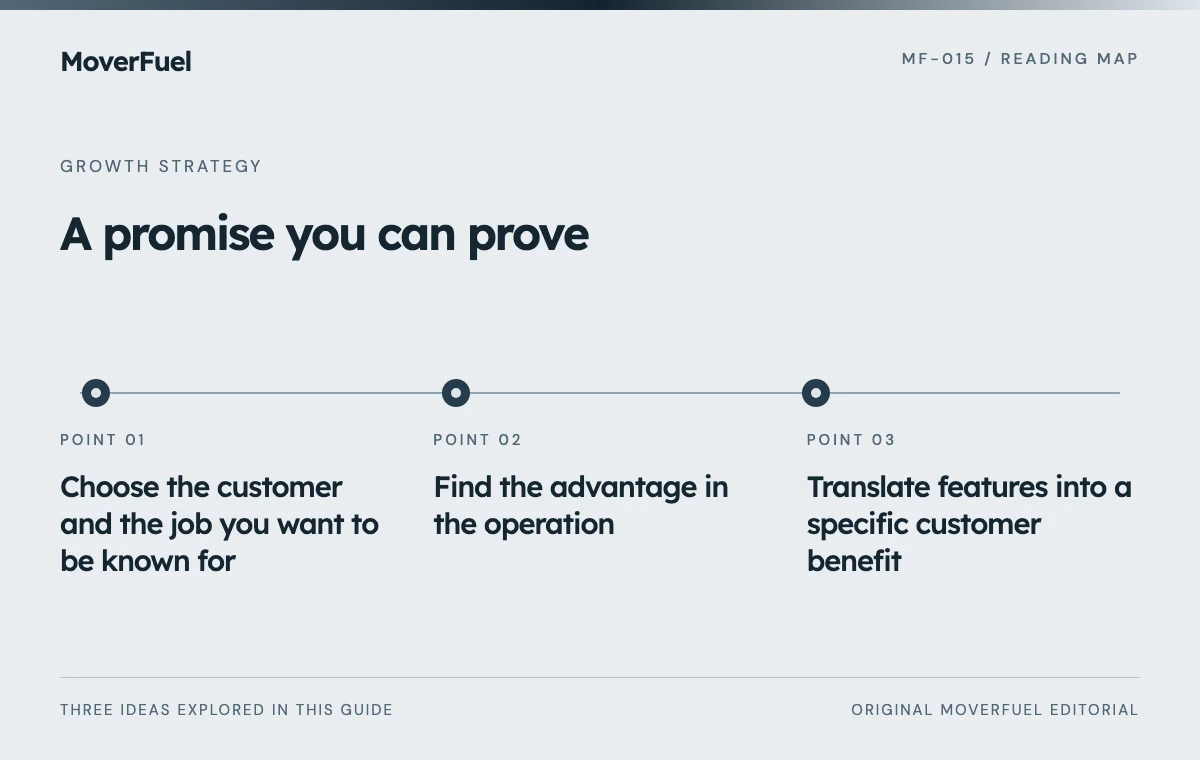
Choose the customer and the job you want to be known for
A downtown apartment customer, a family planning an interstate relocation and a facilities manager coordinating an office move face different decisions. Positioning becomes clearer when the business chooses which needs it is especially equipped to serve. That choice should follow actual capabilities and growth priorities, not a fashionable audience label.
Describe the customer's practical concern in plain language. They may need help coordinating access, understanding the estimate process or planning work around business operations. Avoid inventing a psychological profile when a concrete service task explains the need.
Scroll the table horizontally to compare all columns.
| Customer task | Capability to investigate | Evidence to seek |
|---|---|---|
| Move from a building with access restrictions | A reliable access-planning process | Approved checklist and genuine examples |
| Understand a complex relocation | Clear estimate and communication steps | Accurate process explanation and responsible contacts |
| Coordinate an office project | Project planning and stakeholder coordination | Approved survey process and relevant work documentation |
Find the advantage in the operation
Interview the people who deliver and sell the work. Ask what they do consistently, which situations they handle well and where the service has limits. Review customer questions and documented feedback for evidence of what people actually value. Do not promote an isolated exceptional effort as a standard service promise.
Test whether the capability is repeatable
A useful advantage needs an owner, a process and enough resources to survive normal variation. If a promise depends entirely on one employee improvising, clarify the limitation before making it central to the brand. Growth can expose a promise that the operation has not made repeatable.
The SBA's planning framework asks businesses to identify a competitive advantage and connect marketing with the customer experience. For movers, that means translating an operating strength into a buying reason rather than adding a stronger adjective to the same generic claim. [1]
Translate features into a specific customer benefit
A feature describes what the company has or does. A buying reason explains why that matters for the customer's move. The translation should remain accurate and avoid promising an outcome beyond the company's control.
Scroll the table horizontally to compare all columns.
| Feature to verify | Possible buying reason | Boundary to state |
|---|---|---|
| An organized pre-move access checklist | The customer knows what building details to confirm | Building approval and availability still need confirmation |
| A defined estimate process | The customer understands the next step and required information | A request does not itself establish a final price |
| A named project contact | The customer knows where to direct coordination questions | Coverage and response expectations must be accurate |
Use the language customers can act on. A phrase like ‘white-glove service’ needs explanation: which handling, preparation or communication is actually included? A specific description can support a premium position more credibly than an unexplained label.
Build a claim-and-evidence table before writing the campaign
For every important claim, identify its evidence, owner and limits. Distinguish an operating fact from a customer opinion, a verified result and a future aspiration. The FTC's advertising guidance states that advertising claims must be truthful, not misleading and supported as appropriate. Do not let a creative rewrite make the claim broader than its evidence. [2]
- Operating facts: confirm the current service, coverage and process.
- Customer statements: retain authentic wording and permission for the intended use.
- Performance claims: document the metric, period and underlying records.
- Future ambitions: label them as plans rather than present capabilities.
- Limitations: keep material conditions visible where they affect the buying decision.
Do not fabricate reviews or present staged concepts as completed customer work. A concept can explain an idea when it is clearly labeled, but it cannot supply proof that the moving company has delivered the promised result.
Carry the promise from the ad to the estimate
Review the ad, service page, inquiry confirmation and estimator conversation together. The customer should encounter a consistent explanation of the service and next step. A premium communication promise loses credibility when the form disappears into an unmonitored inbox.
Give staff a short message brief containing the intended customer, the main promise, supporting evidence and boundaries. It should help them explain the service naturally rather than force every conversation into identical promotional wording.
The sales and marketing alignment guide explains how shared definitions and ownership keep the message connected to intake.
Use different service explanations where the customer needs differ while preserving a recognizable company identity. A local residential page and a commercial project page can share visual branding without making the same promise or using the same proof.
Review positioning through customer decisions
Listen for whether customers understand the difference you are trying to communicate. Review recurring questions, estimate objections and documented lost reasons. If prospects keep asking whether a service is included, the message may be unclear even when the headline sounds polished.
Scroll the table horizontally to compare all columns.
| Observation | What to investigate |
|---|---|
| Customers misunderstand the scope | Whether the message explains inclusions and conditions |
| The team cannot supply the promised evidence | Whether the claim exceeds the current capability |
| A service attracts the wrong job type | Whether the intended customer and exclusions are clear |
| The promise is understood but not delivered consistently | The operating process and resources behind it |
Update the position when the business develops a real new capability or learns that the chosen message does not answer the customer's decision. Do not change it merely because a competitor launches a different slogan. A useful position should guide what the company promises and what it must be prepared to deliver.
Common questions
Does a moving company need a narrow niche to have clear positioning?
Not necessarily. A business can serve several segments while explaining the relevant promise for each. The important point is to avoid an indistinct claim that says the same thing to every customer.
Can we position the company as premium without luxury imagery?
Yes. A premium claim should be supported by the actual service, process and evidence. Visual presentation can help communicate it, but it cannot replace the operating capability.
How do we know whether the message is working?
Review whether suitable customers understand the service and progress through the estimate journey. Use questions, objections and outcomes as evidence, while accounting for other changes that affect conversion.
Your next step
Choose a customer need, identify a repeatable operating strength and connect it to evidence. Keep the promise consistent through the estimate journey and review it against real customer questions. Distinction is most useful when the company can explain and deliver it.
Sources & editorial notes
Platform claims cite the documents below. Operating frameworks and labeled examples are MoverFuel editorial analysis, not client results or industry benchmarks.
- SBA: marketing and salesCompetitive advantage and the connection between operations and customer experience. Reviewed .
- FTC: advertising and marketing guidanceTruthful, non-misleading advertising and appropriate support for claims. Positioning examples are original editorial illustrations. Reviewed .