
A commercial moving campaign needs to reach a business problem, not simply a person with an office-related job title. The useful conversation may concern downtime, building access, phased relocation or coordination with other contractors. Build the social offer around that problem and a credible next step toward project assessment.
 View full-size graphic ↗
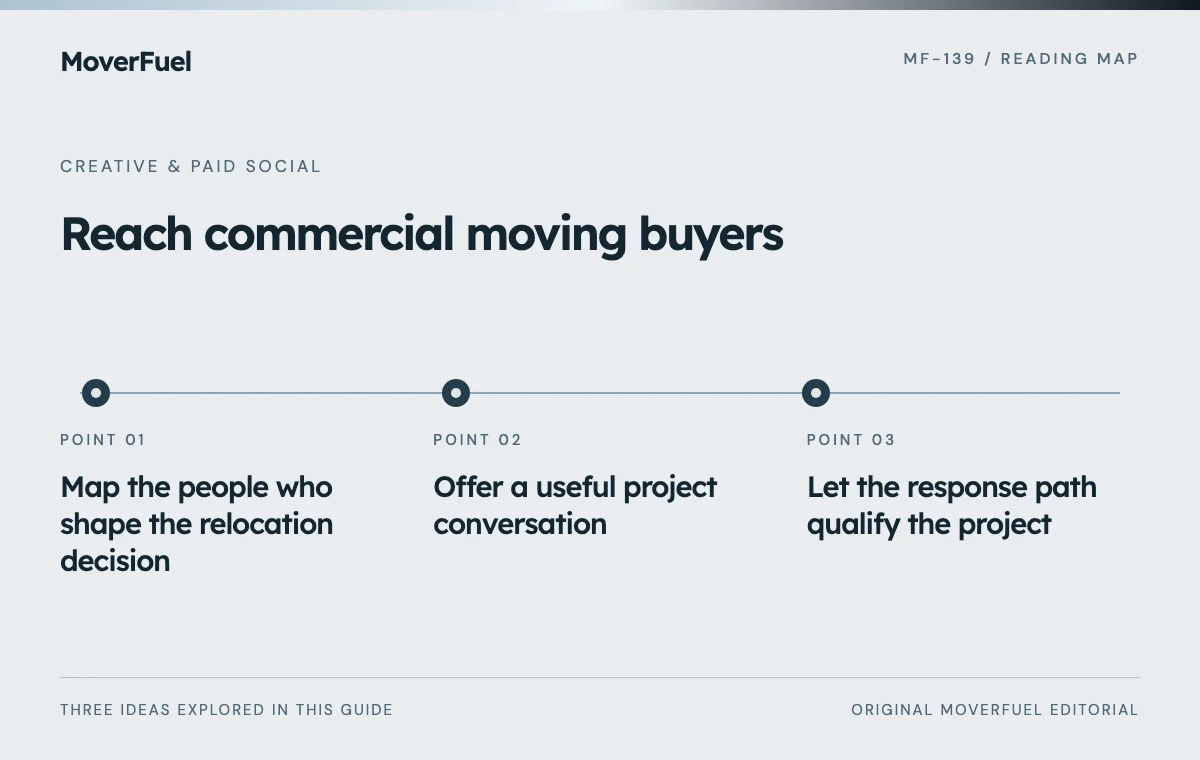
Map the people who shape the relocation decision
Scroll the table horizontally to compare all columns.
| Role | Likely concern to investigate | Useful information |
|---|---|---|
| Owner or general manager | Business continuity and total scope | Clear process and responsibilities |
| Facilities or office manager | Access, inventory and coordination | Survey preparation and move plan |
| Finance or procurement | Comparable scope and approval process | Documented proposal assumptions |
| IT or specialist partner | Equipment and sequencing requirements | Defined coordination and handoff |
| Building contact | Access windows and property rules | Verified requirements and scheduling |
These roles are a research framework, not a claim that every project has a large committee. A small office relocation may have one person making the decision. Ask who is involved and what approval is required instead of forcing the customer through an enterprise-style qualification process.
Ad-platform job titles or interests do not guarantee that a viewer controls a real relocation. Validate the available targeting options and use the response process to establish project relevance. Avoid presenting audience selection as proof of decision-maker access.
Offer a useful project conversation
Choose a specific entry offer the business can deliver: a relocation planning discussion, a site-survey request or a review of access and scheduling requirements. Explain what the customer will receive and what information is needed. Do not advertise a free detailed plan if the team cannot reasonably provide it.
Example concept: reduce uncertainty before the move plan
An original creative concept might show the sequence from site review to inventory confirmation to a coordinated move schedule. The message invites the prospect to discuss their project's constraints. It does not promise zero downtime or a fixed completion time without evidence.
Use genuine project material with approval, or clearly labeled process illustrations. FTC truth-in-advertising guidance applies to service claims and proof. A commercial case example should not imply that another client's outcome is guaranteed for a different building and scope. [1]
Match the campaign to the commercial moving solution and the actual capabilities the operating team can support.
Let the response path qualify the project
A commercial landing page can explain the assessment process, relevant services and the information needed to arrange a useful conversation. An in-app form may be suitable for a simpler initial contact, but it still needs a clear explanation of what follows. Test the path instead of assuming a short form is always superior.
Scroll the table horizontally to compare all columns.
| Field or question | Why it matters |
|---|---|
| Business and project contact | Identifies the organization and responsible person |
| Origin and destination areas | Establishes geographic fit |
| Project type and rough scope | Routes to the appropriate estimator |
| Timing and access constraints | Identifies feasibility questions |
| Assessment or proposal deadline | Clarifies the decision process |
| Preferred next step | Sets a useful contact expectation |
Do not request confidential employee lists, security credentials or detailed sensitive inventories in a general marketing form. Move necessary project information into an appropriate controlled process after the initial fit discussion.
Support the longer decision without generic pressure
Assign a commercial owner who can interpret the request and coordinate an estimator. Follow-up should help complete a project task: arranging access for a survey, confirming a phased scope or supplying an approved proposal clarification. Repeated residential-style booking reminders may be irrelevant.
Record the next decision milestone and responsible contact. A project waiting for a lease decision is different from one comparing final proposals. Keep those states visible so marketing does not mistake every open opportunity for weak lead quality.
The follow-up sequence guide explains how stage changes and stop conditions can keep communication relevant.
Measure quality at the project level
Deduplicate multiple contacts from the same relocation where the evidence supports the connection. Three employees asking about one office move should not automatically become three pipeline opportunities. Preserve the contacts while reporting the underlying project accurately.
Evaluate qualified projects, completed surveys, proposal progression, accepted work and eventual contribution. Keep a sufficiently long observation window for the actual sales cycle. Early form cost is a diagnostic, not a substitute for project outcomes.
Review why projects fail to progress: unsuitable geography, unavailable capacity, incomplete scope, procurement requirements or an unconfirmed project. Use those findings to refine the creative and response offer before making broad claims about social advertising.
Run a bounded campaign with a defined spend limit and learning question. If the audience is difficult to reach or the resulting projects do not fit, revise or stop. Paid social should complement the company's broader commercial acquisition plan, not be justified by a large but unverified pipeline number.
Connect Facebook Ads with lead tracking so project-level outcomes remain visible beyond the first form.
Common questions
Should commercial movers optimize only for form submissions?
Forms can be an early signal, but evaluate qualified projects, surveys, accepted work and mature economics. A low-cost form that does not represent a suitable relocation may add intake work without useful pipeline.
How should multiple contacts at one company be counted?
Retain the individual contacts but connect them to the same project when supported. Distinguish separate relocations from multiple people involved in one decision.
Your next step
Commercial paid social works as a testable route into a relevant project conversation. Build the offer around real constraints and measure progress at the relocation level.
Sources & editorial notes
Platform claims cite the documents below. Operating frameworks and labeled examples are MoverFuel editorial analysis, not client results or industry benchmarks.
- FTC: advertising and marketingFTC guidance requires truthful, substantiated service advertising and proof claims. Reviewed .