
‘We disappeared from Maps’ can describe several different problems: a profile restriction, a search from a different neighborhood, a service mismatch or a real decline in visibility. Start by identifying which problem exists. Changing every profile field before establishing a baseline makes the diagnosis harder and may leave the original issue unresolved.
 View full-size graphic ↗
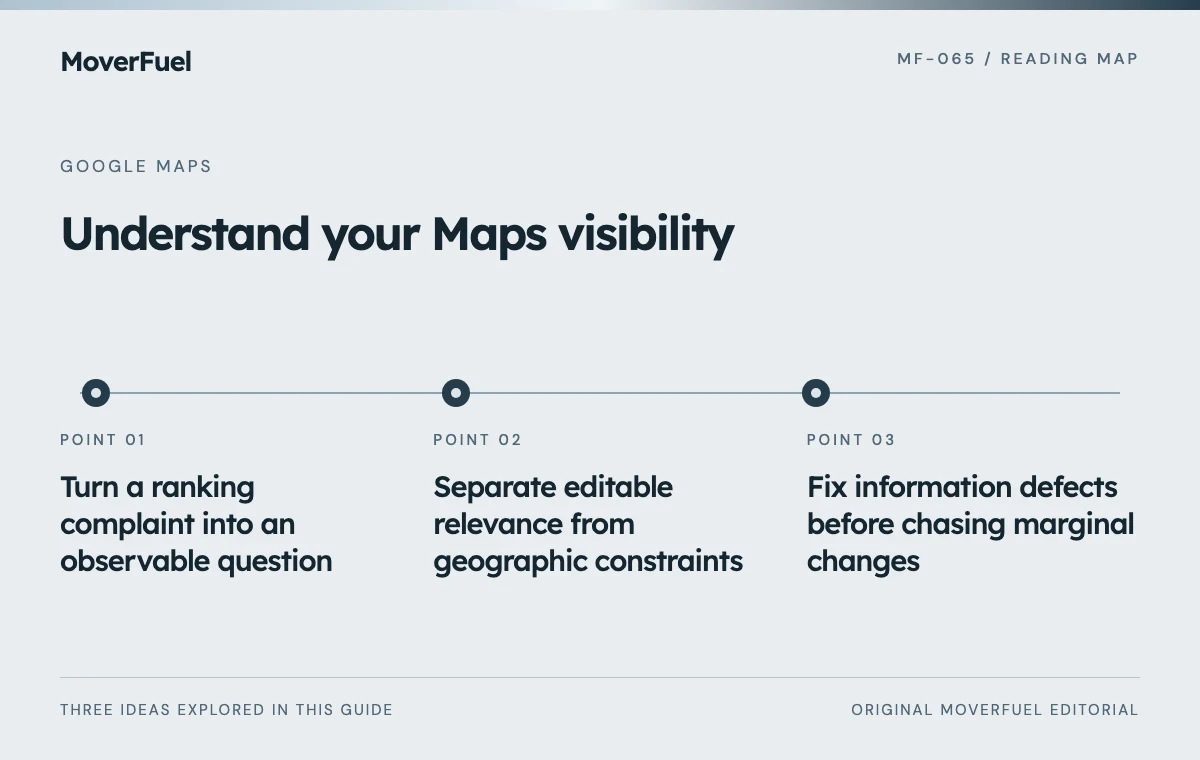
Turn a ranking complaint into an observable question
Ask the person reporting the problem for the query, search location, date, device and surface used. Searching a company name in Maps is different from searching for office movers in general Search. Save the result as an observation, not as the company’s universal position.
Scroll the table horizontally to compare all columns.
| Field | Example to record, not a benchmark |
|---|---|
| Intent | Household mover, office relocation or storage inquiry |
| Query | The exact wording used |
| Place | The stated or observed search location |
| Surface | Maps app, Maps website or local results in Search |
| Context | Date, device and relevant account settings |
| Result | Profile shown, absent, restricted or displaying wrong information |
Repeat a small, stable set of commercially relevant observations across the places where you genuinely want work. Keep branded searches separate from nonbranded searches. If you change the query set every month, the report cannot distinguish improved visibility from easier questions.
Separate editable relevance from geographic constraints
Google describes local ranking in terms of relevance, distance and prominence. Complete and accurate information can help the system understand the business, but there is no paid request for a better organic local ranking. [1]
Look for a geographic pattern
If the company appears near its operating base but less often farther away, inspect the pattern before assuming the profile is broken. Compare similar service queries at consistent points. Adding more city names does not create additional physical proximity or establish new branches.
If the company is visible for household moves but not office relocation, examine whether commercial work is genuinely offered and clearly explained. The profile category, service descriptions and website should support the same answer. Do not add services simply because the associated queries look valuable.
Fix information defects before chasing marginal changes
Scroll the table horizontally to compare all columns.
| Finding | Action | How to confirm completion |
|---|---|---|
| Wrong phone or broken website link | Repair the contact path | Test from a customer device |
| Incorrect hours or service description | Confirm current facts with operations | Review the live profile and landing page |
| Unclear business category | Use an evidence-based category review | Record the rationale and final selection |
| Conflicting business identity | Reconcile important public records | Check the corrected listings |
| Unsupported location claim | Correct the operating model | Verify address and coverage language |
Prioritize changes that prevent a customer from making a bad decision. An accurate phone number and clear service scope have immediate practical value even when a ranking effect cannot be isolated. Keep a change log so later analysis can distinguish a repair from a promotional campaign.
Use the category decision guide when the business identity is unclear, and the service-area guide when geography is the issue.
Build evidence customers can evaluate
A profile should help a prospect understand who will handle the move. Current equipment photos, specific service explanations and authentic customer feedback can answer questions that a category alone cannot. On the website, explain the estimate process, access considerations and what the team needs to know before confirming availability.
Look for legitimate opportunities to make the company’s work understandable elsewhere: accurate industry association information, genuine local relationships and useful business mentions. Evaluate whether each placement helps a real reader establish who the company is. Directory volume alone is a poor operating objective.
Review visibility alongside suitable inquiries
Keep three reports distinct: sampled visibility, profile interactions and sales outcomes. A mover can gain visibility for low-fit requests while its booking economics deteriorate. Record the service requested, pickup area, timing and reason an inquiry was accepted or declined.
For example, an apparent improvement in storage searches may produce requests for self-access units that the company does not rent. That is a relevance problem, even if impressions increased. Review the language and category choice before spending more effort on the same traffic.
Compare equivalent periods and note changes in crews, seasonality, pricing and paid campaigns. Choose the next action from the evidence: repair a factual issue, clarify an offer, improve the estimate path or investigate a specific geographic gap. A rank chart becomes useful when it supports one of those decisions.
Common questions
Why do Maps results differ between neighborhoods?
Location is part of local-search context. Record where each observation was made before interpreting different results as a sudden performance change.
Should visibility or bookings be the main report?
Use both for different decisions. Visibility helps diagnose discovery; qualified inquiries and booked outcomes show whether the demand fits the business.
Your next step
Define the search context, repair factual and conversion defects, then evaluate local visibility with commercial outcomes. The useful goal is being discoverable for suitable work in markets you can actually serve.
Sources & editorial notes
Platform claims cite the documents below. Operating frameworks and labeled examples are MoverFuel editorial analysis, not client results or industry benchmarks.
- Google: local rankingRelevance, distance and prominence as local-ranking factors; no payment or request for better organic local ranking. Diagnostic framework is original guidance. Reviewed .